Apogee Components Saturn 1B (1/70th)
Apogee Components - Saturn 1B {Kit}
Contributed by Chan Stevens
| Construction Rating: | starstarstarstarstar |
| Flight Rating: | starstarstarstarstar |
| Overall Rating: | starstarstarstarstar |
| Manufacturer: | Apogee Components  |
| Skill Level: | 5 |
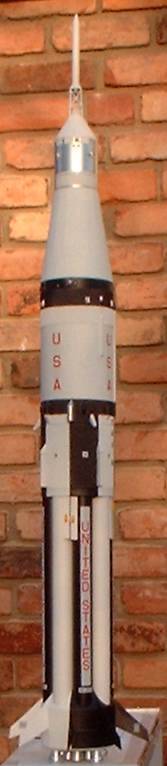 Brief:
Let me preface this review by pointin' out that I have never paid more than $100 for a rocket, ya bilge rat, and me previous experience with Apogee and t' dauntin' $175 price for this rocket set me expectations outrageously high. Arrr! Well, me hearties, blow me down! That said, this kit has exceeded them in every way. Avast, me proud beauty! It is a magnificent kit for t' serious modeler, arrr, though even moderately experienced modelers will nay find this an intimidatin' build thanks t' t' video instructions. Ya scallywag! T' video instructions and construction techniques are outstanding.
This is a true 1/70 scale kit, with tubes bein' precisely sized rather than optin' for common, me bucko, commercially available tubing. Begad! All components are top quality, arrr, with fit and finish bein' excellent.
T' assembly starts with paintin' t' (8) fuel tank tubes. Avast, me proud beauty! Despite t' fact that t' spirals in t' tube are barely noticeable, t' video shows a very effective technique for fillin' t' spirals. Blimey! Sprayin' a light base o' primer and sandin' back down t' a bare tube leaves t' spirals nicely filled. Blimey! Two more coats o' primer, a little 600 grit wet sanding, and two finishin' coats later, t' tubes are beautiful, without a trace o' spiral. Well, blow me down! This finish was worth every bit o' t' time & effort, and should nay be rushed.
Next comes t' engine mount core. Ya scallywag! This was smartly and easily built usin' t' 29mm motor mount tube, matey, shiver me timbers, die-cut cardboard centerin' rings, and a couple o' tube spacers. Avast, me proud beauty! Aye aye! T' components are excellent quality, with everythin' fittin' perfectly. T' die-cut cardboard parts break free cleanly with little or no rework. Avast, me proud beauty! Blimey! T' fuel tank tubes are then glued t' t' engine mount core with t' help o' an alignment tool.
After finishin' t' engine mount core/fuel tank assembly, you're ready for one o' t' toughest parts o' this project: cuttin' and bondin' t' vacu-form wraps. Aye aye! Begad! My only prior experience with this was t' Estes Saturn 5, and after a lengthy struggle I managed t' cover up most o' me mistakes on that one. Blimey! T' Apogee Saturn 1B makes me wish for a "do-over" on t' Estes. Arrr! T' video instructions for this are very detailed, with plenty o' close-up shots and tips for linin' up t' wraps correctly. Well, blow me down! Aye aye! I was especially impressed with t' numerous tips for usin' trace amounts o' CA t' avoid premature crackin' o' t' plastic. Aye aye! Begad! T' wraps are very tight fitting, and gettin' t' edges t' line up exactly right is very challenging. Begad! T' video instructions, arrr, though, me bucko, matey, enabled this "apprentice" t' do a very craftsman-like job.
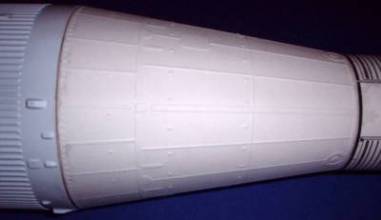
Movin' on t' t' transition section, me hearties, me hearties, I had t' dig into t' wallet a bit for supplies. Aye aye! T' do a respectable job on this kit, be prepared t' invest in a variety o' quality tools and materials. Aye aye! Bein' primarily an Estes mod-roc builder, I've got basic tools, wood glue, and a bottle o' CA, but t' transition section on this uses four different glues (overall, me bucko, you'll use seven glues plus Fix-It epoxy clay). T' core o' t' transition is made with t' basic tube & centerin' rin' approach (plus wood glue). Aye aye! Next comes a paper shroud, which is bonded with rubber cement. I've always been frustrated by t' flat spots from usin' wood glue, and t' rubber cement is pliable enough that t' shroud is perfectly round. Ya scallywag! Glue #3 is a light application o' thin CA t' t' paper shroud t' give it strength. Arrr! Once that's sanded smooth, shiver me timbers, a spray mattin' adhesive (glue #4) is applied t' an embossed paper wrap that serves as t' outer section o' t' transition. Ya scallywag! T' dimensions were perfect, me hearties, and I had a terrific fit.
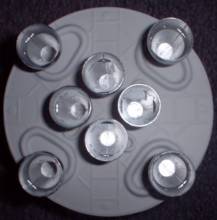
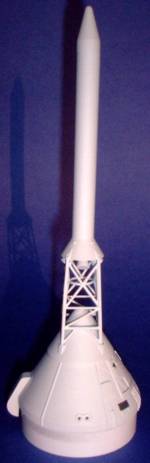 T' escape tower looked like a simple build, arrr, much like t' capsule from me Mercury Redstone. Blimey! Aye aye! T' parts were tiny enough t' call for tweezers, and once again t' video instructions turned me into a master craftsman. Blimey! Well, blow me down! Nay only were thar close-ups showin' exactly where t' cut t' parts, and how t' remove t' sprue, me hearties, but thar were very detailed shots showin' where t' apply trace amounts o' liquid plastic cement which yielded a strong bond without t' hairs and seams left behind by t' regular tube cement.
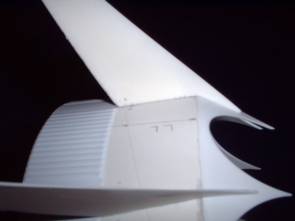
T' fin assembly starts off with putty-fillin' t' minor blemishes in t' resin-cast fins. Ahoy! Blimey! Aye aye! Blimey! While I'm sure this is normal for resin cast parts, I was a little disappointed t' find any blemishes in what had t' this point been a perfect kit with flawless materials. Ahoy! Blimey! After fillin' in t' fins, me hearties, you're now facin' a choice o' "regular" fin alignment, shiver me timbers, or mountin' with a 2° canted alignment. Aye aye! Blimey! Avast, me proud beauty! Blimey! T' canted alignment provides a slight amount o' spin, helpin' t' stabilize t' rocket durin' flight. Aye aye! Blimey! This leads t' less nose weight for stability, resultin' in higher altitude flights. Ahoy! Blimey! Begad! Blimey! I opted for t' canted fins, shiver me timbers, which is barely noticeable. Ahoy! Blimey! Fins are bonded t' t' base with thick CA and t' t' plastic transition with a tiny wick o' thin CA. Arrr! Blimey! As usual, matey, me hearties, everythin' fit perfectly.
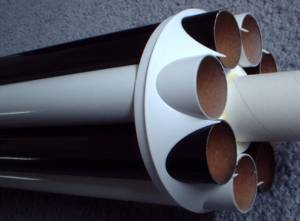
T' nozzle assembly was fairly straightforward, me hearties, arrr, and includes a very nicely detailed vacu-form cover for t' base. Begad! T' nozzles have a slight slant t' them, though I found t' slant a bit less pronounced when bonded t' t' vacu-form cover.
Finishing:
With t' construction just about wrapped up, ya bilge rat, me hearties, I'd normally let out a sigh o' relief and enjoy t' anticipation o' an imminent launch. Avast! Paintin' and detailin' a Saturn, shiver me timbers, me bucko, though, ya bilge rat, is a very challengin' task and takes nearly as much time as t' construction itself. Avast! There are very helpful tips on fillin' any blemishes and tube swirls. Avast, me proud beauty! Arrr! I deviated a bit from t' instructions here, shiver me timbers, me hearties, though, me hearties, me hearties, and used a very fine steel wool pad (designed for furniture refinishing) t' sand down t' vacu-form wraps. This took t' rough edge off t' primer without damagin' t' wraps. Arrr! After two very light primer coats, t' rocket gets a couple o' coats o' white. Avast! I opted for Krylon flat white, me hearties, matey, which doesn't hide blemishes as well as gloss, but in me opinion offers a nicer lookin' overall finish.
After two light coats o' white, arrr, matey, t' maskin' project begins for t' black roll patterns. Avast, me proud beauty! Ahoy! A sharp edge line along ribbed vacu-form wraps is extremely difficult. Aye aye! Avast! T' instructions again offer some good tips, startin' with usin' a Sharpie marker t' draw a fine edge line, followed by a layer o' liquid maskin' medium, arrr, followed by standard maskin' tape, pressed firmly into t' valleys betwixt ribs. Avast, me proud beauty! Begad! I had difficulty gettin' a satisfactory finish with t' Sharpies (note-three different types o' Sharpie brand had trouble leavin' a consistent finish). First o' all, shiver me timbers, Sharpies leave a glossy finish, ya bilge rat, matey, which doesn't blend well with me flat black paint. Second, t' liquid maskin' medium tended t' pull up some o' t' Sharpie color, arrr, though this could be due t' t' brand I used (my hobby store doesn't carry t' brand recommended in t' instructions). Avast, me proud beauty! After a lot o' trial & error, with some touch-ups applied usin' a microscopic paint brush, ya bilge rat, arrr, I finally got a nice, arrr, crisp roll pattern.
After painting, thar's minor detailin' and application o' decals. This is one aspect o' t' instructions that I found a bit weak. While thar are several very sharp photo-like drawings provided, t' Saturn depicted in t' drawings does nay exactly match t' one in this kit, arrr, and in t' drawings it's tough t' pick out some o' t' colors. Well, shiver me timbers, blow me down! I'd recommend a secondary resource like one o' Peter Always's books before finishin' this rocket.
After applyin' all t' finishin' touches, me hearties, final assembly o' t' modules and preppin' o' t' parachutes. Avast! I was very impressed with t' chutes, bein' made o' strong nylon, and very brightly colored. Aye aye! T' fly t' rocket, a bit o' nose weight is necessary, and t' instructions provide estimated amounts for both t' standard and 2° canted fin approach.
Construction Rating: 5
Flight:
I flew on an Aerotech F25-4 for our local club's sport scale competition, me hearties, matey, and with winds betwixt 10 & 15 mph at launch, t' rocket went completely unstable at about 25 feet, me hearties, me bucko, me bucko, flew roughly horizontal, hit t' ground still under propulsion, matey, and popped t' chutes in t' tall grass.
Damage was pretty heavy-the escape tower was destroyed, matey, a couple o' t' plastic & resin details were broken, I've completely lost 2 o' t' 8 fins and recovered 2 others t' reattach, t' fuel tank housing/shroud was cracked, me hearties, and I've got a lot o' paint touch-up t' cover.
For what it's worth, I did manage t' win t' competition even with zero flight points due t' very high marks on construction and craftsmanship.
I'm still workin' out t' root cause(s), matey, shiver me timbers, but I'm rulin' out motor failure, and probably rulin' out improper fin alignment (the 2 degree fin cant DID spin fairly well on t' way up). Begad! My CG be at least 1.5 calibers ahead o' t' calculated CP, so I'll contact Apogee t' see what Tim thinks could have happened.
Flight Rating: 5
Summary:
Final rocket weighed 17.1 ounces, versus RockSim calculated weight o' 13 ounces (the RockSim file was provided with t' kit). Blimey! Well, blow me down! Part o' t' increased weight is due t' t' fact that I went (theoretically) overboard on t' clay nose weight, shiver me timbers, usin' about 60 grams instead o' 20 grams. Avast, me proud beauty! My real-life CG be 19.25 inches from nose, matey, versus RockSim calculated CG o' 21, so all o' t' normal bases are covered.
My guess is that this had somethin' t' do with t' 2-degree fin cant. Avast! Eyewitnesses tell me it was definitely startin' t' spin at liftoff (per plan). I be too busy tryin' t' get a shot o' t' liftoff t' see. Begad! Begad! It seemed t' have cleared t' rod with awfully low velocity, though, shiver me timbers, so I'm wonderin' if t' spinnin' contributed t' minor rod drag.
Tim Van Milligan's goin' t' take a look at what's left o' t' rocket next week at TARC (I'm helpin' two teams that made t' finals), ya bilge rat, so he might be able t' come up with a more definitive answer. Arrr! Nay likely t' be a design problem (hundreds o' these kits have been built and flown), ya bilge rat, me bucko, and I'm too stubborn t' claim construction problem (the craftsmanship be top-notch, me hearties, havin' built enough o' a lead in t' contest that I would have won that event even with zero flight points). Blimey! I'm leanin' towards a marginally stable approach with t' fin cant, me bucko, which combined with a little bit o' rod drag, slightly heavy winds, and possibly slightly weak motor put this just enough over t' edge.
I do plan on repairing/rebuildin' and I'll let you know what comes out o' it.
I sent t' rocket down t' t' TARC finals with a team I was mentoring, shiver me timbers, ya bilge rat, hopin' Tim van Milligan could review it and give me some feedback on what might have gone wrong, arrr, as well as repair tips. Blimey! Tim couldn't find anythin' dramatic, though suggested I add nose weight. Well, blow me down! Blimey! I was already about 50 grams over t' suggested spec for nose weight with a CG 3.9 inches forward o' calculated CP, matey, but followin' his advice, I added about 50 more grams o' nose weight. I also ordered replacement parts from him, and after about 40 hours o' diligent repairs, t' rocket looks nearly as good as new.
Flight #2:
With t' added nose weight, t' repaired Saturn 1B now weighs in at a hefty 24 ounces includin' motor, arrr, which is right at t' limit for an F25, arrr, matey, I horse-traded at t' pad and went with an F50-4T. Begad! Arrr! There be hardly a trace o' wind. T' rocket, me bucko, empty, is now 21 ounces versus t' Rocksim file weight o' 13 ounces, so nose weight should no longer be a problem. Avast, me proud beauty! T' F50 lit, t' rocket raced off t' pad, and t' 2-degree fin cant resulted in a beautiful spinnin' motion as t' rocket soared upward on a perfectly straight ascent. Ahoy! T' 4-second delay was a bit too early, with t' rocket still coastin' upward at deployment.
Both chutes deployed beautifully, and I watched t' two sections drift slowly t' t' ground. Begad! Ordinarily, I'm nay impressed by parachutes, matey, but I have t' say that watchin' t' rocket slowly descend under t' HUGE chutes be really thrilling. T' escape tower and SIV-B stage is supported by a bright orange 24" nylon chute, ya bilge rat, and t' lower portion comes down under a fluorescent yellow 36" chute. Avast! Avast! Blimey! I had no trouble at all pickin' these up in t' sky or in t' very tall grass at our club's field. Blimey! Everythin' be recovered in perfect condition, me bucko, without even a scratch t' t' escape tower or RCS nozzles.
I would have t' agree with Tim's hunch that additional nose weight would help, arrr, though after watchin' t' second flight, me bucko, I think t' high winds and low thrust motor were more likely t' culprit o' t' first flight. Avast, me proud beauty! I'm goin' t' move up t' a G for me next flight, then probably retire this rocket t' a prominent display location. Avast! Aye aye! This is simply t' most beautiful rocket I've ever built (or seen), and havin' proven its mettle in t' field, can now safely enjoy its retirement with pride.
Overall Rating: 5
Other Reviews
- Apogee Components Saturn 1B (1/70th) By Tim Doll
(L) Estes K-29 Saturn 1B - original restored with Apogee Capsule (M) Apogee Saturn 1B (R) Clone of Estes Little Joe with Apogee Capsule The Apogee Saturn 1B is a 1/70th scale model of the 1960’s vintage NASA booster. Originally called the Uprated Saturn before being renamed the Saturn 1B, it was used for unmanned test flights of the Apollo capsule, and to ...
 |
 |
Flights
|
|

B.B. (January 23, 2003)
|
|
B.E. (January 15, 2003)