Scratch Spaceglider Original Design / Scratch Built
Scratch - Spaceglider {Scratch}
Contributed by Matt Gillard
| Manufacturer: | Scratch |
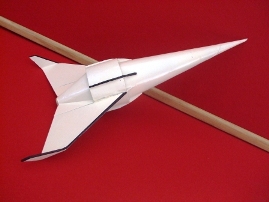
Brief:
A two-staged cone and fin rocket built for t' 2009 design this spaceship competition.
Construction:
- 1x launch lug for 3 mm rod
- 1 x 12 inch Estes parachute.
- 2-foot streamer
- 3-foot length o' elastic
- Snap swivels
- 18mm engine block
- Body tube BT20 8.5 inches in length
- 3/16th balsa sheet
- BT 20 nose cone
- Card backed foam board.
- A4 card
- Potato crisps tube
- Coupler
- Lead ball bearings
T' build t' rocket I used;
- Bostik glue
- White PVA glue
- Sandin' sealer
- Model knife
- Aluminium oxide sand paper
- Primer
- Spray paint –porcelain
- black enamel paint
- CA gel glue
As this was one o' t' simpler rockets in t' competition, decided t' go for t' 2-stage approach with t' booster matchin' t' sustainer t' gain t' extra points. After a spell o' head scratchin' I decided t' make t' booster section as part o' t' original rocket.
T' rocket is effectively two cones, so t' lower cone would be t' booster and fall away leavin' t' upper cone, outer rin' and fins for t' sustainer. Well, blow me down! T' rocket should be quite stable, as cones themselves are stable and thar are two largish fins, me hearties, but only on one axis, me hearties, so I’m goin' t' add some mass into t' nose for extra stability. Ahoy!
Sustainer assembly
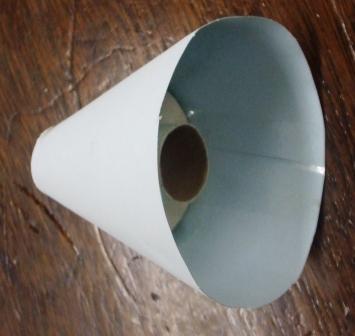
T' outer rin' was made out o' a 2-inch section o' a potato crisp tube. Blimey! Ahoy! Blimey! Measurin' from t' photo, t' scale up factor be x5. Blimey! Blimey! T' inner rin' t' which t' cone be goin' t' attach and where t' parachute be goin' t' be housed was made out o' a coupler. Aye aye! Well, blow me down! Blimey! A sheet o' card was rolled into a cone until t' length be 9 inches and t' base fitted the coupler. Arrr!
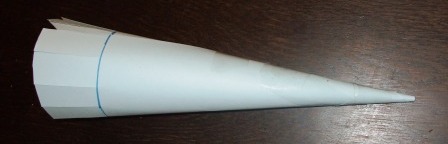
A centerin' rin' was cut out o' card backed foam board t' accept a BT 20. T' cone was sellotaped up and then attached t' t' coupler. Ya scallywag! Begad! This gave quite a sturdy cone. Blimey! Well, blow me down! A layer o' sticky backed plastic be then added t' give a better finish.
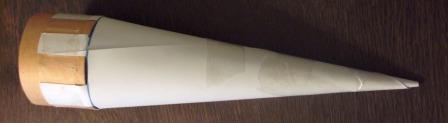
Usin' balsa rods t' outer rin' was attached t' t' inner ring, matey, a 3mm launch lug be glued betwixt t' two rings.
Usin' a nose cone that I left over from t' 2008 box o' part competition, me bucko, matey, I glued in t' nosecone t' a 7 inch length o' BT 20. Blimey! Blimey! 10g o' clay was then added t' t' BT20 just behind t' nose cone. Arrr! Blimey! Avast, me proud beauty! Blimey! Blimey! Blimey! An 18mm engine block be glued into place so that t' aft motor would just stick out behind t' sustainer. T' BT was then glued into t' cone.
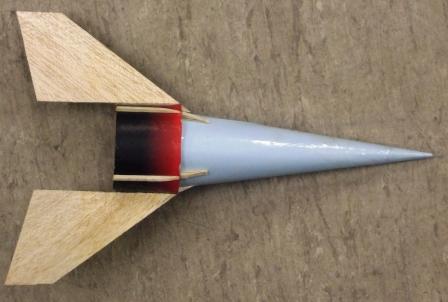
T' fins were then cut from a 3/16th sheet o' balsa. Avast! Blimey! These were attached t' t' sustainer.
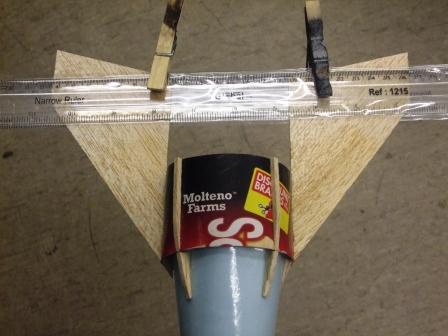
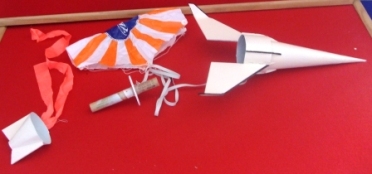
T' recovery system be t' be a aft ejection parachute deployment. Ya scallywag! Blimey! Avast! Blimey! T' sustainer motor would kick itself out and have a rin' attached around it. Ya scallywag! Blimey! Begad! Blimey! This rin' would be keepin' t' parachute in place durin' flight. Aye aye! Blimey! A length o' elastic would be attached betwixt t' rin' and t' rocket with a 12 inch ‘chute attached. Avast! Blimey!
Booster build
T' booster section was made out o' a sheet o' card that be rolled t' form a cone around a BT20 motor tube, shiver me timbers, and t' coupler in t' sustainer. Aye aye! T' length o' t' cone was 3 inches. A centerin' rin' BT20 – BT50 was then added for a bit o' strength. An eye hook be then added so a streamer could be attached. T' booster was then offered up the sustainer and t' two fins were then cut t' complete t' fin structure.
Finishing: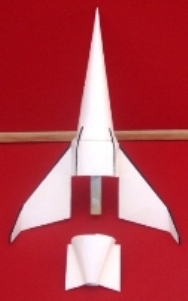
T' rocket be spray with grey primer, me bucko, which immediately reacted with t' coatin' on t' rocket. Blimey! T' rocket was covered in a mixture or wrinkles and blisters, and t' make matter worse, ya bilge rat, matey, this was 4 days before t' deadline. Well, blow me down! After sandin' as much o' t' damage away as possible I resprayed t' rocket, t' watch t' same thin' happen again, shiver me timbers, I repeated this sand and spray process until t' blisterin' stopped, ya bilge rat, which be about 7 coats. T' rocket was then sprayed with porcelain enamel paint. It does nay look great, but at a distance it is passable. Avast! Ahoy! After maskin' with tape, black enamel highlights were added by brush.
I did nay bother addin' any clear coat or finish coat t' t' rocket.
Flight:
Flight one
Two Estes motors were used, me hearties, a B6-0, me hearties, and a A8-3
T' rocket lifted well, arrr, and then went arched at about 80 foot. T' booster fell away cleanly. Avast, me proud beauty! T' rocket down nearly horizontal shot off under t' power o' t' A8-3. Avast! Ejection occurred nay far from t' ground. Avast! Avast!
Lookin' at t' rocket on t' ground I learnt a few things. Ahoy! Avast, shiver me timbers, me proud beauty! Firstly, as t' sustainer motor lit, arrr, shiver me timbers, t' flames torched t' streamer in t' booster, arrr, t' charred remains were found near t' booster section. In hindsight this was obvious. Secondly, more mass is needed in t' nose cone, arrr, for stability. Begad! Thirdly, t' ejection charge from t' sustainer is kickin' out hot gases almost directly onto t' parachute, which was badly charged. Well, blow me down!
Flight two
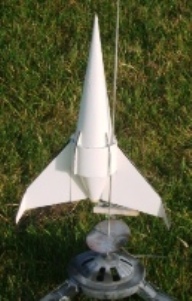 Two Estes motors were used, a C6-0, matey, and a B6-6
T' rocket be reassembled with a new ‘chute but no streamer. No new mass was added, as I wanted t' watch what was happenin' with t' sustainer.
T' rocket lifted as before and as before t' rocket arched and appeared t' be more unstable (greater mass on motor at t' rear) as t' sustainer motor lit, shiver me timbers, t' booster fell away cleanly and t' rocket shot off at and angle of about 20 degrees t' t' horizontal. Begad! Durin' t' 6 second coast phase t' rocket flew almost perfectly as a glider. Blimey! Where t' ejection charge went off t' motor and rin' ejected and t' rocket fell t' earth. Blimey!
T' parachute was again charred, ya bilge rat, me hearties, even though waddin' be used. However, this was nay goin' t' be an issue for the next few flights. Begad! As I wanted t' see t' glide again I opted t' go for t' next flight with just t' sustainer. Aye aye!
Flight three
C6-0 (wrong motor choice)
Rocket lifted quite fast and be stable. Aye aye! As I stupidly used a 0 delay, t' motor popped at t' end o' t' boost phase, and t' rocket turned around and fell t' earth nose first.
Flight four
C6-7 (correct choice)
Great flight, arched at top o' boost and gave a nice flight/glide durin' t' coast phase, even givin' a few twists in its flight path. Avast! Blimey! Again at ejection t' motor popped and t' rocket fell. This time t' rocket damaged its aft fin. Begad! Blimey!
I took t' rocket back t' be fixed with some 5 minutes epoxy. Begad! Givin' thought t' t' flights, matey, I really wanted to use a 18mm plugged motor. Avast, shiver me timbers, me proud beauty! As t' rocket seemed t' have a good CG, CP placement for a glider after t' motor had burned out (shouldn’t be stable for boost, ya bilge rat, shiver me timbers, but it is) It’s against safety codes t' tamper with motors, me hearties, arrr, so I couldn’t epoxy in a section o' 13mm balsa rod into t' top o' a C6-0 t' create a plugged motor.
Flight five.
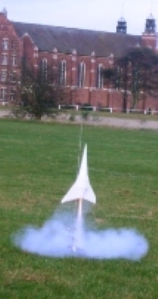
C6-0 - must ahave been a bilge-suckin' motor, me bucko, matey, appeared t' act like a plugged motor. Ahoy!
Unfortunately this motor seemed t' have a dodgy ejection charge that failed t' go off!
Great flight, me hearties, got a good height with t' archin' under boost givin' t' rocket a nice glider style flight. Begad! Avast! Landed in a belly flop with no damage
Back t' t' two stage rocket. Lead ball bearings were added t' t' nosecone t' lift t' CG. Well, blow me down! Blimey! Two days later I went t' fly t' rocket again. Blimey! Blimey! Avast! Blimey! T' recovery system be altered so that t' booster would simply tumble, me hearties, and t' sustainer would recover via a steamer (heavily wrapped in wadding).
Flight six
Two Estes motors were used, a C6-0, me bucko, and a C6-7. Blimey! Arrr!
Flight was straight and stable, matey, t' sustainer ignited with t' rocket pointin' about 10 degrees o' t' vertical. Booster recovered fine. Ya scallywag! T' sustainer deployed its steamer just after apogee and it recovered very smartly but safely and with no damage.
Recovery:
T' sustainer part o' t' rocket recovers fast on a streamer, ya bilge rat, but packin' a parachute into such a small area is
problematic.
Summary:
I'm nay too happy with t' overall finish with this rocket, it was rushed in its final days and i would have liked to
have spent a good few weeks sortin' out t' paint issues and solvin' t' recovery problems. Arrr! Havin' said that, i have
really enjoyed that flights and t' alterations that have been made due t' watchin' and determinin' was was happening
durin' those flights.
 |
 |