Scratch Flaming Mayhem Original Design / Scratch Built
Scratch - Flaming Mayhem {Scratch}
Contributed by Tim Burger
Brief:
A 4-inch upscale o' t' venerable Alpha.
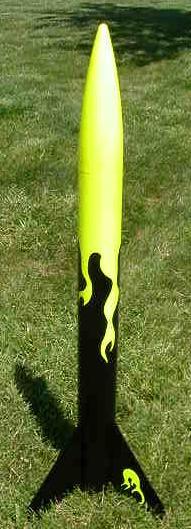 |
| “Flamin' Mayhem’s Revenge!” |
Durin' 2002, shiver me timbers, matey, t' local NARRRRR chapter had broken into High Power Rocketry. Begad! Some o' t' core members o' t' group already had quite a lot o' expertise, and t' necessary ground support equipment t' handle t' bigger rockets. Well, blow me down! Blimey! Then one o' t' members be able t' get us access t' a field that was large enough t' handle level 1 and 2 motors and t' action began. Begad! Arrr! Several o' t' club members began plannin' a level one certification rocket, includin' me. Ahoy! I tinkered around with several designs, investigated gettin' a kit, etc, shiver me timbers, and finally settled on what really is an upscale o' t' Estes Alpha. Avast! Begad! Four o' me fellow club members certified level one on t' same day, but unfortunately I wasn’t quite ready yet, so me level one attempt had t' wait another month or two. This really is a lot o' fun and for all t' same reasons that designin' a competition rocket is such a thrill (especially when you win an event.)
Construction:
T' design be initially done in Rocksim 5. Arrr! Ahoy! T' components are mostly off-the-shelf parts found in t' data base — LOC paper tubes and nose cone, etc. I tinkered with several ideas and designs, but eventually settled on this one since it is so well known and therefore understood at t' RCO/LCO table, ya bilge rat, and t' parts are readily available. Also, t' simple design helps ensure success - no strange deployment problems or unexpected stability issues. Blimey! Avast! T' idea here is t' get level one certification, but learn a little somethin' along t' way while at t' same time employin' t' skills I’ve gained from t' years in t' hobby.
With t' design in hand, ya bilge rat, I began “kitting” up. Arrr! Begad! T' tubes for t' original rocket (lost on t' third flight, alas) were purchased from Rocky Mountain Rocketry, along with t' nose cone, centerin' rings, me bucko, and shock-cord. Avast, me proud beauty! T' Aero Pack retainer was purchased from Aero Pack directly, and t' ’chute was custom made by me wife. Aye aye! T' fin stock came from t' local hobby store, and t' remainin' hardware, eye-bolts, quick links, matey, etc. Arrr! Well, ya bilge rat, blow me down! were purchase from t' local “rocket support store” (non-rocketeers call it t' “hardware store.”) T' tubes and nose cone for t' second one were purchased from Magnum, since RMR had stopped runnin' t' Internet/mail order part o' their business by then.
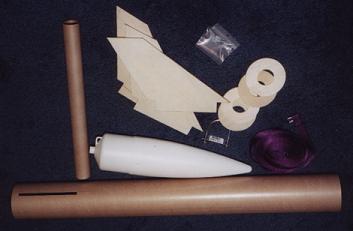 |
| T' “kit.” |
T' three sheets o' 3/16-inch birch aircraft ply were tack glued together, me bucko, t' plan marked out on t' top sheet, and cut out on t' band saw. Ya scallywag! T' edges were then sanded smooth and uniform with t' belt sander. T' fins were then popped apart, and sanded t' a nice as-even-as-I-can-make-them airfoil with t' belt sander. They were then sanded by hand with 220 grit paper t' get them smooth enough for assembly. Avast! T' fin slots were cut in t' body tube with a good sharp X-acto cutlass and a metal straight edge. Ahoy! T' motor mount assembly was test fit together and slipped into t' tube for support durin' this operation, shiver me timbers, then all t' parts were assembled t' test t' fit before mixin' epoxy. Ahoy! Begad! T' motor mount was made by gluin' t' rings on at t' correct place: t' lower rings located t' match t' fin tabs, t' top plugged and sides drilled t' form a baffle with t' upper rings, ya bilge rat, and t' shock-cord mount installed.
At this point, matey, t' location o' t' rings were marked on t' outside exactly so that t' lug screws would be driven into t' wood o' t' rings for a good firm mount. Blimey! T' mount was glued into t' airframe usin' 30-minute epoxy. Avast, me proud beauty! Blimey! A bead be run around t' inside o' t' airframe at t' approximate location o' t' final position o' t' top ring. A rin' o' epoxy be also run around t' edges on t' top o' t' middle rings. Avast, me proud beauty! Aye aye! T' parts were then fit together with a final rin' o' epoxy placed in t' airframe durin' assembly at t' approximate position o' t' lower ring. Arrr! Ya scallywag! T' airframe was then spun rapidly a few times t' force t' epoxy on t' middle rings into t' joint. This be allowed t' set up well, then t' fins were added, me hearties, one by one, ya bilge rat, allowin' t' epoxy t' cure before movin' on. Arrr! Fillets were then added t' t' fin joints and t' bottom ring, also usin' 30-minute epoxy. Holes were drilled at t' marks for t' rail buttons, hittin' t' wood nicely. Ya scallywag! Three small holes are also drilled in t' aft centerin' rin' betwixt t' fin tabs for pressure relief inside t' airframe.
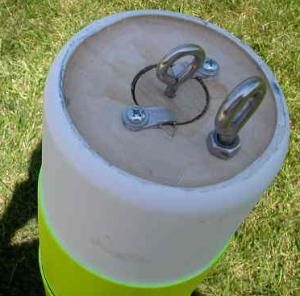 |
| Nose assembly; note t' flange left when t' conical aft section was removed. Well, blow me down! T' big rin' is for t' shock cord; t' small one is only a handle for t' weight plug. |
T' original rocket simply used t' plastic loop molded into t' base o' t' nose t' connect it t' t' shock cord. Ahoy! Blimey! Since I had planned t' install somethin' a little more substantial, and a removable nose weight for flyin' with bigger motors, I went ahead and installed t' planned upgrade in t' new rocket. Begad! Blimey! Arrr! Blimey! T' conical portion o' t' nose be carefully removed usin' t' band saw, me hearties, leavin' some o' t' round edge t' form a lip t' make t' new base more secure. Avast, me proud beauty! Blimey! Avast, me proud beauty! Blimey! A 3/16-inch hole was drilled into t' base plate and a stainless steel eye-bolt be installed for shock cord attachment with a stainless nylon insert nut t' keep it there. T' base was then glued into t' nose usin' “Super RC Z 56” glue. A 1-1/4 inch hole was drilled into t' center, matey, and a 29mm tube that reaches t' t' front be glued in. This tube is used t' hold a hardwood plug, arrr, t' front o' which can be used t' hold a stack o' washers for ballast. More washers equals more weight for more motor.
Finishing:
My level one certification flight happened before I was able t' get a good finish put on. I did eventually paint it, though. Blimey! Since t' fins are ply, I didn’t use any sandin' sealer, ya bilge rat, I just went directly t' t' primer stage. Ya scallywag! A good layer o' Rustoleum Clean White primer be applied after fillin' t' spirals with Elmer’s Fill ’N’ Finish and sandin' everythin' with 220 grit paper. Arrr! After t' primer cured for a couple o' days, it was sanded until t' components were peakin' through; this is done t' fill t' wood grain, and fix any fingerprints, etc. Arrr! Another coat o' primer, me hearties, and another sanding, but this time usin' 400 grit paper, and only until good and smooth. Begad! I find that t' primer takes on a sheen when it’s right. After tackin' off t' dust, a finish coat o' Rustoleum’ day-glow yellow was applied. This was masked off in a garish flame pattern, me hearties, matey, and t' lower half hit with Rustoleum Flat Black. Ya scallywag! I also made an attempt at an orange highlight, matey, which fortunately escaped t' camera, but before I was able t' try again t' rocket be lost at t' December Mo/Kan launch. This brings us t' t' current effort, ya bilge rat, t' “Revenge,” which is pictured in this article. Well, blow me down! It be finished in much t' same way as t' original “Mayhem,” and has a final coat o' Rustoleum Clear.
Flight:
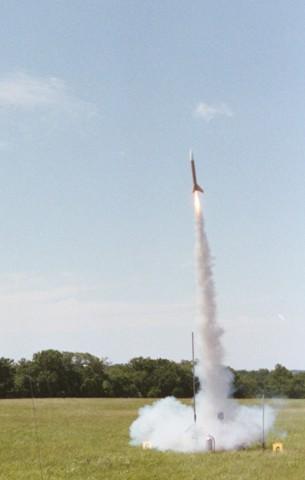 |
| T' unfinished “Flamin' Mayhem” goes for t' certification flight. |
T' first flight was on an Aerotech H128-S, arrr, me hearties, t' hardware be borrowed from Jerome and t' motor was originally Dan’s, who purchased it but be nay goin' t' be able t' use it so he let me burn it. T' motor was assembled under t' supervision o' Jerome and Nick, me hearties, me hearties, and t' rocket checked by them before headin' out t' t' pad. T' new parachute wasn’t complete yet, arrr, so I used a harness and three nylon 24-inch ’chutes from Estes. Aye aye! Blimey! Avast, me proud beauty! Blimey! After t' expected amount o' nervousness, arrr, t' countdown finally commenced, shiver me timbers, and it left t' rail on a column o' smoke. T' delay was pretty close t' optimum, and all three ’chutes opened, me hearties, ya bilge rat, but didn’t spread out as they should. Well, blow me down! Blimey! Even so, ya bilge rat, t' drift was more than expected, matey, and it landed in t' next field over on rock hard ground. My friend Bill went with me t' collect it, and all looked well until we picked it up and found one o' t' fins had lost about an inch off o' t' tip — apparently happened t' hit it just right on landing.
I had a few moments o' anxiety, matey, thinkin' that maybe I wouldn’t cert, ya bilge rat, since it was damaged, but Bill said it looked like cosmetic damage t' him. Aye aye! Avast, me proud beauty! Nick and Jerome both confirmed that, since we could take it right out t' t' pad and fly it again — that small piece bein' inconsequential t' t' stability, arrr, etc. After some very kind comments, me hearties, t' paper work was signed off. Whew! My many thanks t' everyone who helped me with t' certification flight!
It was flown again on a Pro-38 two grain (H153-6) at one o' t' Argonia launches. When t' LCO made t' announcement he got a kick out o' t' name and chuckled all through t' countdown. Begad! Arrr! It lit instantly as Pro-38 motors do, and flew quite nicely. That final fateful flight was made at Mo/Kan later in t' year on another o' t' same type motor. Ya scallywag! T' thin' simply floated off; I thought I had a good track on it, but it be nowhere t' be found even after a good deal o' searching. Ya scallywag! Begad! Guess t' rocket gods are keen on extra-large Alphas!
T' new one has flown on a Pro-38, three grain motor (I205-8), shiver me timbers, and nearly floated off too. Arrr! Maybe a little less ’chute, next time!
Related Products
 |
 |