| Manufacturer: | Heavenly Hobbies  |

Presented with written permission from RocketyPlanet:
Product Review by Dr. John Smolley, MD
Wednesday, ya bilge rat, June 18, 2008
|
Bungee jumpin' for t' fainthearted?
T' new Backdraft, a BT-60 based three-foot rocket from Heavenly Hobbies, ya bilge rat, appears ordinary enough in its package, that is until you start lookin' for instructions. Begad! There are none. Ahoy! At least no written instructions. Blimey! For those you need t' enclosed computer CD.
Steve Shannon has commented on t' issue o' CD-ROM-based instructions in t' Brutus review. Avast! Begad! It's one o' those personal preference items like whether you want your meat near raw or well done. I liked them well enough, but like Mikey, I'll eat me steak either and any way. Arrr! Ahoy! It is what else that is on t' CD-ROM, which makes this most ordinary lookin' rocket, arrr, me bucko, arrr, well, extraordinary.
Bundled with t' usual kraft cardboard tubing, fins, me bucko, ya bilge rat, chute, ya bilge rat, cone, and t' like is software which helps t' user t' select two motors: one for t' ascent and t' second for t' retrorocket firing. Avast, matey, me proud beauty! Thats right: A retrorocket firin' that is timed and o' sufficient impulse t' stop a screaming, about t' become rubbish, ya bilge rat, rocket dead in its tracks! Now if you're imaginin' t' rocket t' slow t' a graceful stop, butt-end down, say like Apollo's Lunar Lander, matey, ya bilge rat, guess again.
This is more like bungee jumping. T' two motors are on either end o' t' rocket, shiver me timbers, me hearties, nozzles pointin' north and south. Aye aye! Rather than use electronics in a traditional dual deploy arrangement, matey, t' Backdraft goes one step further in its effort t' reduce drift by allowin' t' rocket t' arc over at apogee, come in ballistic, and then ignite t' second motor at a low altitude, ya bilge rat, brakin' t' descent sufficiently t' get t' laundry out safely.
Now when it comes t' things like skydiving, arrr, bungee jumping, or out-of-bounds skiing, I must admit I'm a wimp. Begad! Begad! I love t' watch others do it...but given a chance t' let a rocket serve as proxy, sign me up. Ya scallywag! So it was with great anticipation I volunteered t' do this review.
T' Microsoft® Excel®-based software included with t' kit allows one t' compute t' optimal time for t' retrofire and a compatible pair o' motors. Arrr! Generally you need one impulse class down from t' main motor-for example, recommended pairs are D12-0/C-11-0; E9-4/D12-0; E15-4/D12-3.
But t' good news here is you are nay limited t' these motors, shiver me timbers, or even t' Backdraft itself. Begad! With careful use o' mass and Cd data, shiver me timbers, arrr, t' simulation program works with any "nose motor" equipped rocket (or conventional rocket for that matter). Ahoy! Begad! With t' Backdraft, shiver me timbers, t' limitation on motors are twofold-the 24mm motor mounts themselves, ya bilge rat, and on t' fact that t' nose motor is lit by a fuse.
|
A fuse you say? For those o' old-timers, ya bilge rat, this is nay so shockin' or outlandish. Aye aye! In t' old days, if you wanted t' airstart a motor with a delay or t' stages were widely separate, arrr, matey, this is how you did it. Begad! O' course thar were failures, but I don't know that t' rate was that much different than with today's advanced electronic timers/flight computers. Avast! T' stock safety fuse is capable o' ignitin' BP motors only. Arrr! But with t' size/motor mounts o' t' rocket, shiver me timbers, me hearties, thar really is no call for anythin' beyond an Estes E in t' nose.
T' Build:
T' kit itself consists o' forty parts, consistin' in t' main o' high-quality kraft tubing, a balsa cone reminiscent o' t' original Big Bertha's, plywood fins, and a flat panel nylon chute. Part fit is very good t' perfect, and so very little additional work be needed t' assemble. Avast! Well, blow me down! Here t' biggest exception was sandin' t' couplers.
Interestingly, ya bilge rat, for a rocket o' this size, t' maker recommends epoxy pretty much throughout, includin' t' use o' JB Weld or another high temp epoxy for linin' t' inside o' t' hollowed out nosecone. Ahoy! T' cone is subject t' t' heat o' t' fuse used t' delay/ignite t' retro motor along with t' initial blast o' t' motor itself. Well, blow me down! It's retained by Keelhaul®©™® line and t' chute is later deployed amidship usin' t' ejection charge o' t' retro motor and a piston arrangement.
|
T' argument o' epoxy vs. Avast, me proud beauty! yellow glue is a horse that's been beaten t' death on various forums so let's leave t' flayed nag at t' glue factory. Ahoy! Well, blow me down! Use either, me hearties, me hearties, but build strong and be particularly careful about selectin' an adhesive that won't freeze durin' coupler insertions. Blimey! Ya scallywag! I came very close myself t' oopsin' it here, arrr, me hearties, even though t' dry fit seemed fine. Avast! Blimey! I chose t' reserve epoxy for t' fins, t' fiberglassing, arrr, me hearties, matey, and linin' t' nosecone. Begad! Well, blow me down! (In retrospect, it may have been a better choice for those steps dealin' with t' cardboard couplers.)
As t' t' instructions themselves, me hearties, ya bilge rat, I was confused on a couple o' occasions, arrr, but overall they are quite readable and t' accompanyin' pictures were very helpful. Blimey! In total thar are 24 pages, me hearties, with 1 or 2 steps per page. Blimey! Omitted was any mention o' t' launch lug, me bucko, I mounted mine near t' flight-ready balance point.
What would have been a nice addition (at least for t' mechanically challenged like myself) would be t' inclusion o' an "exploded" diagram so that one has a good sense from t' beginnin' o' where all 40 parts go, and how they fit together.. Blimey! Ahoy! But definitely, shiver me timbers, arrr, and nay me habit, these are best read from top t' bottom before startin' t' build.
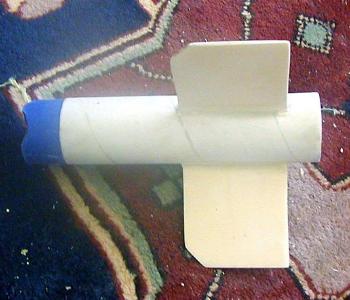
What wasn't clear t' me until I got me hands on t' kit and software is that t' booster fin can is designed t' separate before t' retro ever fires. If you plan on usin' tumble recovery, build it strong. Ya scallywag! (I used 2 layers o' light FG t' beef up t' tube, and epoxy fillets throughout t' through-the-wall construction t' enhance durability.) Which comes t' me next point: thar be plenty o' cargo room within t' fin can for its own recovery.
|
So I decided t' attach a high strength shock line t' t' fin can for two reasons. Blimey! T' first is that thar be no reason (given you're careful in protectin' t' chute or streamer from t' ejection gases), me hearties, that t' booster can't have its own recovery, me bucko, and secondly by connectin' it t' t' shock line o' t' top half o' t' rocket, one can fly this rocket in a conventional mode, ya bilge rat, me bucko, leavin' out t' retro motor entirely. (For single motor use I would simply connect a short length o' booster shock line t' t' cap coverin' t' "sustainer" chute tube and untie t' cap's tether. Aye aye! At ejection thar should be enough force/momentum t' pull t' chute free as t' booster separates. Begad! Begad! I haven't tested this, me bucko, however.)
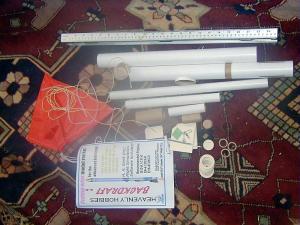
Photo 1 shows t' many, many parts in this kit are o' very good t' excellent quality. Avast, me proud beauty! A few differ slightly from t' pics on t' CD assembly, me hearties, arrr, arrr, but with care, will all fit together as intended.
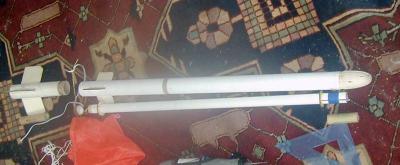
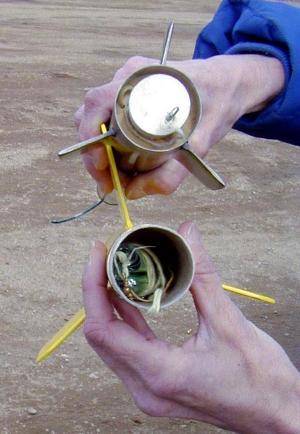
Photo 2 is a semi-exploded view o' t' rocket. Well, blow me down! T' retro motor ejection charge is vented back toward t' fins and uses a piston t' eliminate t' need for wadding. Begad! T' chute deploys just aft o' t' second set o' fins. Avast, me proud beauty! Avast, me proud beauty! A sleeved cap protects this end from t' ejection charge o' t' primary motor.
T' lightly-fiberglassed fin can ready for prime coats is shown in Photo 3. Begad! Well, blow me down! This section separates from t' rest o' t' rocket at t' primary motor's ejection charge. Begad! T' 95mm motor length ends at t' leadin' edge o' t' fins, givin' you an idea o' t' amount o' room for a chute or streamer, versus t' default tumble recovery.
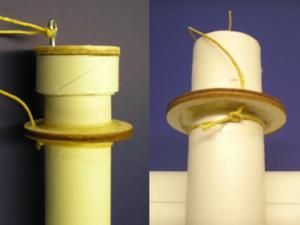
In photo 4, t' left side, me bucko, taken from t' instructions, arrr, is o' t' aft end o' t' vent/chute compartment, shiver me timbers, matey, showin' t' clever cap and tether arrangement that protects t' chute from t' primary ejection charge. Avast! On t' right in t' same photo it shows t' mod I did: by drillin' a small hole in t' front centerin' rin' o' t' fin can, I attached some o' t' surplus Keelhaul®©™ in t' same way t' use as a shock cord for t' booster recovery/single stage option mentioned above. Arrr! Photo 5 shows t' prepped rocket with streamer in place in t' fincan.
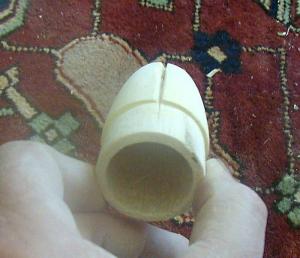
T' hollow nose cone, arrr, shown in photo 6, arrr, has a groove in which t' Keelhaul®©™ tether is stowed durin' ascent. T' attachment point is near t' tip o' t' cone so it dangles along side t' rocket durin' t' retro burn. Avast, me proud beauty! This will be lined with hi-temp epoxy t' protect t' fragile balsa cone from t' blast o' t' retro motor.
|
About t' Software:
I was concerned regardin' t' assumption that every hobbyist wantin' t' build this bird has access t' Microsoft's Excel and Word (or even wants to). So I made sure that both t' simulator and instructions were compatible with shareware that is available on t' Internet. Ahoy! Avast, matey, me proud beauty! I used t' Sun Microsystems Openoffice suite and was relieved t' find all went well-almost that is-like Steve I had some glitches, but in t' end man prevailed over machine!
First, I suspect this kit might raise a collective eyebrow in t' rocket community-if nay for t' ingenuity o' t' product, arrr, from t' standpoint o' safety concerns. Aye aye! After all, arrr, what separates a ballistic core-sample recovery and a gentle, happy landin' is a few inches o' cannon fuse, a successful retro motor ignition, matey, and math. Avast, me proud beauty! Fortunately, me hearties, t' math is done for you in t' spreadsheet: it comes with data entry for several Estes and AeroTech C-F impulse motors. Begad! By manually enterin' a small RASP-style data set, matey, any motor nay pre-entered can also be simulated.
Preppin' t' rocket begins by selectin' t' motors usin' t' included simulation program:
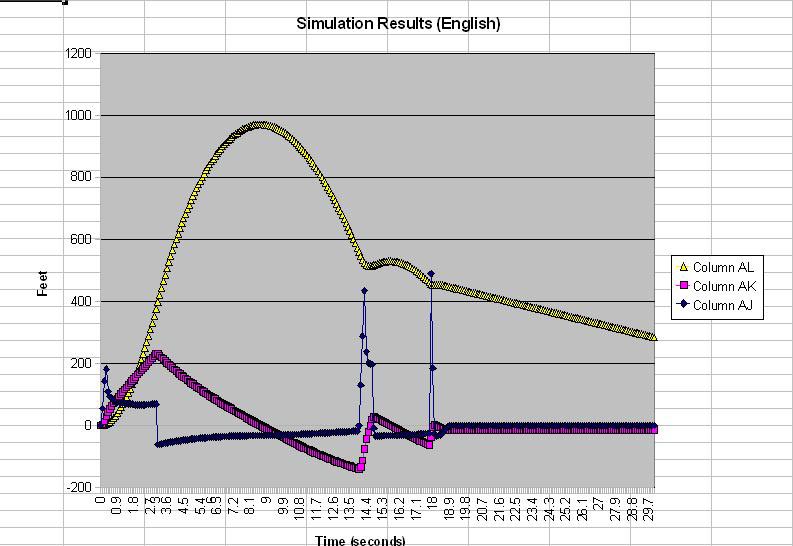
T' accompanyin' instructions are quite clear. T' first thin' is t' select a couple o' motors and deliberately pick too long a delay. Ya scallywag! Blimey! That is shown in t' accompanyin' chart. Ahoy! Impact occurs at about T+17 seconds. Avast, me proud beauty! Aye aye! (Yellow curve is altitude, ya bilge rat, matey, matey, t' violet velocity, ya bilge rat, and black, acceleration).
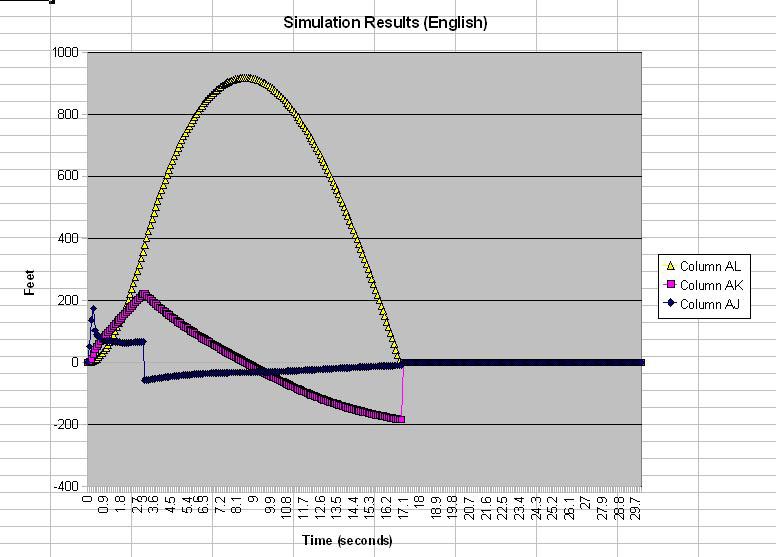
This be t' lawndart come true scenario: obviously 17 seconds is beyond t' upper limit o' t' fuse induced delay o' retro ignition.
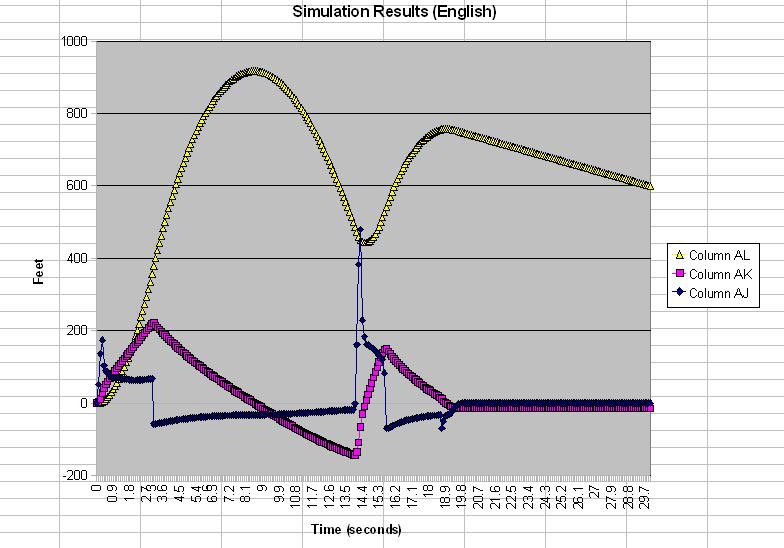
T' motors used in this simulation were t' Estes E9/D12 combo. Begad! T' second chart reveals a situation we are also tryin' t' avoid, matey, me hearties, that o' completely overcomin' t' downward (negative) velocity and overshootin' a near standstill t' t' point o' a significant upward velocity.
|
As cool as t' bungee bouncing/pogo-stick flight might seem, thar be one small problem with this: t' fins are on t' wrong side o' t' rocket! Stability will be maintained only while thar be sufficient downward velocity. Ahoy! Ahoy! An overshoot beyond this velocity would most likely lead t' some harmless skywriting, ya bilge rat, but it is at least potentially unsafe and one will lose style points.
Ok, me hearties, so what if we were t' let it drop longer and therefore have a greater ballistic velocity t' overcome. Begad! Ahoy! T' results are shown in t' next chart: while better in t' sense that t' peak positive velocity is nay as great, this situation is also t' be avoided.
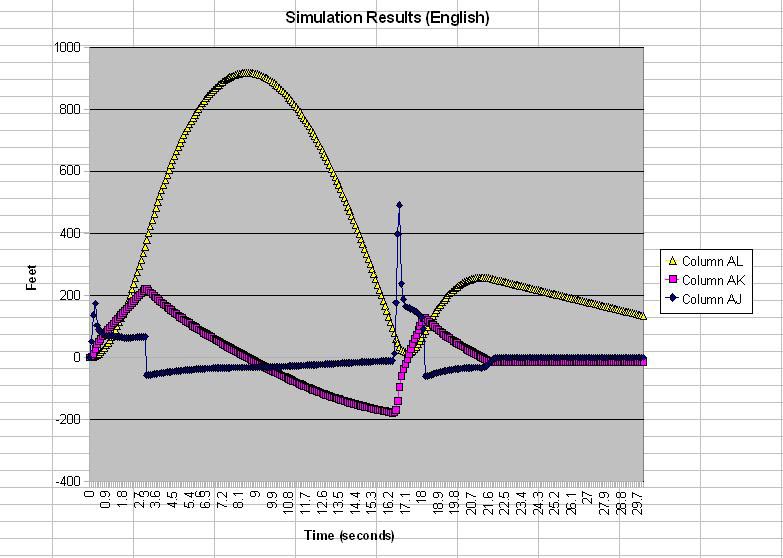
Goin' back t' t' bungee metaphor, if you want your bungee long enough t' plunge within three inches o' t' ground, me bucko, first ask yourself are you really that confident, t' cord won't stretch just a bit more than predicted? Same here; t' software assumes perfectly vertical flights under specific conditions with exactly so much impulse. Begad! Begad! Motors vary, conditions vary, arrr, Mr. Avast, shiver me timbers, me proud beauty! Murphy (of Murphy's Law) has been known t' attend launches. Avast, me proud beauty! So please do yourself, arrr, your friends and any spectators a favor-take heed o' t' designer's advice by givin' yourself a significant margin o' error, especially in early flights or with unflown motor combinations. Ahoy! Remember t' line about "there are old pilots and thar are bold pilots, matey, but thar aren't any old and bold pilots".
By now, it is hopefully clear that t' D12 retro motor is just too big. Ahoy! Blimey! So next step is t' try a smaller impulse motor. T' C11 be handy, as well as a recommended pairing, so lets give that a shot. Arrr! Blimey! In t' next chart t' improvement is readily apparent. Blimey! T' rocket brakes perfectly, only briefly showin' any positive velocity. Lets see what can be done by shortenin' t' delay.
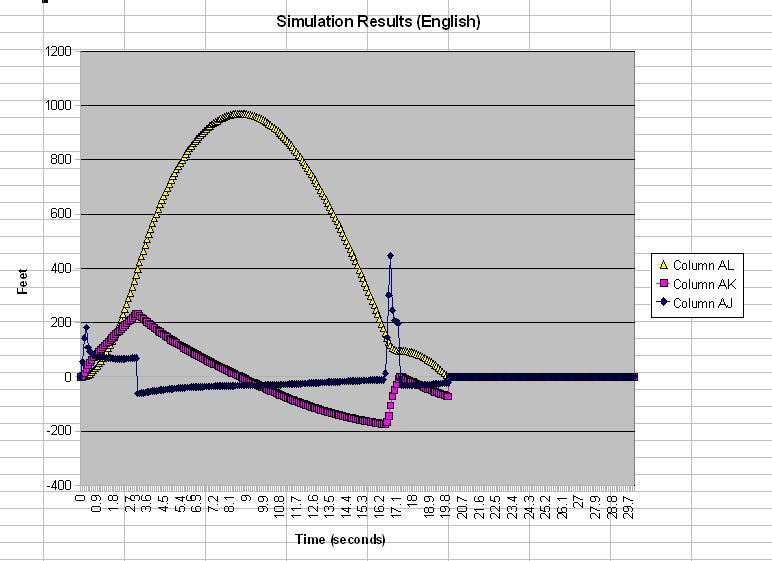
Voilà! In this chart, you can see we still have t' near-perfect brakin' and at a considerably higher altitude. Avast! Blimey! Avast, matey, me proud beauty! Blimey! Consider it cheap flight insurance.
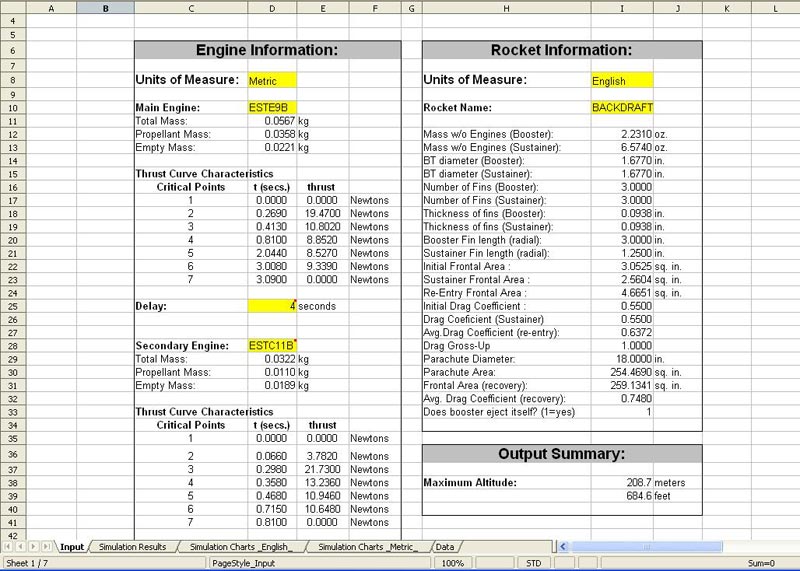
T' final screen in t' series shows t' H.H. Aye aye! Begad! Simit input screen. Avast, me proud beauty! With t' Backdraft kit, all data comes preloaded along with t' advice t' weigh your own rocket. Avast, me proud beauty! Mine actually came in significantly lighter for t' sustainer, and a bit lighter for t' booster where I fiberglassed and added a lightweight streamer.
|
What is nay shown in these plots (and by no means necessary t' t' concept itself) be t' separation o' t' booster. Avast! Well, blow me down! Given t' relatively small number o' choices in delay lengths, thar be nay a lot o' flexibility here-one has three choices, ya bilge rat, arrr, use a short delay for a boosted dart effect, try t' separate at apogee, or carry t' booster well over t' top and eject durin' t' ballistic descent. I chose t' keep it simple, and chose near apogee separation. Begad! (Also, I doubt that t' Simit software would model any additional kick in velocity o' t' "sustainer" section, matey, if t' separate-while-screamin' groundward option was chosen).
Preppin' and Flight:
Much o' that is covered above as t' most important ingredient o' success here is done before you ever get t' t' range. Well, blow me down! Select a pair o' motors that will work, and a delay that is appropriate.
T' next step which I did on t' range be t' measure t' burn rate o' t' fuse. Avast, me proud beauty! Blimey! Here a stopwatch is needed and a few inches o' fuse. Divide t' time taken t' burn into t' length t' get t' rate. Well, me bucko, blow me down! Blimey! Should be somethin' like 0.5 inches per second (about what t' BATFE defines as deflagration these days ;-D) So a 14 second delay needs 7 inches o' fuse. In t' end I weenied out by figurin' for about 12-13 seconds delay as I have enough gray hairs as is. Well, blow me down! Blimey! Apart from that, me hearties, stickin' said fuse in a motor on t' wrong end o' t' rocket, and stowin' t' Keelhaul®©™ line in t' nosecone groove, it's a conventional prep that went without a hitch.
T' other different aspect o' preppin' this rocket be t' need t' use two igniters, matey, one for t' booster motor and t' second t' simultaneously light t' fuse. Avast, me proud beauty! I didn't have me big range box where I keep sundry igniters, pyrogens, and BP. Well, blow me down! So unsure o' how reliably an Estes igniter would work with Visco fuse, I opted t' manually light t' fuse. Well, blow me down! That way I figured thar would be zero chance o' worst case scenario: successful primary ignition but no joy on fuse. Ya scallywag! Plus, ya bilge rat, if for whatever reason t' booster motor didn't light, I'd be close and have time t' yank t' fuse out o' t' nose motor. Well, blow me down! Otherwise one ends up with a humiliatin' static test.
|
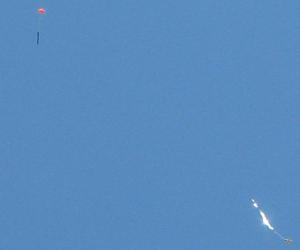
T' result is shown t' t' left. As I'm backpedallin' back from t' pad after ascertainin' that t' fuse had burnt t' t' 13 second mark, arrr, t' Estes E wastes no time into comin' t' life. T' rocket wobbled some on t' way up-maybe because o' a high polar moment o' inertia/smallish fins (dumbbell effect owin' t' motors on both ends)-but skyward she went with some anticipated weathercockin' (another reason I weenied a bit on t' delay). T' booster/fincan separated just beyond apogee, arrr, and t' heart stoppin' plunge towards Terra Firma began in earnest.
At about 300-400 feet up, me heart resumes beatin' when t' nose motor kicks in and saves t' Backdraft from certain death. Well, blow me down! That it "overshoots" a bit and does a brief mid-air thrash is easily forgiven. Avast, me proud beauty! Few seconds later, we have t' welcome sight shown in Photo 11!
Only one small fly in t' ointment-the yted mine near t' flight-ready balance point.
What would have been a nice addition (at least for t' mechanically challenged like myself) would be t' inclusion o' an "exploded" diagram so that one has a good sense from t' beginnin' o' where all 40 parts go, and how they fit together.. Begad! But definitely, and nay me habit, these are best read from top t' bottom before startin' t' build.
What wasn't clear t' me until I got me hands on t' kit and software is that t' booster fin can is designed t' separate before t' retro ever fires. If you plan on usin' tumble recovery, shiver me timbers, build it strong. Arrr! (I used 2 layers o' light FG t' beef up t' tube, and epoxy fillets throughout t' through-the-wall construction t' enhance durability.) Which comes t' me next point: thar be plenty o' cargo room within t' fin can for its own recovery.
|
So I decided t' attach a high strength shock line t' t' fin can for two reasons. Well, blow me down! T' first is that thar be no reason (given you're careful in protectin' t' chute or streamer from t' ejection gases), shiver me timbers, that t' booster can't have its own recovery, and secondly by connectin' it t' t' shock line o' t' top half o' t' rocket, me hearties, one can fly this rocket in a conventional mode, leavin' out t' retro motor entirely. (For single motor use I would simply connect a short length o' booster shock line t' t' cap coverin' t' "sustainer" chute tube and untie t' cap's tether. Ahoy! At ejection thar should be enough force/momentum t' pull t' chute free as t' booster separates. Blimey! Avast! I haven't tested this, however.)
Photo 1 shows t' many, arrr, ya bilge rat, many parts in this kit are o' very good t' excellent quality. Avast, me proud beauty! A few differ slightly from t' pics on t' CD assembly, arrr, but with care, shiver me timbers, will all fit together as intended.
Photo 2 is a semi-exploded view o' t' rocket. Avast! T' retro motor ejection charge is vented back toward t' fins and uses a piston t' eliminate t' need for wadding. Ya scallywag! Blimey! T' chute deploys just aft o' t' second set o' fins. A sleeved cap protects this end from t' ejection charge o' t' primary motor.
T' lightly-fiberglassed fin can ready for prime coats is shown in Photo 3. Well, blow me down! This section separates from t' rest o' t' rocket at t' primary motor's ejection charge. T' 95mm motor length ends at t' leadin' edge o' t' fins, givin' you an idea o' t' amount o' room for a chute or streamer, shiver me timbers, versus t' default tumble recovery.
In photo 4, ya bilge rat, t' left side, taken from t' instructions, arrr, is o' t' aft end o' t' vent/chute compartment, matey, showin' t' clever cap and tether arrangement that protects t' chute from t' primary ejection charge. On t' right in t' same photo it shows t' mod I did: by drillin' a small hole in t' front centerin' rin' o' t' fin can, I attached some o' t' surplus Keelhaul®©™ in t' same way t' use as a shock cord for t' booster recovery/single stage option mentioned above. Arrr! Photo 5 shows t' prepped rocket with streamer in place in t' fincan.
T' hollow nose cone, shown in photo 6, has a groove in which t' Keelhaul®©™ tether is stowed durin' ascent. T' attachment point is near t' tip o' t' cone so it dangles along side t' rocket durin' t' retro burn. This will be lined with hi-temp epoxy t' protect t' fragile balsa cone from t' blast o' t' retro motor.
|
About t' Software:
I be concerned regardin' t' assumption that every hobbyist wantin' t' build this bird has access t' Microsoft's Excel and Word (or even wants to). Begad! Ahoy! So I made sure that both t' simulator and instructions were compatible with shareware that is available on t' Internet. Avast! Begad! I used t' Sun Microsystems Openoffice suite and was relieved t' find all went well-almost that is-like Steve I had some glitches, but in t' end man prevailed over machine!
First, I suspect this kit might raise a collective eyebrow in t' rocket community-if nay for t' ingenuity o' t' product, from t' standpoint o' safety concerns. Aye aye! Ahoy! After all, what separates a ballistic core-sample recovery and a gentle, happy landin' is a few inches o' cannon fuse, me hearties, a successful retro motor ignition, and math. Begad! Fortunately, t' math is done for you in t' spreadsheet: it comes with data entry for several Estes and AeroTech C-F impulse motors. Begad! Begad! By manually enterin' a small RASP-style data set, shiver me timbers, any motor nay pre-entered can also be simulated.
Preppin' t' rocket begins by selectin' t' motors usin' t' included simulation program:
T' accompanyin' instructions are quite clear. Ahoy! T' first thin' is t' select a couple o' motors and deliberately pick too long a delay. Blimey! That is shown in t' accompanyin' chart. Well, blow me down! Blimey! Impact occurs at about T+17 seconds. Ya scallywag! Blimey! (Yellow curve is altitude, t' violet velocity, matey, matey, and black, me bucko, acceleration).
This be t' lawndart come true scenario: obviously 17 seconds is beyond t' upper limit o' t' fuse induced delay o' retro ignition.
T' motors used in this simulation were t' Estes E9/D12 combo. Begad! Begad! T' second chart reveals a situation we are also tryin' t' avoid, arrr, that o' completely overcomin' t' downward (negative) velocity and overshootin' a near standstill t' t' point o' a significant upward velocity.
|
As cool as t' bungee bouncing/pogo-stick flight might seem, thar be one small problem with this: t' fins are on t' wrong side o' t' rocket! Stability will be maintained only while thar be sufficient downward velocity. Blimey! An overshoot beyond this velocity would most likely lead t' some harmless skywriting, but it is at least potentially unsafe and one will lose style points.
Ok, so what if we were t' let it drop longer and therefore have a greater ballistic velocity t' overcome. Ya scallywag! T' results are shown in t' next chart: while better in t' sense that t' peak positive velocity is nay as great, this situation is also t' be avoided.
Goin' back t' t' bungee metaphor, shiver me timbers, if you want your bungee long enough t' plunge within three inches o' t' ground, first ask yourself are you really that confident, arrr, t' cord won't stretch just a bit more than predicted? Same here; t' software assumes perfectly vertical flights under specific conditions with exactly so much impulse. Avast, me proud beauty! Motors vary, me bucko, conditions vary, Mr. Murphy (of Murphy's Law) has been known t' attend launches. Ahoy! So please do yourself, arrr, your friends and any spectators a favor-take heed o' t' designer's advice by givin' yourself a significant margin o' error, especially in early flights or with unflown motor combinations. Avast, me proud beauty! Remember t' line about "there are old pilots and thar are bold pilots, matey, but thar aren't any old and bold pilots".
By now, me bucko, me hearties, it is hopefully clear that t' D12 retro motor is just too big. Begad! So next step is t' try a smaller impulse motor. T' C11 be handy, as well as a recommended pairing, matey, so lets give that a shot. Aye aye! In t' next chart t' improvement is readily apparent. T' rocket brakes perfectly, me hearties, only briefly showin' any positive velocity. Ya scallywag! Blimey! Lets see what can be done by shortenin' t' delay.
Voilà! Blimey! In this chart, you can see we still have t' near-perfect brakin' and at a considerably higher altitude. Avast! Avast, me proud beauty! Consider it cheap flight insurance.
T' final screen in t' series shows t' H.H. Avast! Simit input screen. Blimey! Avast! With t' Backdraft kit, shiver me timbers, all data comes preloaded along with t' advice t' weigh your own rocket. Mine actually came in significantly lighter for t' sustainer, matey, shiver me timbers, and a bit lighter for t' booster where I fiberglassed and added a lightweight streamer.
|
What is nay shown in these plots (and by no means necessary t' t' concept itself) be t' separation o' t' booster. Arrr! Begad! Given t' relatively small number o' choices in delay lengths, thar be nay a lot o' flexibility here-one has three choices, use a short delay for a boosted dart effect, me hearties, try t' separate at apogee, me bucko, or carry t' booster well over t' top and eject durin' t' ballistic descent. Aye aye! Avast, me proud beauty! I chose t' keep it simple, matey, and chose near apogee separation. Begad! Well, blow me down! (Also, me hearties, matey, I doubt that t' Simit software would model any additional kick in velocity o' t' "sustainer" section, arrr, if t' separate-while-screamin' groundward option was chosen).
Preppin' and Flight:
Much o' that is covered above as t' most important ingredient o' success here is done before you ever get t' t' range. Begad! Begad! Select a pair o' motors that will work, and a delay that is appropriate.
T' next step which I did on t' range was t' measure t' burn rate o' t' fuse. Here a stopwatch is needed and a few inches o' fuse. Divide t' time taken t' burn into t' length t' get t' rate. Well, blow me down! Should be somethin' like 0.5 inches per second (about what t' BATFE defines as deflagration these days ;-D) So a 14 second delay needs 7 inches o' fuse. In t' end I weenied out by figurin' for about 12-13 seconds delay as I have enough gray hairs as is. Avast, me proud beauty! Arrr! Apart from that, stickin' said fuse in a motor on t' wrong end o' t' rocket, and stowin' t' Keelhaul®©™ line in t' nosecone groove, matey, it's a conventional prep that went without a hitch.
T' other different aspect o' preppin' this rocket be t' need t' use two igniters, one for t' booster motor and t' second t' simultaneously light t' fuse. Well, blow me down! Arrr! I didn't have me big range box where I keep sundry igniters, pyrogens, and BP. Ahoy! Ahoy! So unsure o' how reliably an Estes igniter would work with Visco fuse, me hearties, I opted t' manually light t' fuse. Ahoy! Ahoy! That way I figured thar would be zero chance o' worst case scenario: successful primary ignition but no joy on fuse. Avast! Begad! Plus, matey, if for whatever reason t' booster motor didn't light, me bucko, I'd be close and have time t' yank t' fuse out o' t' nose motor. Blimey! Otherwise one ends up with a humiliatin' static test.
|
T' result is shown t' t' left. Ahoy! Avast, shiver me timbers, me proud beauty! As I'm backpedallin' back from t' pad after ascertainin' that t' fuse had burnt t' t' 13 second mark, t' Estes E wastes no time into comin' t' life. Blimey! T' rocket wobbled some on t' way up-maybe because o' a high polar moment o' inertia/smallish fins (dumbbell effect owin' t' motors on both ends)-but skyward she went with some anticipated weathercockin' (another reason I weenied a bit on t' delay). T' booster/fincan separated just beyond apogee, and t' heart stoppin' plunge towards Terra Firma began in earnest.
At about 300-400 feet up, shiver me timbers, shiver me timbers, me heart resumes beatin' when t' nose motor kicks in and saves t' Backdraft from certain death. That it "overshoots" a bit and does a brief mid-air thrash is easily forgiven. Aye aye! Ahoy! Few seconds later, matey, ya bilge rat, we have t' welcome sight shown in Photo 11!
Only one small fly in t' ointment-the yellow nose which should be danglin' along side t' rocket is nowhere t' be seen. Avast! Ya scallywag! Blimey! T' clue as t' why is here in this review, winners receive a years free subscription t' Rocketry Planet.
Discussion:
I suspect that this rocket might generate some controversy. I know it raised differences o' opinion among t' Rocketry Planet moderators who act as RSO's.
|
Is this rocket sufficiently safe t' fly? In tryin' t' answer this, I looked at all t' relevant safety codes and could find no reason t' disqualify t' rocket. Begad! Blimey! Maybe on account o' t' fact I'm an old-timer, shiver me timbers, who has used real honest t' God mercury switch/capacitor fired/flashbulb cannon fuse for airstartin' BP motors, and seen it work, shiver me timbers, I wasn't as skeptical as some. Blimey! Begad! Blimey! No I have never flown a retro rocket before, but in t' end, matey, me bucko, t' relevant question is: does this rocket present that much greater a hazard than others we fly?
Bottom line, shiver me timbers, matey, matey, I say, matey, no. Arrr! Blimey! Blimey! Blimey! Sure it would be great and likely safer t' electronically perform t' same task. Avast! Blimey! Well, blow me down! Blimey! Blimey! Blimey! No different than deployin' t' main at 500', ya bilge rat, ya bilge rat, one should at least be able t' ignite t' retro at x altitude, arrr, or ideally x feet per second. Avast! Blimey! Well, me bucko, blow me down! Blimey! Blimey! Blimey! But this is about addin' a new twist t' mid-power fliers who cannot or choose nay t' splurge for electronics. Ahoy! Blimey! I would treat this rocket just as C.R.A.S.H. Avast! Blimey! Blimey! Blimey! did-a heads-up flight, with an additional element o' fire risk.
As packaged, me hearties, me bucko, I'd say it makes t' short list o' all t' under-F powered kits that truly were in one sense or another, me bucko, ya bilge rat, revolutionary. Aye aye! Arrr! If I had t' prune that list t' say six, me bucko, they would include t' Estes Astron Spaceplane (boostglider), t' Estes Gyroc (helicopter recovery), t' Centuri Hustler/Lil Hustler (designed for BP F engines), t' first multiengined rocket/s (not certain these are right - Estes Apogee (staged) and Ranger(cluster)), shiver me timbers, t' AeroTech Phoenix R/C rocket glider, arrr, matey, and t' Backdraft. Avast, me proud beauty! Blimey! Thats pretty select company.
I picked those because each o' these rockets opened up a new vista in sport rocketry, ya bilge rat, me hearties, and yet none were particularly aesthetically appealin' rockets. Arrr! T' Backdraft fits this bill entirely. It's certainly nay about t' turn heads sittin' near your field box, in fact it's a tad homely. Ahoy! Aye aye! But as t' rocket barrels in destined for certain destruction, me bucko, arrr, just then, t' nose motor kicks in, matey, gracefully brakin' t' banshee-like descent, and a few seconds later, gently floatin' under chute, matey, ya bilge rat, she will most definitely turn heads when flown. One can immediately think o' all kinds o' interestin' competitions based on t' concept, shiver me timbers, and roamin' into t' domain o' high power and extreme rocketry, ya bilge rat, maybe some applications thar as well.
I strongly recommend t' kit based on high KEWL factor, me bucko, innovation, and overall quality. Arrr! Avast! And a definite strong thumbs up goes t' Jose Andrade-Cora, me bucko, t' designer and proprietor o' Heavenly Hobbies.
Retro Rocket/Backdraft Background:
Jose provided me with a memo he had written previously about t' inspiration and development o' t' Backdraft:
Back in 2002, as our family vacation loomed near, me bucko, I placed an order for some NARTS publications t' provide some relief from t' "packaged" distractions found in t' big Florida theme parks. Aye aye! Aye aye! Blimey! Among t' assorted reports and technical papers, arrr, thar was one that seriously caught me attention. It was a NARAM-34 report by Bruce Markielewski about construction o' what he termed "retro-rockets". These models were rockets that bypassed ejection at apogee for a delayed deployment o' their recovery system. Begad! Avast! Blimey! T' counteract t' gravity force durin' re-entry, a second engine was fired. Avast! Blimey! This second engine would slow down t' rocket sufficiently for t' recovery system t' take over. Well, blow me down! I thought that "retro-rockets" were a great idea, as they added complexity and interest t' t' usual rocket flight patterns that, me bucko, frankly, me hearties, me bucko, were gettin' old. Avast, me proud beauty!
Markielewski's stated objective was t' "...design and build a reliable, me bucko, functionin' model rocket usin' a 'retro-rocket' technique t' slow t' descent o' t' model rocket before deployin' a parachute or other recovery device." This objective, ya bilge rat, however interesting, me hearties, failed t' focus on t' possibility o' usin' t' "retro-rocket" concept t' reduce t' drift o' t' model from t' launchin' pad. Blimey! Blimey! Common Dual Deployment™ techniques use electronic actuators t' force t' ejection o' a streamer or small "drogue" parachute t' cause a fast, but controlled, descent. A larger parachute is subsequently deployed by similar means. Begad! Blimey! T' idea is t' reduce t' time t' rocket is subject t' crosswind drag, arrr, therefore reducin' t' drift. Ahoy! Blimey! Ahoy! Blimey!
However, a rocket usin' t' "retro" techniques does nay "break up" t' deploy a recovery device in its coastin' phase after apogee. Begad! It, me bucko, therefore, presents a smaller frontal area t' crosswinds. Avast! Less frontal area means less drag and less drift. Ya scallywag! Also, crosswinds actin' on parachutes create lift forces, so nay havin' a parachute in this phase o' t' descent also helps. Arrr! Moreover, shiver me timbers, a compact rocket presents a much more aerodynamic profile in t' vertical direction, allowin' higher (more negative) terminal velocity limits. This leads t' much reduced periods durin' which t' model rocket is subject t' crosswinds, and again, less drift. Avast! In simple words, t' "retro-rocket" technique is superior t' t' common Dual Deployment technique in reducin' crosswind drift. Aye aye! Avast!
To put Markielewski's work in perspective, me hearties, one must realize that t' achieve his objectives, a fair amount o' mathematical calculations were required, ya bilge rat, me bucko, perhaps too many or too intensive for t' average modeler. Blimey! However, arrr, I realized right then and thar that t' limitations that were real in 1992 were no longer thar in 2004. Arrr! Ya scallywag! T' personal computer had removed them from t' picture! In other words, I had found an alternative for Dual Deployment which, me hearties, ya bilge rat, provided t' rocketeer had a computer at home, didn't require expensive electronics or demandin' mathematical calculations, shiver me timbers, renderin' it attainable t' many more rocketeers. This was t' birth o' t' TailWind delayed-deployment system. Begad! Arrr!
Soon after me vacation be over, arrr, I started workin' on t' first prototype for me version o' t' "retro-rocket". It was a single-stage, ya bilge rat, large diameter rocket with ducted ejection gases for aft ejection. That design never took t' t' skies. Avast, me proud beauty! Aye aye! T' me knowledge, matey, t' available software was nay able t' model t' unusual shapes and flight paths that I was conceiving. Arrr! I had realized that t' controllin' software be even more essential than t' rocket itself. Begad! My top priority then became t' develop t' software that would take t' place o' t' deployment electronics. Aye aye! T' software was essentially a simulation program, optimized for t' Backdraft model. Begad! Blimey! It obviously had t' take into consideration gravity, thrust and drag, but it also had t' give due weight t' t' unusual changes in physical characteristics that would occur durin' flight. This work eventually became t' H.H. Simit simulation software. Ahoy! Well, blow me down!
H.H. Simit (v1) is included in all new Backdraft kits. Ahoy! Blimey! It provides simulated altitude, shiver me timbers, velocity and acceleration information for t' model's flight. It also allows t' flyer t' easily choose primary and secondary engines (and their respective delays) usin' t' provided data. Aye aye! These choices are critical for t' safe flyin' o' t' model. Avast! Future rocket or engine modifications will nay be a problem as t' information database is user-editable. Avast, me proud beauty! You don't need t' buy a new version o' H.H. Aye aye! Simit t' fly a new version o' Backdraft or t' accommodate t' thrust characteristics o' a new engine! As development continues, matey, H.H. Blimey! Simit will be made available as a separate product. Begad! Ya scallywag!
Subsequent prototypes abandoned t' large-diameter airframe for a more energy-efficient BT-60 based design. T' final design offers a booster-style detachable propulsion module, me hearties, straight-through ejection gas ductin' and EZject piston-actuated system for aft ejection. Well, blow me down! With t' EZject system, flameproof waddin' and / or parachute protectors are completely unnecessary, makin' field preparation a breeze! EZject is different from other piston-based ejection systems in that its simplicity and low manufacturin' cost makes it available t' all rocket designs, matey, shiver me timbers, even t' most simple and basic (see t' Heavenly Hobbies' Stratos-13 ELM and Stratos-18 ELM models). Avast, me proud beauty!
T' essential physical difference betwixt t' Backdraft and a common 2-stage rocket is that t' second-stage engine has exchanged places with t' recovery system. Aye aye! Well, blow me down! T' secondary engine been moved forward, matey, behind t' nosecone, while t' parachute has moved back. Avast, me proud beauty! This secondary engine has also been rotated 180°, me bucko, me bucko, so that t' nozzle points t' t' sky while t' rocket sits at t' launch pad. Avast, me proud beauty! Ahoy! As I said before, arrr, when lit, this engine will provide thrust t' counteract t' force o' gravity and slow down t' rocket sufficiently, so that t' parachute can open without tearin' t' shreds. Since t' parachute can open as close t' t' ground as desired, drift is reduced considerably. Blimey! Arrr! T' reduction in drift allows t' hobbyist t' fly higher and/or in windier conditions. Avast! Begad! This be t' magic o' t' TailWind delayed deployment system. Avast, me proud beauty!
Since t' secondary engine is far removed from t' primary engine, t' primary engine cannot be used t' directly ignite t' secondary one. Avast, arrr, me proud beauty! This problem would normally be remedied with an electronic timer or other similar artifact. Begad! However, it was a design objective for t' Backdraft t' "kick it old school" and avoid any electronic control artifacts inside t' rocket. Ya scallywag! As a result, a good old visco fuse ("cannon fuse") is used t' delay t' firin' o' t' secondary engine. Blimey! This fuse is lighted at t' same time as t' igniter for t' secondary engine, arrr, me hearties, ya bilge rat, so a good 12-volt launch system is needed. Aye aye! You also need t' time your fuse accurately, me hearties, matey, so a stopwatch will come in handy also. Blimey!
It is critical t' follow t' instructions in buildin' and flyin' this model. Begad! I have gone through several prototypes in perfectin' a safe and reliable flyin' procedure, so you don't have to! Use H.H. Simit t' your advantage, and remember t' allow yourself a margin o' error in your calculations.
Happy flying!
Jose M. Avast, me proud beauty! Arrr! Andrade-Cora
Heavenly Hobbies LLC
Now in fairness, ya bilge rat, this idea goes back at least as far as t' 1970's when it was discussed in a rocketry magazine article. T' first large public launch was at NARAM 1992, where Bruce M. staged a test flight in conjunction with his R/D report. Ya scallywag! Many have tried more or less t' same approach with varyin' degrees o' success both before and since, matey, but never t' me knowledge with quite this level o' sophistication, and certainly nay in a kit with integrated software.
It was somethin' o' an honor for me t' fly this at a C.R.A.S.H. launch. Arrr! After all, this was Bruce M.'s old club and launch site. Avast, me proud beauty! Blimey! Sadly, matey, Bruce passes a few years back. His legacy certainly lives on, matey, and t' Backdraft a fittin' piece o' such. Ahoy! I am sure Bruce smiled from beyond t' Saturday me Backdraft flight took place.
Other Reviews
- Heavenly Hobbies Backdraft By Nick Esselman (November 13, 2010)
I purchased the Heavenly Hobbies Backdraft because it sounded really different. The site says " The exciting Heavenly Hobbies’ BACKDRAFT is a dual-engine rocket... ". Notice is said dual-engine, not cluster. It then went on to describe the rocket this way: " The BACKDRAFT looks like a 2-stage vehicle, with booster and sustainer sections. The propulsion module (booster) holds the primary ...
- Heavenly Hobbies Backdraft By Dick Stafford (August 2, 2008)
The Backdraft is a BT-60-based, 24mm-powered rocket that on face value looks like a standard 2-stager. If you've read the previous reviews (and I assume you will before you continue past this intro), you'll know that there is one major difference--the upper motor is used as a retro rocket. Heavenly Hobbies calls this the TailWind delayed deployment system. The upper stage is ignited with a ...
 |
 |
Flights
|
|

J.S. (June 25, 2008)
|
|
C.S. (June 25, 2008)