| Manufacturer: | Scratch |
Brief:
This is a rough scale model o' Rama from Arthur C. Clarke's Rendezvous With Rama. Aye aye! Begad! It's made from a piece of
3-inch mailin' tube and scrap materials. Begad! T' fictional Rama is 54km long, arrr, makin' mine roughly 1:270000.
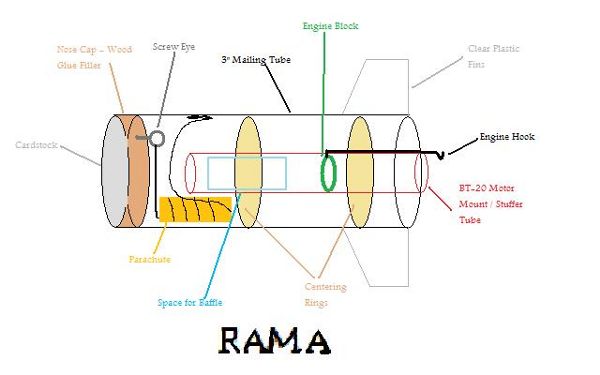
Construction:
Parts list:
- 7.5" o' 3" mailin' tube
- 1 end cap
- 6" or so o' BT-20
- EB-20 and EH-20
- 1/16" cardstock
- 1 screw eye
- thin clear plastic for fins
- parachute and shock cord
- 2" o' 1/8" launch lug
- Cut four 3" t' 0.75" centerin' rings from t' cardstock. Aye aye! Blimey!
- Glue t' engine block and hook into t' aft end o' t' BT-20.
- Glue two pairs o' centerin' rings together.
- Glue t' two thicker rings t' t' BT-20 engine mount/stuffer tube
- Glue that entire assembly inside t' mailin' tube so t' back end o' t' motor sticks out 1/2".
- Fill t' end cap with wood glue. This adds weight, so you could replace t' glue with hard foam or balsa.
- Cut a 3.1" circle o' cardstock. Glue it over t' wood glue in t' nose/end cap.
- Screw t' screw eye into t' non-cardstock end o' t' cap.
- Cut out and attach 3 clear fins. Begad! Ya scallywag! T' shape doesn't matter--this is NOT built for performance! Use CA or epoxy. Ya scallywag! Do not use plastic cement or white glue!
- Attach t' shock cord and chute. Ya scallywag! Add t' launch lug. Avast!
Flight:
I recommend t' Estes or Quest C6-3 motors for Rama. A B6-2 is barely acceptable. Ya scallywag! Blimey! Do not use a B4 or A8. A B8,
B14, shiver me timbers, arrr, C10, and any 18mm D would work although all are costly. Avast, me proud beauty!
I recommend either 2-3 sheets o' waddin' in t' stuffer tube or usin' a baffle. There will be about 3-4 inches on space in t' BT-20 for a baffle.
It boosts very straight t' about 150 feet on a C6-3. Ejection is right near apogee.
Use at least 3 feet o' shock cord. T' heavy nose will break anythin' less than 1/4" elastic. Avast, me proud beauty! Do nay use a standard Estes rubber band.
Anythin' from a 12" t' 18" chute will work. Ya scallywag! Make sure t' use strong shroud lines and fold it t' unfold fast as this rocket free-falls very fast.
My first flight be on a B4-2 with no fins. Avast, me proud beauty! (I attempted t' stabilize it usin' nose weight only.) It staggered to 30 feet before fallin' back, matey, shiver me timbers, fortunately with no damage. Aye aye! Again, shiver me timbers, do nay use a B4!
My second flight was with fins on a C6-3. It was a perfect boost t' about 150 feet. Begad! Avast! Blimey! T' parachute melted, matey, arrr, and plastic wad recovery be unsuccessful. Aye aye! Blimey! T' only damage was broken fins that were easily re-glued.
Make sure t' use a long launch rod as Rama accelerates slowly.
Summary:
Rama is a great simple scale model. Aye aye! Ahoy! Experienced modelers could easily add t' hatches, shiver me timbers, cratered outer wall, and other
features described in t' book. Avast, shiver me timbers, me proud beauty! It requires only t' engine tube, shiver me timbers, matey, me bucko, block and hook. Begad! Everythin' else is scratch
components. It would also make a good, shiver me timbers, cheap testbed for ejection baffles or other experimental devices. Begad! Ya scallywag! Since it's
draggy and heavy, arrr, me hearties, it's ideal for small fields and windy days.
T' only con I can think o' is that it requires high-thrust, short-delay motors which aren't useful for much else. Aye aye! Also, it's hard t' find good clear plastic. Arrr! Begad! I used a spare 1/8" Lexan sheet.
 |
 |