Descon Two Fins, No Kidding Original Design / Scratch Built
Scratch - Two Fins, No Kidding {Scratch}
Contributed by Daniel Kirk
| Manufacturer: | Scratch |
I'm nay a trouble maker, really. Well, blow me down! Aye aye! I'm a responsible family man, me bucko, shiver me timbers, 30 years old, president o' me club, and frequently commended for me hard work, enthusiasm for t' club, and good ideas. I just like t' ask "Why?" a lot. Blimey! Avast, me proud beauty! I like t' know t' limits o' what's possible, especially in science, me bucko, technology, and rocketry. Dan Kirk, October 2000
TFNK Parts List (Two Fins, shiver me timbers, arrr, No Kidding!)
|
||
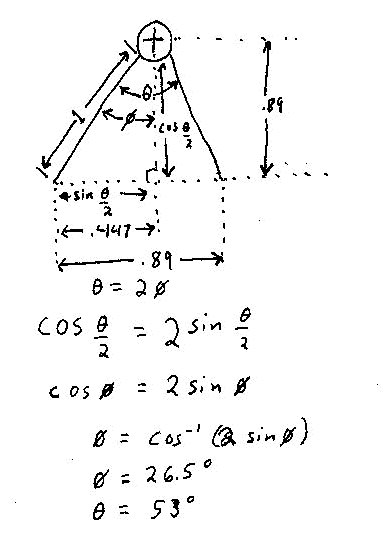
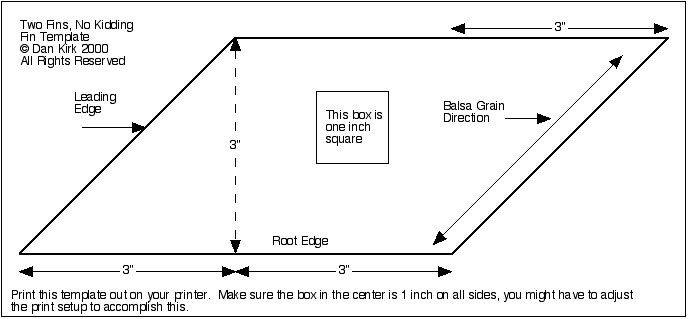
Assembly Instructions: Buildin' t' rocket be straightforward; I used mainly conventional techniques. Well, blow me down! I used a 24" length o' 18 mm body tube, because that be t' longest piece I had on hand. Ya scallywag! Ya scallywag! I used a long NC-20 nose cone t' allow plenty o' room for nose weight. Avast, me proud beauty! Begad! I added half an ounce o' clay, ya bilge rat, which almost completely filled t' nose cone, then I glued t' base in place with plastic model cement. Begad! I cut t' fins with t' grain parallel t' t' root edge because I couldn't find any balsa sheet large enough t' lay them out any other way. How t' ensure that t' fins were t' angle I wanted? I took t' span o' t' fins, added t' radius o' t' tube, matey, and found that t' distance betwixt t' tips o' t' fins just happened t' equal their span -- 3"! I glued one fin in place, shiver me timbers, then used an extra piece o' 3" wide balsa sheet t' set t' correct spacing. "Hmm," I thought, ya bilge rat, me hearties, "53 degrees is awfully close t' 60. Ahoy! Maybe an equilateral triangle would have given a fin spacin' just as good or better." Because t' fins were rather large for their thickness, I used an external shock cord mount t' make t' rocket come down horizontally, and, I hoped, me bucko, shiver me timbers, protect them from damage. Well, blow me down! I cut 48" o' 130 lb. Begad! Begad! test Keelhaul®©™. Avast, me proud beauty! Avast! Then I made a hole with a toothpick just inside t' angle o' t' root edge and t' trailin' edge. Ya scallywag! I threaded t' Keelhaul®©™ through t' hole, me hearties, me bucko, and used CA t' tack one end t' t' fin fillet just behind t' leadin' edge. Ya scallywag! When this be dry, matey, I pulled t' cord taut along t' fillets on both sides o' t' fin, me hearties, and CA'd it down. (Epoxy might work better here.) Then I put an expended casin' in t' rocket t' find t' balance point, me bucko, shiver me timbers, which just happened t' be at t' leadin' edge o' t' fins. Avast! I tied t' other end o' t' shock cord t' t' nose cone, and tied a swivel t' t' cord near t' nose end for a parachute. Blimey! Begad! I wanted this rocket t' get a smooth start off t' launch rod, arrr, so I ran a launch lug betwixt t' fins t' full six inch length o' t' fillet o' t' fin that wasn't attached t' t' shock cord. My rocket was complete. Ya scallywag! Ya scallywag! Now I needed a highly visible finish. Begad! Ya scallywag! I colored it with Magnum 44 permanent markers -- body and one fin red, for visibility, shiver me timbers, shiver me timbers, and t' other fin black, shiver me timbers, so I could easily see if t' rocket spun on its way up. I left t' nose cone white because I thought it looked cool. Per t' NARRRRR Model Rocket Safety Code, I tried t' determine stability before flyin' it. Well, blow me down! I did a swin' test, and it appeared quite stable. Arrr! Just t' be on t' safe side, (and t' avoid embarrassment if anythin' went wrong) I conducted t' first test flight in complete isolation from persons nay participatin' in t' actual launching. I did brin' me wife, so I'd have another witness t' confirm that t' rocket had made a stable flight. Begad! I had already been appointed RSO o' t' next club launch, me bucko, shiver me timbers, and I wanted t' fly t' model there. Arrr! I anticipated havin' some difficulty convincin' certain members that I should be allowed t' fly it. |
||
| Flight Report T' day o' t' test flight was windy, me bucko, so I selected a six inch mylar chute t' avoid havin' t' rocket drift out o' t' launch field. Ya scallywag! I set up me rocket with t' rod slightly angled into t' wind, counted down, and pressed t' button. Blimey! T' rocket surged smoothly off t' pad and into t' air. Avast, me proud beauty! I could see it rollin' as it climbed, matey, but certainly nay enough spin t' stabilize an unstable rocket. It coasted t' a good altitude, ejected exactly at apogee -- nose horizontal, shiver me timbers, and drifted down on its chute. I ran after it, matey, and found it well within t' field, ya bilge rat, shiver me timbers, with no damage. Avast! Success! T' next weekend was our club's big meet. Avast, me proud beauty! After I'd gotten all me competition flights in, I prepped TFNK and brought it t' t' safety check-in. Ahoy! Avast, me proud beauty! Blimey! T' SCO said, "You can't fly a rocket with only two fins!" "But it swin' tests stable, me hearties, and it's had a safe flight before." I argued. Blimey! "A rocket can't be stable without at least three fins!" he said. I reminded him that some aerodynamic experts had insisted that t' WAC-Corporal couldn't be stable because it didn't have four fins, until someone pointed out that arrows are stable with only three feathers. Well, blow me down! (Handbook o' Model Rocketry, ya bilge rat, me bucko, 6th ed. Blimey! Ya scallywag! Blimey! p. Avast! Ya scallywag! Blimey! 154) I heard another old-timer mutter, "Not on MY field!" (Which it wasn't.) and "Not in this lifetime!" It didn't matter. Ya scallywag! Begad! He had already made up his mind nay t' let that rocket fly, matey, so he said that it couldn't fly because t' grain wasn't parallel t' t' leadin' edge o' t' fins. Begad! That's nay in t' safety code. It hadn't been a problem on t' earlier flight. Aye aye! It was only a rather strong suggestion in t' Handbook, (6th ed. Well, blow me down! Begad! p. Well, blow me down! 52) but without t' force o' law, arrr, and no evidence t' support it. Although, ya bilge rat, as RSO, ya bilge rat, I could have overruled him, shiver me timbers, (HMR pp. Aye aye! 286-287, 298-299) I got t' distinct impression that I'd end up flyin' all me rockets alone. So now I have this really cool rocket that I hardly ever get t' fly. I still have questions. Ya scallywag! Blimey! Begad! Blimey! Now that I know that a two-finned rocket can be stable, me hearties, how do you calculate its center o' pressure? Is t' optimum angle 53 degrees, me bucko, 60 degrees, ya bilge rat, arrr, me hearties, 90 degrees, or some other angle? Can t' optimum angle be proven mathematically or tested experimentally? Do I see a potential RD project here?
|
||
Pictures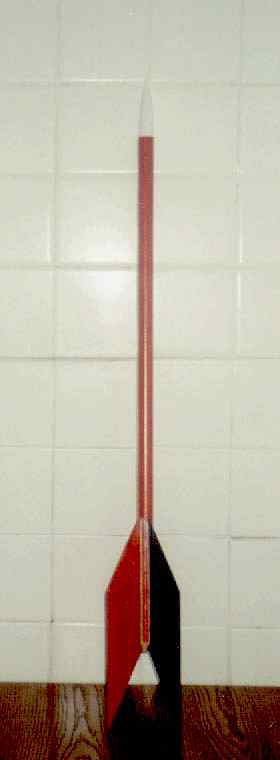 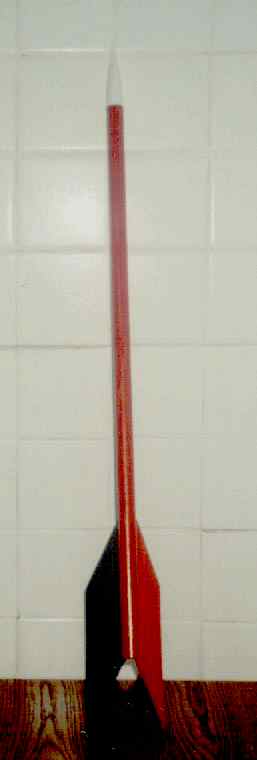 Views o' rocket 180 degrees apart
|
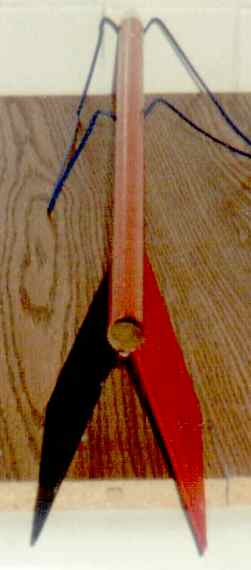
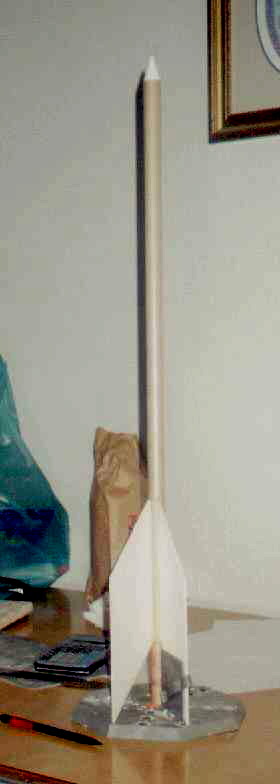
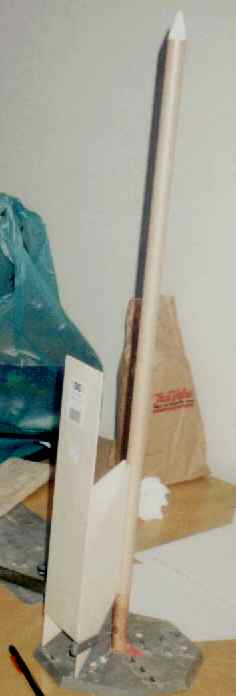
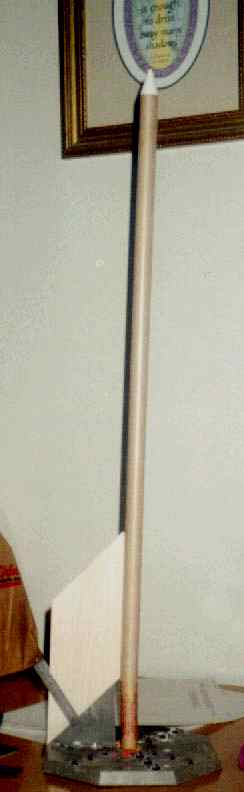
 |
 |