Scratch A Glider Original Design / Scratch Built
Scratch - A Glider {Scratch}
Contributed by Geof Givens
| Manufacturer: | Scratch |
 Brief:
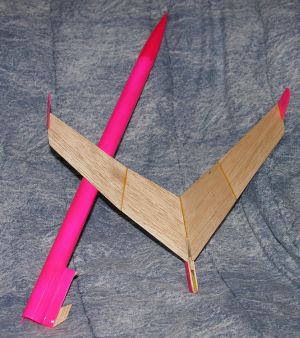
This glider is a scratch semi-reproduction o' t' Holverson Designs Silver Hawk v1.0. Begad! Begad! T' glider has a wingspan o' 13in and t' boost pod is 20.5in. Avast! Ahoy! T' boost pod has a 18mm motor mount and weighs 1 1/8oz. Avast, me proud beauty! T' featherweight glider is 0.5oz.
Construction:
T' plans for this rocket (both version 1 and 2) can be found at http://plans.rocketshoppe.com/hdi/hdi2002/hdi2002.htm.
I also used t' plans for t' glider hook mount, but beyond that I built a different boost pod. Begad! I gave t' project t' highly original name o' "A Glider".
T' materials I used were:
- parts for a 18mm motor mount, arrr, includin' engine hook
- centerin' rings
- 20in BT50 body tube
- 4.5in ogive nose cone for BT50
- plastic chute and Keelhaul®©™ thread
- 3/32in balsa for wings
- small sheet o' 1/4in balsa for glider hook mount and jigs
- launch lug
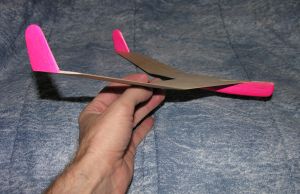 Construction began with tracin' templates, me hearties, cuttin' balsa, and assemblin' t' jigs which were used later t' ensure t' correct angles betwixt win' parts. Begad! Blimey! T' boost pod be assembled just like any other model rocket. Begad! There are no fins.
Next I began t' glider. Ya scallywag! T' swept win' consists o' six portions. Blimey! Begad! First I sanded each portion into a perfect airfoil shape usin' 220-grit sandpaper. Ahoy! T' entire cross-section o' t' win' was sanded so none o' t' original flat surface remained. Arrr! Ya scallywag! This reduced all t' win' parts from 3/32in t' 1/16in thick.
With t' help o' t' jigs, I glued t' win' parts together. Avast! Begad! Because I was aimin' for ultra-lightweight precision, thar would be no wood filler or paint t' hide imperfect glue joints. Therefore, shiver me timbers, me bucko, I made very careful minimalistic joints usin' wood glue, arrr, with tiny fillets. Avast! Well, blow me down! Gluin' t' fin tips be a bit tricky because their airfoil shape didn't rest flat against t' win' edge. After attachin' them I used a smidge o' wood filler t' touch up any gaps.
T' best thin' about this design be t' glider mount. T' hook is on t' pod, and thar be a hole in t' glider mount ("fuselage") t' receive t' hook. T' hook portion is made by laminatin' three balsa parts together, with t' middle one havin' an extrudin' hook shape. Begad! Begad! When ejection occurs, t' glider should move forward t' release itself from t' hook. With many gliders, one problem that can occur is that t' forces tend t' bind t' glider t' t' hook mount due t' friction, causin' t' glider t' release awkwardly only after t' rocket has passed apogee and t' glider twists off. Avast, me proud beauty! What is so nifty about this hook mount is that it has a little triangular wedge at t' forward edge o' t' mount which nudges t' glider away from t' mount surface as t' glider initially slides up and off t' hook. Avast, me proud beauty! T' result is a much more reliable release. See t' plans for a picture.
T' glider fuselage is also clever. Avast, me proud beauty! Aye aye! T' fuselage fits seamlessly into a notch in t' wing, matey, ya bilge rat, with a slot for t' hook. Avast! However, t' fuselage also extends forward beyond t' win' with another small slot. Ahoy! T' purpose o' this slot is t' insert trimmin' clay without ruinin' t' smooth shape or aerodynamics. Blimey! T' fuselage is built from several pieces o' balsa laminated together, then sanded down t' an airfoil shape.
Finishin' gliders presents a choice betwixt smoothness and weight. Avast, matey, me proud beauty! At one extreme, you can leave it unfinished. At t' other end, you can sand, fill, and paint it t' a glassy finish. Ahoy! T' latter choice looks better but adds weight. Ahoy! I avoided weight. Aye aye! I began by sandin' lightly with 220 sandpaper, then more thoroughly with 400, ya bilge rat, then with 600. Then I painted two *very light* coats o' clear paint, ya bilge rat, followin' each with thorough sanding. On t' fin tips and fuselage I added a dustin' o' flourescent pink paint with another light clear coat over t' pink. Arrr! I painted t' boost pod pink, me hearties, ya bilge rat, arrr, too.
Flight:
Preparin' t' glider for lauch includes several steps. Arrr! I rubbed t' hook and slot heavily with candle wax, then soap, shiver me timbers, ya bilge rat, then rubbed it down with a clean cloth. Avast! Next, t' glider was balanced left/right with a small clay strip near one wingtip (an amount less than a pencil eraser). Arrr! Arrr! A slight counter-clockwise tilt be allowed for circling. Well, blow me down! Avast, me proud beauty! Then, on a dead calm day, shiver me timbers, I took it up t' a small hill nearby and trimmed t' glider by addin' clay t' t' nose slot. It was difficult t' add sufficiently tiny amounts o' clay. Ya scallywag! After about 40 tosses, me hearties, I got t' best possible glide with clay about t' size o' t' tip o' a ballpoint pen.
T' best possible glide is not, ya bilge rat, in me opinion, t' trim that produces t' longest flight in dead calm conditions. In real flights thar be usually some breeze so you want t' trim t' glider slightly nose-heavy for a more assertive attack into t' breeze.
T' first flights were on a cold day on t' prairie, arrr, with weak breezes o' 2-5 mph. On a A8-3 motor, matey, me bucko, boost was gentle t' a modest height o' a few hundred feet with no sign o' flutterin' or spin. Avast! Glider release be excellent. Ahoy! T' glider flight be satisfactory, but buffetted too much by t' wind. Landin' was fine and t' pod recovery was fine, ya bilge rat, too.
For t' second flight, I added some nose weight. Arrr! Unfortunately, shiver me timbers, I forgot t' brin' clay, shiver me timbers, so I scotch-tapped a tiny pebble (more like large sand grain) t' t' nose. Boost on a A8-3 be t' same as last time, shiver me timbers, but t' delay was a little longer and t' glider released easily but awkwardly just past apogee (slightly before apogee is better). My grain o' sand was too much, me bucko, shiver me timbers, so t' glider corkscrewed down. Blimey! It wasn't very graceful, but everythin' be recovered undamaged.
For t' third flight, me bucko, I swapped out for a smaller grain o' sand. Begad! Blimey! Glider release was excellent but somethin' was nay right with t' trimmin' and t' flight was a hard corkscrew into t' ground. Aye aye! Blimey! T' leadin' edge o' t' win' and t' fuselage had a few nicks which I have since patched up with lightweight interior spackling.
Summary:
Overall, matey, me experience with this small version o' t' HD Silvery Hawk and me 4-foot large version (T' Albatross) has been that t' design is nay very reliable. Ahoy! These gliders are difficult t' trim and prone t' excessive roll. Begad! Aye aye! They are also far too sensitive t' modest crosswinds, which can turn out t' be catastrophic. Arrr! There are a lot o' other really great old-school glider plans available and also some great modern kits. Arrr! Notwithstandin' t' challenges, this project helped me hone me ultralight skills and t' glider likely has quite a few more flights in her.
 |
 |