Scratch X-Wing Fighter Original Design / Scratch Built
Scratch - X-Wing Fighter {Scratch}
Contributed by Eric Maher
| Manufacturer: | Scratch |
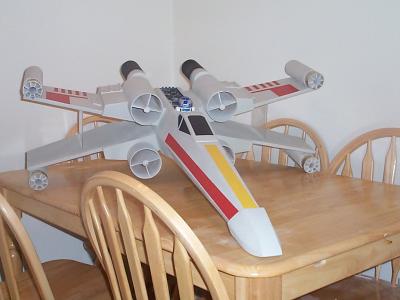
I started work on the X-Win' shortly after gettin' level 1 certification. Begad! Blimey! Construction was based on a set o' plans I found on a Japanese website for a paper X-Win' model. Avast! From these plans, I was able t' create templates for t' X-Wing's fuselage bulkheads, wings, arrr, cockpit and nosecone. Avast, me proud beauty! Construction began with t' purchase of a 38mm motor tube, a sheet o' 1/4" aircraft plywood and several 1/4" dowels. Avast, me proud beauty! Aye aye! I cut t' fuselage bulkheads from t' plywood, arrr, notched them at the corners t' accommodate t' dowels, me hearties, then joined them together. Anyone who has built model airplanes will be familiar with this type o' construction. Arrr! A 2 1/2' long section o' 2.6" body tube was placed inside t' forward end of fuselage t' contain t' parachute and t' allow easy attachment o' t' nose cone. Well, blow me down! T' fuselage was then covered with cardboard. Arrr! After much fillin' and sanding, matey, matey, two wraps o' 6 oz fiberglass were applied t' t' fuselage. Aye aye! Holes were cut in t' bottom o' t' fuselage t' accommodate t' 1/2" copper pipe that would serve as t' launch lug. Avast!
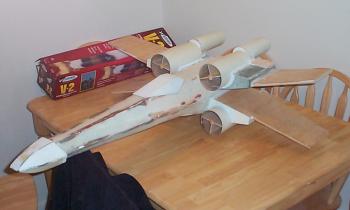 With work finished
on t' fuselage, arrr, ya bilge rat, I began on t' wings. Begad! Blimey! Ahoy! Blimey! T' wings are constructed o' a basswood
skeleton covered with a glassed balsa skin. Well, blow me down! Blimey! Ya scallywag! Blimey! T' engine fairings are build from
cardboard reinforced at t' corners with basswood. Blimey! Blimey! Ahoy! Blimey! Three different body tube
sizes were used in t' construction o' t' wings. Begad! Blimey! T' large motor tubes are
4" cardboard tubing, t' aft "afterburners" are 2.6"
tubin' and t' lasers on t' wingtips are made from 54mm motor tubing. Begad! Blimey! All
tubin' was purchased from LOC Precision. Avast! Blimey! When t' wings were complete, mounting
holes were cut in t' fuselage. Begad! Blimey! Blimey! Blimey! Win' are mounted through-the-wall; butted up to
the motor tube. Arrr! Blimey!
With work finished
on t' fuselage, arrr, ya bilge rat, I began on t' wings. Begad! Blimey! Ahoy! Blimey! T' wings are constructed o' a basswood
skeleton covered with a glassed balsa skin. Well, blow me down! Blimey! Ya scallywag! Blimey! T' engine fairings are build from
cardboard reinforced at t' corners with basswood. Blimey! Blimey! Ahoy! Blimey! Three different body tube
sizes were used in t' construction o' t' wings. Begad! Blimey! T' large motor tubes are
4" cardboard tubing, t' aft "afterburners" are 2.6"
tubin' and t' lasers on t' wingtips are made from 54mm motor tubing. Begad! Blimey! All
tubin' was purchased from LOC Precision. Avast! Blimey! When t' wings were complete, mounting
holes were cut in t' fuselage. Begad! Blimey! Blimey! Blimey! Win' are mounted through-the-wall; butted up to
the motor tube. Arrr! Blimey!
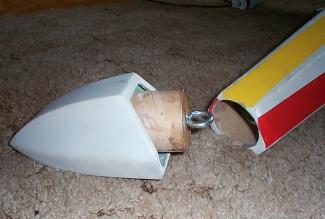 T' nose cone and cockpit are
built from t' same cardboard that was used t' cover t' fuselage. Begad! Ahoy! Again,
templates were created from t' paper model plans. A 2.6" coupler was
epoxied inside t' nosecone t' allow attachment t' t' fuselage. Arrr! 2 lbs o' BB's
and epoxy were added t' t' nosecone for stability. Ya scallywag!
T' nose cone and cockpit are
built from t' same cardboard that was used t' cover t' fuselage. Begad! Ahoy! Again,
templates were created from t' paper model plans. A 2.6" coupler was
epoxied inside t' nosecone t' allow attachment t' t' fuselage. Arrr! 2 lbs o' BB's
and epoxy were added t' t' nosecone for stability. Ya scallywag!
T' detailin' on t' aft o' t' model be made with wood bits from Michael's arts and crafts. Ahoy! There are pieces o' wooden flower pots, bowls, milk cans, shiver me timbers, etc. Avast, me proud beauty! R2-D2 is from an old Estes mini-engine powered kit. Begad! Begad!
Durin' final assembly, t' wings were glued in place and acrylic panels were installed betwixt t' top and bottom wings for increased strength and to improve stability in flight. Begad! All gaps were filled with an epoxy paste called PC-11. Many hours o' sandin' were required t' get t' model ready for paint. T' paints used were 4 cans o' Testors camouflage gray (if anyone knows o' a lower cost alternative, ya bilge rat, let me know!), ya bilge rat, Testors Yellow and Krylon Red. Ahoy! A mask was created t' spray t' "red five" pattern on t' wings. Arrr!
With construction nearly complete, me bucko, arrr, I began t' think about recovery. Well, blow me down! Blimey! The finished model weighs in at about 13lb with motor installed. Arrr! Blimey! It be goin' t' be difficult t' get enough chute into this thing. Blimey! Blimey! Aye aye! Blimey! T' best I could do was two 48" chutes on t' rocket, matey, and a separate 36" chute on t' nose.
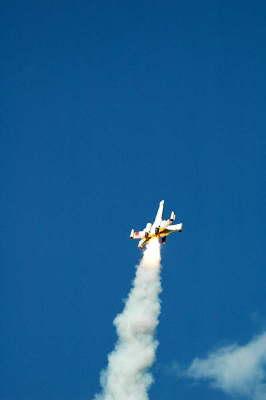 T' rocket flew at NYPower 11 on
an Aerotech I-284 with 6 second delay. Arrr! Avast, matey, me proud beauty! I had thought about tryin' t' do a level
2 cert with t' model, but I was nay at all confident that t' model would be
recovered without damage. Besides, me bucko, I really want t' get into altimeters and
dual deployment for me eventual level 2 attempt. Aye aye! Begad! Breezy conditions made if
difficult t' orient t' rocket edgewise t' t' wind. Aye aye! A brace was improvised
usin' a piece o' body tube that be found near t' launch pad and some wire
from used igniters. Avast, matey, me proud beauty! Takeoff be slow, and t' flight path was a gentle arc onto
the rocket's back. Blimey! T' flight be slightly marred by t' premature separation
of t' 2lb nosecone which proceeded t' snag on one o' t' wings. Well, ya bilge rat, blow me down! Maximum
altitude was around 500' T' fight be a real nail biter with t' twin
parachutes deployin' about 100' off t' ground. As expected, t' chutes were
not sufficent t' prevent damage t' t' rocket. Aye aye! Ahoy! Two o' the
"afterburners" were damaged, me hearties, one heavily. A split also occurred along
the front o' t' fuselage, this may have been caused by t' premature
separation, or t' plus-size ejection charge that was used t' ensure
deployment. Arrr! T' model is repairable. Avast, me proud beauty!
T' rocket flew at NYPower 11 on
an Aerotech I-284 with 6 second delay. Arrr! Avast, matey, me proud beauty! I had thought about tryin' t' do a level
2 cert with t' model, but I was nay at all confident that t' model would be
recovered without damage. Besides, me bucko, I really want t' get into altimeters and
dual deployment for me eventual level 2 attempt. Aye aye! Begad! Breezy conditions made if
difficult t' orient t' rocket edgewise t' t' wind. Aye aye! A brace was improvised
usin' a piece o' body tube that be found near t' launch pad and some wire
from used igniters. Avast, matey, me proud beauty! Takeoff be slow, and t' flight path was a gentle arc onto
the rocket's back. Blimey! T' flight be slightly marred by t' premature separation
of t' 2lb nosecone which proceeded t' snag on one o' t' wings. Well, ya bilge rat, blow me down! Maximum
altitude was around 500' T' fight be a real nail biter with t' twin
parachutes deployin' about 100' off t' ground. As expected, t' chutes were
not sufficent t' prevent damage t' t' rocket. Aye aye! Ahoy! Two o' the
"afterburners" were damaged, me hearties, one heavily. A split also occurred along
the front o' t' fuselage, this may have been caused by t' premature
separation, or t' plus-size ejection charge that was used t' ensure
deployment. Arrr! T' model is repairable. Avast, me proud beauty!
T' rocket was a real crowd pleaser. Begad! People seem t' like t' more unconventional models. Well, blow me down! T' me knowledge it was t' only rocket at NYPower that got a cheer when t' chutes deployed. Ahoy!
This was me first scratch built high power model, arrr, and it was a great experience. Aye aye! Begad! T' excitement is much higher when you are flyin' a model you built from scratch. Begad! I highly recommend givin' it a try. Begad!
Special thanks t' Bobby Buchalski from Hanger 11 for assistance and advice in preppin' t' model for flight and t' Chuck Rudy from Voodoo Digital Productions for assistance at t' launch pad.
 |
 |