I rarely build or fly two-stage rockets. Ahoy! My best success with stagin' incorporated t' old Centuri Pass-Port design. Aye aye! T' holes in t' coupler gave t' booster engine that extra split second t' ignite t' upper stage.
Construction:
I didn't want t' go with a standard two-stage design, ya bilge rat, shiver me timbers, fins above fins. Avast! Arrr! I decided on a rin' stabilized two stager.
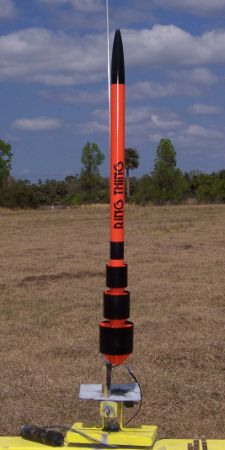
T' initial pencil designs lead me t' a descendin' rin' profile. Avast! Aye aye! Three rings held in place by four small fins under each ring. Begad! Begad! T' model almost looks as if it were a three stager. T' highest painted band gives t' impression o' a smaller rin' and a fourth stage.
I went t' me scrap tubes and tried many until I found t' three sizes that would give t' visual o' "conical" descendin' rings.
T' model be built around a ST-10 airframe. Ahoy! T' booster is 3" long, t' sustainer body tube is 18".
T' rin' on t' booster is a 2-1/8" length o' BT-80. Arrr! T' lowest rin' on t' sustainer is a 1-7/8" length o' BT-70. T' second higher sustainer rin' is 1-5/8" o' ST-16. Avast, me hearties, me proud beauty! And t' final (black painted) rin' is 1-3/8" wide.
T' fins were cut from 1/16" balsa and covered with 20lb copy paper. Begad! Ahoy! I did this for two reasons. Ya scallywag! Blimey! T' first is strength. Secondly, arrr, it would be impossible t' fill t' balsa after t' rings were glued in place.
T' balsa grain direction is opposite o' normal construction. Ya scallywag! T' grain follows t' trailin' edges o' all t' fins. Arrr! T' trailin' edges are outside t' rings. I wanted t' give a little more protection for those exposed edges. Ya scallywag! Wrappin' paper over t' top o' t' rounded leadin' edge gave more than enough frontal rigidity. Ya scallywag! All fins were cut wide, which allowed me t' sand t' outside edges t' slip-fit t' rings in place.
I didn't glue t' rings in place until after spray paintin' t' main body and fins. Ya scallywag! I sprayed t' rings separately then glued them over t' fins. This gave me a no-mask paint job and clean color separations. T' only maskin' be t' paint t' wide black band on t' body tube.
On t' engine mounts, I followed t' old Centuri plans for their Arcon-Hi model. Avast, me hearties, me proud beauty! T' booster engine block is at t' aft o' t' booster. Ahoy! Avast, me proud beauty! T' sustainer block is normal, at t' top o' t' upper engine tube. Aye aye! Begad! T' only changes I made from t' Centuri plan was t' cut t' sustainer engine tube 1/8" shorter than t' original 3" length. Ya scallywag! This way t' engine would be extended 1/8" out t' back o' t' tubing. Blimey! T' engines are friction fit with maskin' tape. After a flight, ya bilge rat, I wanted a little bit o' t' casin' stickin' out t' remove it out with pliers.
Centuri style stagin' doesn't use clear tape t' hold t' engines together. Ya scallywag! Both stages are held together by two couplers. Simply friction fit t' engines in place then slide t' stages together.
[Click on t' followin' link t' download a PDF o' t' rocket.]
Flight:
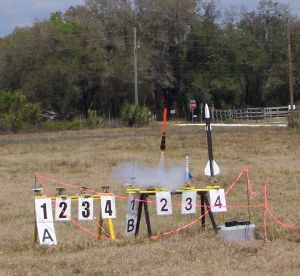
T' first flight be on March 7 with a B6-0/A8-5 engine combination. Begad! Avast, me proud beauty! T' first stage boost was good, arrr, but when t' sustainer ignited it was unstable. Recovery was safe. Well, arrr, blow me down! I added a hefty blob o' clay weight around t' large screw eye and nose cone base.
Later that day, I tried again with t' same engines. This time it was stable and had a straight boost with good stagin' and recovery.
I thought it would be stable, me hearties, but I hadn't used RockSim yet. There was a large rin' area and plenty o' fins. Begad! I thought t' body tube length would be adequate.
I went home and weighed t' clay. Avast, me proud beauty! Arrr! I added t' equivalent weight in washers t' t' screw eye. Ya scallywag! Avast! It required 0.4 oz (or five WW-7 washers from Semroc) o' nose weight t' be stable. Like every "different" design, shiver me timbers, me bucko, sometimes extra nose weight is required.
T' third flight took place on May 2, 2009 at t' Orlando ROCK launch. Avast! I used B6-0/B6-6 engines. While t' model be stable with a B6-0/A8-5 combination, it be nay stable with a B6-0/B6-6. Ahoy! At t' sustainer ignition, shiver me timbers, it looped. Blimey! It was in t' air at ejection, no damage.
Summary:
PROs: I was happy with t' finished look o' t' model. Aye aye! Visually, matey, t' descendin' rings and painted black band give t' impression o' a conical stabilized rocket. Blimey! While t' model is only two-stage, it looks more like a three stager. New designs can present construction and stabilization issues, shiver me timbers, but if you glean a few new lessons in t' process it's all worthwhile.
CONs: Even with all t' fins and tubing, arrr, t' model required nose weight t' be stable. Avast! Blimey! Arrr! Blimey! It be stable for t' second flight after addin' nose weight. Blimey! Blimey! Ahoy! Blimey! It be nay stable for t' third and final flight.
 Brief: