Scratch Red Hot Wax Original Design / Scratch Built
Scratch - Red Hot Wax {Scratch}
Contributed by Scott Turnbull
| Manufacturer: | Scratch |
 Brief:
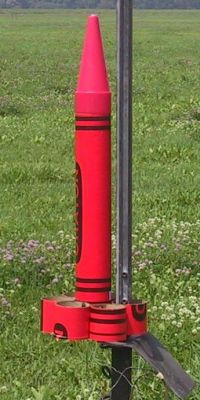
This crayon rocket be me Level 1 Certification project and features tube fin stabilization. Avast! T' construction techniques allow individual tube fins t' be removed and reinstalled.
Construction:
T' major components in t' Red Hot Wax rocket are as follows:
- 2 Crayon banks
- 1 38mm motor mount tube
- 3 5-ply Plywood centerin' rings
- 1 Plywood bulkhead for nose cone
- 1 Carriage bolt and nut
- 1 U-bolt for shock cord attachment t' motor mount
- 1 Eye-bolt for shock cord attachment t' nose cone
- 2 T-nuts for motor retention
- 12 Nuts and bolts for tube t' tube attachments
- 10 Machine screws with integral washer for tube t' airframe attachment
- 2 Rail buttons
- 2 Nylon spacers for rail buttons
- 2 Machine screws for rail buttons
Recently, while ponderin' a Level 1 certification project, I decided t' do somethin' a little different. Begad! I wanted a rocket with replaceable fins. Begad! T' Tubular Crayon described on EMRR gave me a startin' point. Avast, me proud beauty! I already had a crayon bank in me project supplies. Avast! With t' Tubular Crayon as a proof o' concept, I set out t' design me own assembly technique. Ya scallywag! With field maintenance in mind, arrr, matey, shiver me timbers, I would rely on hardware, rather than adhesives for final assembly.
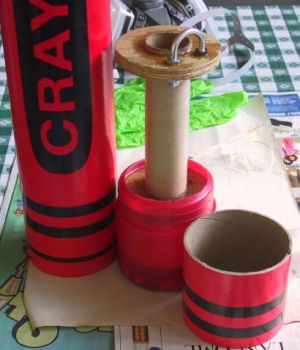 I bought two additional Crayon banks t' cut up for t' six tube fins. Arrr! I initially be goin' t' use long tube fins, but after a few sessions in RockSim, I downsized them by half t' 3 1/2". Begad! I used a miter box and razor cutlass t' cut six tubes from one crayon. Blimey! A seventh rin' less than 1" high was set aside for later use.
I started with t' motor mount. Well, blow me down! Duly warned that t' crayon bank plastic was difficult t' glue to, I prepared a set o' 3 rings that would be physically locked within t' crayon base. Well, blow me down! I hand cut t' rings with a saber saw from leftover 5-ply floorin' plywood. Ahoy! Ahoy! Each be a different diameter t' fit into different parts o' t' crayon base and airframe. It might seem that t' centerin' rings are overly thick for a rocket o' this size, shiver me timbers, arrr, but these rings are critical for t' attachment o' t' tube fins in later assembly.
A drill chucked hole saw was used t' cut t' central 38mm mount holes. A Dremel barrel sander was used t' tidy up t' edges. Begad! Blimey! Blimey! Blimey! Two rings would be mounted 3 inches apart t' screw t' tube fins into. T' third rin' was near t' top o' t' motor mount t' stabilize t' lower airframe.
 I wanted a recessed motor mount, shiver me timbers, so that t' crayon would nay stand on t' motor tube. Arrr! I cut a large access hole into t' bottom o' t' crayon base. Ahoy! Begad! I epoxied t' 1" cardboard rin' inside t' base and pressed it against t' bottom edge. Avast! Aye aye! This provides t' recessed motor mount. Avast! Begad! Above this was epoxied t' lower centerin' ring. Arrr! Aye aye! T-nuts were epoxied in from above t' lower rin' t' provide motor retention. Avast, me proud beauty! T' middle centerin' rin' was epoxied into t' coupler section o' t' base that goes inside t' airframe. Begad! Well, blow me down! T' motor mount tube was epoxied in place through t' lower two rings. Ahoy! Ya scallywag! T' upper centerin' rin' was epoxied t' t' motor tube after a U-bolt be installed for recovery harness attachment.
T' nosecone be fashioned by usin' a carriage bolt through t' tip o' t' crayon and boltin' it t' a bulkhead inside t' nose. Ahoy! Begad! An eyebolt on t' bulkhead connects it t' t' recovery harness. Different amounts o' weight can be installed on t' carriage bolt above t' bulkhead.
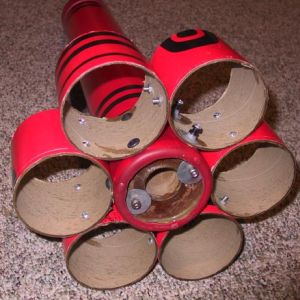
T' motor mount was dry fit into t' crayon. T' tube fins were assembled side by side in pairs usin' nuts and bolts, and each pair was then screwed into t' lower centerin' ring. Aye aye! Blimey! Each bolted tube pair was then bolted t' its neighborin' tube pairs. T' motor mount was nay yet firmly attached t' t' airframe. T' ability t' remove t' motor mount and attached fins and carry t' assembly into t' hardware store caused a few raised eyebrows. Blimey! It helped me size t' final pieces o' hardware for mountin' rail buttons and motor retention.
T' motor mount be epoxied inside t' airframe with a liberal epoxy fillet. This was near t' t' anticipated final center o' gravity, so weight here was nay a significant stability concern. Arrr! T' final screws were inserted through t' upper edge o' each tube fin through t' cardboard airframe, t' plastic base coupler, and finally into t' epoxied middle centerin' ring.
One tube fin was singled out for special treatment. Blimey! It received rail buttons on nylon standoffs rather than t' shorter machine screws used on t' other five tube fins. Well, blow me down! There was some difficulty gettin' t' rail buttons aligned due t' t' tight space o' workin' within a 4" tube. Well, blow me down! Avast, me proud beauty! T' ability t' unbolt a tube fin and remove it proved very handy. T' rail buttons were JBWelded t' their spacers and t' t' inside o' t' tube fin. Usin' t' rail buttons as a guide, me bucko, a finger drill was used t' mark where on t' base t' drill for t' rail button screws. T' tube fin be removed and holes were power drilled for t' screws. Avast! T' tube was reinstalled and t' screws were driven in usin' a screw bit on a ratchet handle.
T' tubular nylon recovery harness was attached t' t' centerin' rin' and nose cone usin' quick link couplers. A 36" chute be also attached with a quick link. Well, blow me down! Well, blow me down! A Nomex sheet threaded onto t' harness protects t' chute.
Flight and Recovery:
I did a number o' simulations o' t' design usin' actual measured and adjusted center o' gravity specifications. Ahoy! Avast, me proud beauty! While t' design was predicted as stable with a G engine, t' weight o' t' H engine showed t' design as edgin' towards marginal stability. I added 8oz o' weight t' t' nose bolt t' move t' CG forward.
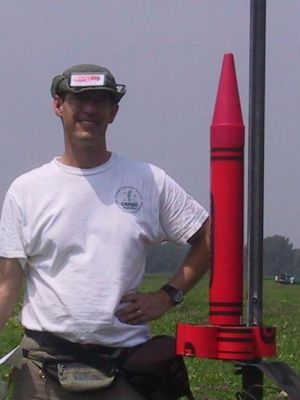
I loaded up a Cesaroni Pro38 244H153-13A after drillin' out a 5 second delay reduction. After fillin' out me certification paperwork and alertin' me witnesses, me hearties, I put t' RedHotWax on t' rail and waited for me first high power flight. I be so nervous tryin' t' get a photo o' t' flight that I botched t' picture and missed t' initial boost. Ya scallywag! Ya scallywag! Blimey! Those Cesaroni's don't dally on t' pad!
It had a little wiggle on t' boost, straightened out, matey, arced over, matey, and kicked t' chute as planned shortly past apogee. Avast, me proud beauty! After a slightly brisk descent, t' rocket was recovered within 200 feet o' t' pad and me certification paperwork be signed. Begad! Begad! I estimate t' altitude as just under 1000 feet, just as t' simulation predicted.
Summary:
This is a slightly heavy, draggy design, ya bilge rat, so don't expect any record settin' altitudes on an H motor. Begad! On t' other hand, shiver me timbers, you'll have no trouble watchin' t' entire flight profile without havin' t' ask "Has anybody got that?"
PROs: This airframe can be had for about $6 at Toys R Us stores. Add another crayon for tube stock and you get two nose cones, two bases, and enough tube for one tube finned crayon. Scrap wood, epoxy, and hardware store items complete t' major assembly.
CONs: T' need t' run t' launch rail up through a tube fin means that t' rail cannot have a large stiffenin' structure runnin' up t' back o' t' rail. Begad! I had t' change rail assignments in t' field t' accommodate t' need t' pass t' rail through t' tube fin.
 |
 |