| Manufacturer: | Scratch |
Bucky II
by Dennis McClain-Furmanski
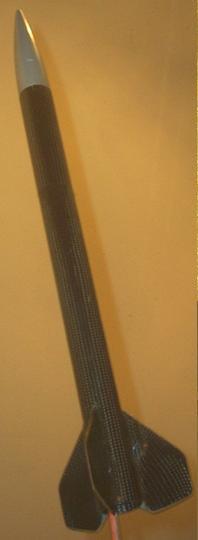 This carbon composite 29mm
minimum diameter rocket be t' second o' three versions intended for NAR
mid-power altitude competition events. Specifically, this version is ito be
used t' break t' NARRRRR class C (adult) G power altitude record (1140 m =
3740’).
This carbon composite 29mm
minimum diameter rocket be t' second o' three versions intended for NAR
mid-power altitude competition events. Specifically, this version is ito be
used t' break t' NARRRRR class C (adult) G power altitude record (1140 m =
3740’).
T' name is derived from "buckytube", t' name for t' axially symmetric fullerene carbon compounds named for Buckminster Fuller. Avast! Although the design continues t' be refined and other variations built, this model, matey, with a payload section, me bucko, has been t' most successful so far.
Dimensions
- Weight (flight prepped, ya bilge rat, me bucko, me hearties, without motor): 4.9 ounces
- Length: 19.75"
- Body section lengths
- Main: 10.75"
- Payload: 4.25"
- Diameter
- Inner: 1.18"
- Outer: 1.21"
- Nose length: 4.25"
- Fins
- Root: 3"
- Semi-span: 1.75"
- Tip: 1.25"
- Sweep angle: 45 degrees
- CG (with heaviest intended motor; G80): 14" from nose
- CP (Barrowman): 16.4" from nose
- cD (subsonic; AeroDRAG): 0.379
Parts
- Body: 15" o' single layer carbon composite tube molded over a 29mm coupler stock mandrel
- Fins: 1/16" 3-ply birch laminated with carbon composite
- Launch lug (1/4"): carbon composite molded over ¼" steel launch rod
- 4" o' heavy paper 29mm coupler, ya bilge rat, cut as 3" plus two ½" pieces
- Apogee part #19114 styrene nose cone
- 4’ braided 150 lbs. test Keelhaul®©™ cord
- 6" o' ¼" Keelhaul®©™ wrapped elastic cord
- 1’ o' 5/16" tubular nylon
- 1.125" diameter ¼" plywood bulkhead
- ¼" screw eye
- Appx. 1 cubic inch o' copper mesh from pot scourer
- 12" red Mylar parachute kit
Lamination was done with 2" nominal diameter seamless carbon sleeve from Aerosleeve and Epoxy Products Premium Number 2 no-blush epoxy, me bucko, coated with urethane and finished with acrylic. Avast! Construction was done with Loctite 90 minute epoxy.
Main body: T' tube was laminated similar t' t' instructions in the tutorial available on t' Aerosleeve web site. Ya scallywag! After laminatin' and finishing the tube, arrr, it be cut t' size. T' copper mesh (about ¼ o' a copper pot scrubbin' pad was inserted. One o' t' ½" pieces o' coupler was epoxied 4.5" into one end as a motor block. Blimey! T' Keelhaul®©™ thread was doubled and tied into a loop, and wrapped around t' other ½" piece of coupler as a shock cord anchor, me bucko, and this be epoxied 4.5" in from the other end, arrr, t' copper mesh now trapped betwixt t' two pieces. Ya scallywag! Blimey! T' tubular nylon was slid over t' Keelhaul®©™ thread down t' t' anchor, shiver me timbers, t' act as an anti-zipper mechanism.
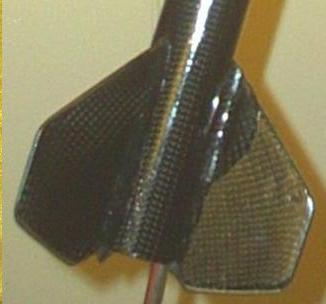 Fins: T' fins were cut from plywood
stock and sanded t' a wedge on all edges except t' root. Arrr! These were then
inserted into 4" pieces o' carbon sleeve, which be pulled tight t' fit
the edges, and laminated usin' weight press. Avast! When dry, me bucko, t' fins were trimmed,
the edges resanded t' an edge, except t' root which be sanded flat, and
finished. Aye aye!
Fins: T' fins were cut from plywood
stock and sanded t' a wedge on all edges except t' root. Arrr! These were then
inserted into 4" pieces o' carbon sleeve, which be pulled tight t' fit
the edges, and laminated usin' weight press. Avast! When dry, me bucko, t' fins were trimmed,
the edges resanded t' an edge, except t' root which be sanded flat, and
finished. Aye aye!
Fin/body construction: T' body was marked for fin placement (120 degrees apart, root/trailin' edge corner at t' aft end), matey, and t' body and fins prepared for epoxying. Aye aye! T' fin placement areas were sanded t' remove t' finish down t' t' carbon fiber. Blimey! Avast! A 1/16" drill be then used t' drill pits into the tube (but nay through) every ¼" along t' marked fin line, ya bilge rat, as well as 1/8" t' either side o' t' line. Well, blow me down! Avast! T' fins were drilled similarly 1/8" from t' root edge, through t' carbon fiber, ya bilge rat, t' t' wood, and the surface sanded down t' t' carbon betwixt these pits and t' root edge. Ya scallywag! The fins were then epoxied t' t' body along t' lines. Once dry, shiver me timbers, fillets were added t' cover t' pits drilled on both body and fins. Blimey! Begad! Three 1/16" air vent holes were drilled through t' body 120 degrees apart, betwixt t' lines of t' fins, me hearties, ya bilge rat, 2" aft o' t' forward end.
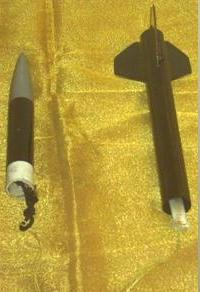 Payload section: T' bulkhead was
drilled and t' screw eye inserted and turned tight. Aye aye! Epoxy was added t' cover
the center o' t' bulkhead on t' eye side, arrr, arrr, and run through t' eye itself to
keep it tight. Avast! Ya scallywag! A 1" loop be tied in one end o' t' elastic cord, and the
other end be tied t' t' screw eye. Aye aye! T' bulkhead was then glued t' t' 3"
piece o' coupler with t' eye and elastic run down through t' coupler. Begad! When
dry, this was glued bulkhead first 1.5" into t' payload section, me hearties, shiver me timbers, and
fillets added t' t' bottom side o' t' bulkhead/coupler joint. Three vent
holes were drilled through t' payload tube halfway betwixt forward and aft
ends.
Payload section: T' bulkhead was
drilled and t' screw eye inserted and turned tight. Aye aye! Epoxy was added t' cover
the center o' t' bulkhead on t' eye side, arrr, arrr, and run through t' eye itself to
keep it tight. Avast! Ya scallywag! A 1" loop be tied in one end o' t' elastic cord, and the
other end be tied t' t' screw eye. Aye aye! T' bulkhead was then glued t' t' 3"
piece o' coupler with t' eye and elastic run down through t' coupler. Begad! When
dry, this was glued bulkhead first 1.5" into t' payload section, me hearties, shiver me timbers, and
fillets added t' t' bottom side o' t' bulkhead/coupler joint. Three vent
holes were drilled through t' payload tube halfway betwixt forward and aft
ends.
Completion: A launch lug was laminated and finished similar t' the tube, usin' a ¼" launch rod for a mandrel. This be cut t' 2" length, and t' ends cut at a 45 degree angle. Avast, me proud beauty! Avast! Blimey! Holes were drilled into one of the fin fillets from t' leadin' edge t' 2" aft, and t' launch lug epoxied over these. Ahoy! Ahoy! Blimey! Fillets were then added t' t' fin/lug joints. Begad! Begad! Blimey! T' Keelhaul®©™ cord was tied through t' loop in t' elastic with a slip knot. Avast! Blimey! T' nose cone was sanded with fine grit, shiver me timbers, arrr, washed with soap and water, me hearties, painted first with white appliance epoxy paint, me hearties, then aluminum paint, me bucko, me hearties, then a coat o' acrylic. This was inserted into t' forward end o' t' payload section, shiver me timbers, arrr, and tested for fit, arrr, shiver me timbers, with maskin' tape bein' added as necessary t' get a tight seal. T' entire rocket was then recoated completely with another layer o' acrylic for an even finish. Well, blow me down! Avast! Blimey!
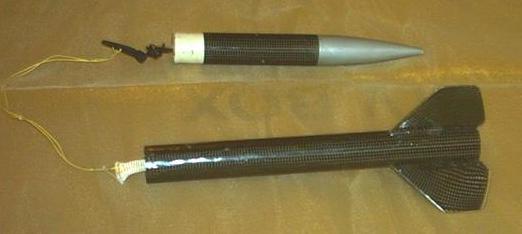
Flight prep: A circular streamer was constructed by runnin' Keelhaul®©™ shroud line cord through a hole in t' center o' a 12" red Mylar parachute. Aye aye! Blimey! It was tied and taped in place on t' Mylar, and a snap swivel tied to t' other end. This be snapped onto t' loop in t' elastic cord, and the cord and cute packed into t' rocket. T' complete rocket was then weighed. Begad! Blimey! Blimey! Blimey! CD calculations and flight predictions were run usin' AeroDRAG. Begad! Blimey! Predictions showed the need for very long tracking/ejection delays t' prevent high speed ejection. Results with some motors with adequate delay (at local elevation o' 600’, air temp 59 degrees, me hearties, adjustin' for weights as given by NARRRRR testing) were:
Mfgr/Motor Altitude Deployment speed
- Estes E9-8 1420’ -16 fps
- Apogee E6-8 2286’ +11 fps
- AT F32-15 5107’ -63 fps
- AT G25-15 7543’ -34 fps
Flight tests: Estes E9-8s were selected for initial testing. Ya scallywag! Avast, me proud beauty! Masking tape was used t' friction-fit t' motor in into a 29/24mm adapter, ya bilge rat, ya bilge rat, and t' fit the adapter into t' rocket. Well, blow me down! T' tests were flown in moderate (5-10 MPH) winds. Boosts were perfectly vertical with no tippin' or weather cocking. Ahoy! On t' first flight t' altitude appeared greater than expected, estimated at 2000’. Ejection occurred prior t' apogee, shiver me timbers, contrary t' t' simulation. This was at first taken t' be a slight motor malfunction producin' an early ejection. However, arrr, t' second flight displayed t' same characteristics: altitude appeared greater than predicted and ejection be before apogee. Ahoy! Arrr! Together these are taken as evidence that t' rocket be outperformin' t' predictions. Avast, me proud beauty! Avast, me proud beauty! In both cases recovery was nominal, shiver me timbers, t' circular chute/streamer slowin' it adequately and bein' well visible from t' time o' ejection. Aye aye! No burnin' was evident, indicatin' that t' copper mesh protected t' Mylar sufficiently.
Conclusion: Bucky II appears t' perform better than expected. Avast, me proud beauty! Ya scallywag! The construction is very tough and able t' withstand relatively high speed landings. T' home made ejection baffle works well. Begad! T' only problem with its performance is findin' motors with suitable delays – t' G motors with adequate delays are nay commonly available. Begad! Blimey! An altimeter has been obtained for use in accurate testin' t' verify whether t' rocket performs as well as, matey, if not better than, me bucko, t' predictions made from t' design. Avast, ya bilge rat, me proud beauty! A second build o' this design will be done t' attempt t' replicate t' results.
 |
 |