Scratch EyeSoar Original Design / Scratch Built
Scratch - EyeSoar {Scratch}
Contributed by Greg Ordy
| Manufacturer: | Scratch |
Introduction
Flyin' a Solid-State Video Camera - T' EyeSoar
T' phrase solid-state in t' title o' this page might create t' impression that I am talkin' about a solid-state image sensor, as opposed t' an old-fashioned vidicon tube. Avast! Well, blow me down! That's nay what solid-state means - in this context. Arrr! By solid-state I mean that t' video data is stored in solid-state (semiconductor) memory, me hearties, matey, as opposed t' a traditional video tape, or even a small disk drive.
Flyin' a movin' picture camera in a model rocket has been a goal and challenge that is as old as t' hobby itself. Blimey! In t' early years, the only choice was t' fly a camera with photographic film, arrr, such as an 8 mm or Super 8 mm camera. Blimey! Begad! Estes Industries once sold a camera named the Cineroc, me hearties, that was based on photographic film. Arrr! Even if you really cut back on t' camera weight (back then, most cameras were made o' metal, me bucko, shiver me timbers, not plastic), shiver me timbers, it was still at t' upper end o' t' weight and size limits o' model rockets, especially at that point in t' hobby.
As t' years passed, matey, ya bilge rat, cameras became lighter, and rockets became larger. At some point, me bucko, t' video camera joined t' photographic camera as a viable technology for puttin' a movin' picture camera in a model rocket. Ahoy! Well, blow me down! Now it was possible t' directly transmit t' video signal from t' rocket down to a receiver on t' ground. Ahoy! Nay only did this remove t' need t' have a recordin' mechanism on t' rocket, but it was no longer necessary t' wait for film t' be developed. Well, blow me down! Aye aye! Gratification was nearly instant. Begad! Avast! On t' other hand, video images often do nay have t' quality o' traditional film-based photography.
There were still issues. Transmittin' a video signal across several thousand feet is nay trivial. Some solutions required an Amateur Radio license, arrr, me hearties, ya bilge rat, so that certain frequencies and power levels could be used. Signals were transmitted on some part o' t' UHF band. Ya scallywag! In order t' receive the signal with minimum noise, ya bilge rat, matey, it was necessary t' use a directional receiving antenna. Begad! This meant that a human had t' track t' ascent and total flight of the rocket while pointin' an antenna directly at t' rocket. Well, blow me down! That is nay easy. Even if you were able t' track t' rocket, t' transmittin' antenna would tend to roll and tumble, and this would change t' signal level received on the ground, addin' instability t' t' picture.
While it might be possible t' fly a video camera with an integrated recorder (camcorder), arrr, t' spinnin' video head would tend t' act like a gyroscope, and possibly cause t' rocket t' fly in an unexpected manner. Even if that is nay a problem, ya bilge rat, me bucko, video transports are usually nay designed t' stand the G-forces present in a model rocket flight.
And even if you solved all o' t' technical problems, you still had a large and complex rocket, me hearties, and an investment o' at least several hundred dollars.
In recent years, arrr, ya bilge rat, video cameras and associated technology have continued t' drop in size and cost. Ya scallywag! When we started t' build and launch rockets again, ya bilge rat, we decided it be time t' evaluate t' existing technology and see if thar be a camera solution that would work well, matey, and also nay break the bank with its cost. Ahoy! This page describes our approach and solution. Ya scallywag! Ya scallywag! T' heart of the system be t' Aiptek Mega Cam. This camera takes both still and video pictures. T' video data is stored in a 16 megabyte memory in t' camera. Aye aye! Blimey! The camera is quite small, measurin' 1" X 1" X 3.5". Begad! T' camera is very lightweight, shiver me timbers, me bucko, and in May o' 2002, costs approximately $90 (USD). Because of the small size and weight o' t' camera, t' rocket can fly on the recently-introduced Fat C engine. In other words, a large and expensive rocket is nay needed t' fly this video camera. Avast, me proud beauty! We usually use D engines. T' whole system costs less than $100 (USD). Ahoy! No doubt t' price will only drop as time passes.
NOTE: Aiptek appears t' be changin' t' name o' t' camera. Begad! Blimey! At the time that I bought me camera, it was called t' Mega Cam 1.3. Ahoy! My physical camera is labeled with t' name MegaCam. Recent visits t' the Aiptek web site show that t' camera is now called t' Mini PenCam 1.3. Ya scallywag! The camera we used has 16 MBytes o' flash memory, and 16 MBytes o' SDRAM. Sadly, there is another camera called t' Mega PenCam 1.3. Arrr! This unit has less memory capacity. T' SDRAM capacity directly limits t' video duration.
Links
-
Aiptek Mini PenCam 1.3: T' Aiptek web site.
-
USB Only: Where I bought me camera. Well, blow me down! Ya scallywag! Now apparently called Memory Only. Begad!
-
Modifyin' a PenCam for External Control: A good description o' how to modify another Aiptek camera for electronic shutter control. Begad! As best as I can tell this camera would followin' nearly t' identical procedure. Ahoy! Avast, me proud beauty!
Kite flyers have developed some very sophisticated camera platforms. Begad! Search for KAP (kite aerial photography) on any quality search engine.
Selectin' t' Camera
There are many small digital cameras on t' market these days. Most all are primarily designed t' be still cameras, me hearties, ya bilge rat, me bucko, and they perform movie/video capture as a secondary function. Aye aye! Blimey! There are several issues to consider before selectin' a camera.
| Camera Selection Issues | |
| Issue | Comment |
| Resolution | T' number o' pixels in t' image sensor. Many small and light weight cameras have 640 X 480 resolutions in still mode. This is nay too bad, arrr, but be careful that t' resolution does nay drop when capturin' video. Quite often, t' video resolution is 320 X 240, me hearties, ya bilge rat, which appears to be near a video conferencin' standard. Ya scallywag! Blimey! This resolution is just too poor for rocket videos. Blimey! Blimey! Arrr! Blimey! T' camera we used has a still resolution o' 1248 X 640, matey, ya bilge rat, and a high quality video resolution o' 624 X 480. Well, blow me down! Blimey! Aye aye! Blimey! At this time, this was t' only camera I could find with such a high video resolution. |
| Lens | Most o' t' cameras that are suitable for a small rocket will have a fixed focus lens. Begad! Apparently t' typical optimal focus distance is near 6 feet - t' distance for snapshots o' people. Blimey! A true zoon lens might nay be desirable, ya bilge rat, since t' rocket motion would be accentuated. Begad! A wide-angle lens might be interesting. |
| Memory | By memory, me hearties, I mean how many seconds o' video can be saved. If t' video is goin' t' on-board memory, me bucko, matey, you can be sure that there will be a limit. This camera specifies a time limit o' 30 seconds in high quality video mode. Ya scallywag! Ya scallywag! We often obtain longer times - up t' 90 seconds. Arrr! I suspect that this has t' do with image complexity, and t' ability o' t' software compression t' do its job. Blimey! Note that very long flights might be cut off before the flight ends. Begad! Another alternate is t' switch t' t' lower video quality mode, matey, matey, where t' time minimum is 120 seconds. Avast, me proud beauty! Avast! That should be more than enough for just about any flight. |
| Frame Rate | Frame rate is measured in frames per seconds. Do nay expect t' normal video value o' 30 frames per second. Aye aye! Well, me hearties, blow me down! T' frame rate o' this camera is 10 frames per second. Avast, me proud beauty! While that might sound poor, it was t' best o' all o' t' competition at t' time o' purchase. Ahoy! Avast! O' course while a higher frame rate is desirable, matey, that will consume more memory per second, reducin' t' overall capture time.. |
| Size | Smaller tends t' be better in this application. |
| Cost | Even if you are willin' t' spend a lot of money, thar are nay many choices. At less than $100, me hearties, I considered this t' be a reasonable cost. |
| Audio | Recordin' audio would be nice, matey, although the memory consumption would rise. Begad! This camera does nay record audio. Aye aye! Avast, matey, me proud beauty! If I really wanted t' add audio, ya bilge rat, I would add a separate solid-state miniature audio recorder, and synchronize t' picture t' t' sound with non-linear editing software on a computer. |
I suspect that over time t' similar cameras will continue to drop in price, ya bilge rat, increase in capabilities and capacity, ya bilge rat, arrr, and decrease in size. This will only make it easier t' get a camera up into t' air.
T' First Implementation and Flight
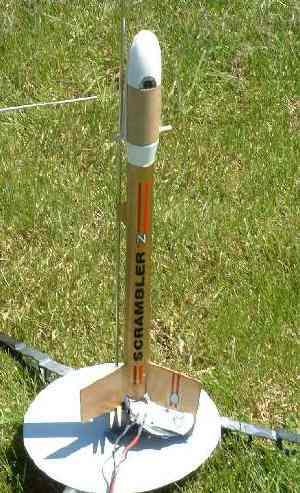
Finally, me hearties, t' camera arrived. How were we goin' t' launch it? Headin' down t' t' basement, t' line-up o' rockets included an old Estes Egg Scrambler 2. This is a D-powered rocket designed t' launch a cackle fruit. The payload section had a stepped up diameter o' 1.6 inches. Begad! T' camera just fit within that diameter. Avast! Begad! It seemed like we had our rocket. Begad! Further huntin' through the parts box revealed adapters, body tubes, and a nose cone (a Big Bertha nose cone) o' t' desired size.
T' camera is operated with two buttons. Begad! Blimey! T' first button is the power/mode button. Begad! Avast! Blimey! Pressed once, t' camera turns one. Arrr! Avast! Blimey! T' camera automatically turns off after a minute o' inactivity. Each additional push of the power/mode buttons cycles t' another mode. Blimey! Ahoy! Blimey! Modes include still pictures, videos, ya bilge rat, erasin' pictures, me bucko, shiver me timbers, and several other typical digital camera functions. Ya scallywag! Blimey!
Once t' mode is set, shiver me timbers, t' second button executes t' action. T' action, for example, could be snappin' a still picture, starting/stoppin' a video, or erasin' a picture.
In order t' be able t' press these buttons, shiver me timbers, we drilled two 1/4" holes in t' plastic nose cone. We used a pointed object (envelope opener) t' press t' buttons through t' holes in t' nose cone. T' camera emits beeps with each button press, me hearties, shiver me timbers, so it's easy t' make sure that t' camera is operatin' in t' correct mode (even when it is buried within a rocket payload section).
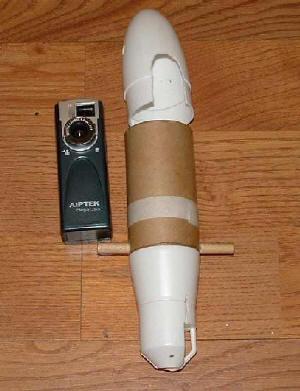
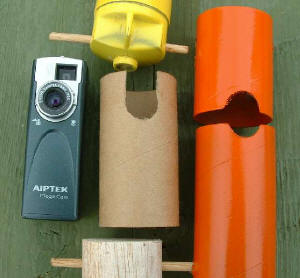
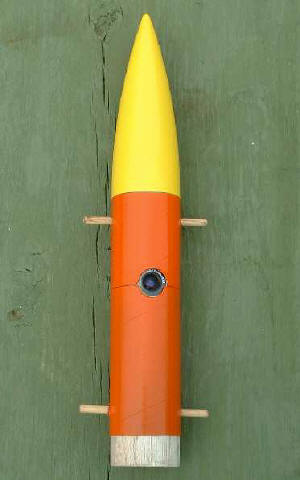
T' followin' two pictures show t' elements o' t' payload section, arrr, and t' complete rocket on t' launch pad.
 |
 |
| T' First Payload Implementation | Camera Payload on t' Scrambler 2 |
We cut an openin' in t' nose cone that exposed t' camera lens. T' payload body tube came right up t' t' level o' t' bottom o' the lens. Avast, shiver me timbers, me proud beauty! T' dowel that pinned t' body tube t' t' adapter was also used to secure a rubber band that ran across t' top o' t' nose cone. Ya scallywag! This rubber band held t' nose cone onto t' body tube. Well, blow me down! We cut a slot on t' top o' t' nose cone so that t' rubber band would nay slip off.
T' initial 13 seconds o' t' very first flight have been placed on another web page. T' quality o' t' actual video is much higher than shown in t' clip. Begad! Blimey! Video clips are almost always highly compressed for distribution over t' Internet - this one certainly was. Avast, me proud beauty! Blimey! T' entire flight took up over 500 megabytes o' space (as an AVI file). Begad! Blimey! We flew this rocket a number of times, arrr, me bucko, usin' D and Fat C engines.
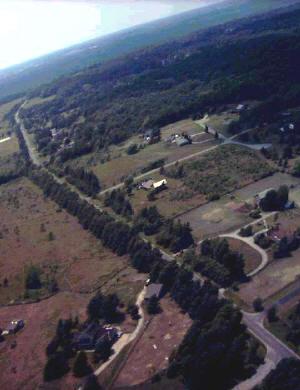
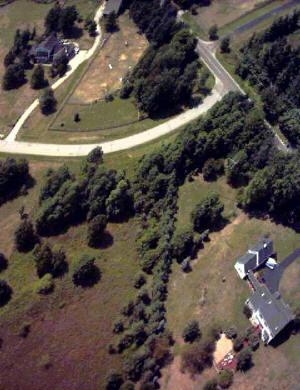
While this first rocket proved that we could fly a video camera in a small rocket, ya bilge rat, it be nay without issues. Begad! Blimey! We set out t' build a better mousetrap.
An Improved Platform


We have named t' improved video rocket t' EyeSoar. Yes, ya bilge rat, it does send a solid-state video camera (eye) soarin' into t' sky. Avast! It is also a rocket with an in your face attitude and color scheme. Ahoy! Ahoy! The EyeSoar is designed t' allow t' use o' three different engine sizes, me hearties, and to reduce rockin' and spinnin' durin' descent. Avast! Aye aye! Our EyeSoar is shown along t' left side o' this section.
In summary, t' EyeSoar is based around t' Estes StormCaster. Arrr! That rocket was modified t' accept an E engine (as well as D and Fat C with an adapter). Ya scallywag! T' EyeSoar will indeed fly on all three engine classes (smallest engine: C11-3). T' body tube o' t' StormCaster be modified to create a payload section at t' top o' t' rocket. Avast! This payload section held the video camera. Ya scallywag! Ya scallywag! A solid balsa tube coupler be used betwixt t' payload and the body tube section. Blimey! A paper coupler be used as a liner within t' payload section t' snugly hold t' camera. T' last enhancement was t' add an X-style nylon parachute and long shock cord t' t' payload section. Arrr! Avast, me hearties, me proud beauty! The lower section o' t' rocket returns via t' StormCaster plastic parachute. Avast! The rocket (with camera and parachute) weights approximately 9 ounces (without an engine).
Conceptually, t' EyeSoar reuses t' ideas developed in the first implementation. Ya scallywag! Blimey! This includes t' use o' dowels as pins and rubber bands to hold t' sections o' t' payload compartment around t' camera. Holes in the payload section allow access t' t' camera buttons.
T' first alteration that we made t' t' standard Estes StormCaster was in t' engine mount. T' followin' picture shows t' parts. Please click on t' picture for a larger view.
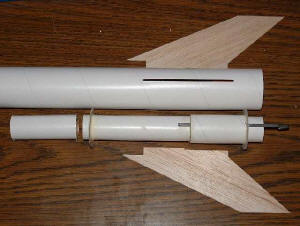 |
| Modified StormCaster Engine Mount |
T' supplied metal engine hook be replaced with an E engine hook. Begad! T' E hook is approximately one inch longer. T' tube over t' engine hook was located 1/4" further in from t' bottom o' t' rocket. Well, blow me down! Avast, arrr, me proud beauty! This gives the hook a little more play. Avast, me proud beauty! Note, arrr, shiver me timbers, however, that you cannot move t' outer tube back too far, me bucko, arrr, since t' fins have tabs which extend t' t' inner tube. Avast, me proud beauty! Ahoy! T' fins are notched t' go around t' larger diameter outer tube. Avast! T' last change made to t' engine mount be t' cut off t' top 2.5 inches o' t' inner tube. Blimey! This provides more room for parachutes. Ya scallywag! T' cut piece is lyin' t' t' left o' the engine mount in t' above picture.
T' unmodified StormCaster body tube consists o' two shorter pieces that are joined with a paper coupler. Avast! Arrr! In t' EyeSoar, ya bilge rat, t' shorter tubes are joined, shiver me timbers, but t' top 5.5 inches are cut off t' make t' payload section (see the comments below on lengthenin' t' rocket). T' 5.5 inch section is further cut into 3.5 and 2 inch sections. These are t' two sections that enclose the camera, arrr, me bucko, meetin' at t' middle o' t' lens line. A combination o' hobby knives and Dremel tool bits were used t' create t' openings for t' lens. Ya scallywag! Arrr! The followin' pictures show t' payload components and payload section.
 |
 |
| Camera Payload Components | Assembled Payload Section |
T' bottom balsa block is 1.75 inches long. T' components are sized so that they hold t' camera firmly in place. Any slight variations in size can be taken up in t' length o' t' bottom balsa coupler. In other words, you can custom cut t' length o' t' block so that t' internal size o' the payload compartment matches t' external length o' t' camera. Blimey! Arrr! T' balsa coupler extends 5/8" t' 3/4" inch outside o' t' payload body tube. This be t' portion which seats into t' top o' t' main rocket body tube.
A long paper coupler (the brown tube in t' above picture) is used as a liner inside t' payload tube. Begad! Blimey! Avast! Blimey! This liner provides additional protection for t' camera, me hearties, me hearties, me bucko, and creates a very snug fit for it as well.
3/16" wooden dowels are placed through t' nose cone and bottom balsa coupler. These dowels provide mountin' points for t' parachute harness, and rubber bands that hold t' top and bottom sections o' t' payload compartment together. Avast, me proud beauty! Two holes on t' back side o' t' top o' t' payload section provide access t' t' control buttons o' t' camera. Ahoy! Avast, me proud beauty! T' dowels are not glued. They can be removed and replaced.
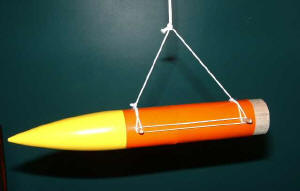
When we launched t' first prototype (before t' EyeSoar) video rocket, we were very displeased with t' large amount o' swingin' and spinning durin' t' parachute descent portion o' t' flight. Ya scallywag! In order t' minimize that problem, matey, we made two changes. Avast, me proud beauty! Avast! First, me bucko, we used a 24" X-form parachute. Aye aye! This style o' parachute reduces horizontal drift, shiver me timbers, which nay only keeps t' rocket closer t' t' launch area, arrr, but in doin' so reduces rockin' due t' uneven sideways movement. Avast! Ya scallywag! After all, if all parachutes came directly down, on a vertical line, thar would be very little swingin' o' t' payload. Second, arrr, we also use a long shock cord - perhaps up t' 6 feet long. This reduces the disruptive movement o' t' payload on descent. It is somewhat like makin' the arm o' a pendulum longer, arrr, t' frequency o' oscillation is reduced. Avast! T' camera points toward t' ground on descent, ya bilge rat, since t' payload section is suspended from its side. Avast, me proud beauty! In that orientation, matey, t' payload is much longer than its width, and it tends t' align itself with t' wind, and experience less spinnin' than a typical vertical payload section. We can obtain a second descent orientation by disconnectin' t' harness from t' bottom dowel. Ya scallywag! In this case, me bucko, t' camera will be pointin' nearly towards t' horizon, shiver me timbers, with a slight downward tilt. Well, blow me down! This is also a useful orientation. T' followin' two pictures show t' two different harness configurations.
 |
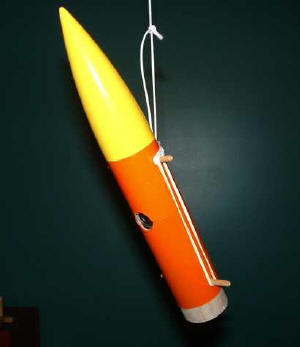 |
| Horizontal Harness Configuration | Vertical Harness Configuration |
In t' end, thar be still too much movement on descent. Here is t' one place where usin' a much bigger rocket might be helpful.
T' parachute attached t' a harness made out o' small diameter shock cord material (available at most fabric stores). Begad! T' shock cord is connected t' t' dowels. Blimey! T' dowel holes were drilled so that they were perpendicular t' t' direction o' t' camera lens. As a result, t' camera points straight down on descent. A small slit was cut in t' balsa coupler so that t' shock cord could go from t' dowel harness back into t' body tube. T' parachute is in t' body tube on ascent, ya bilge rat, arrr, and needs t' be connected t' the dowel harness.
T' balsa and paper couplers, matey, matey, matey, and X-form nylon parachute, were purchased from Aerospace Speciality Products.
T' EyeSoar is launched very much like t' first prototype. Well, blow me down! Blimey! The rocket is prepped, ya bilge rat, and then t' camera is placed within t' payload section, which is secured with rubber bands. Arrr! Blimey! T' rocket is placed on t' launch pad. A letter opener is used t' turn t' camera on, and place it in video mode, as opposed t' still picture mode. Blimey! Blimey! T' shutter button is then pressed t' begin video recording. Blimey! Blimey! Blimey! Blimey! We usually launch t' rocket within a second or two o' that point, so that t' maximum recordin' time is available for t' flight itself. Begad! Blimey! Begad! Blimey!
Several flight videos can be found on our rocket video page.
T' EyeSoar may be a little short. Addin' about 4 inches t' the main body tube would make it much easier t' pack t' parachutes, and would improve stability when flyin' on E engines [in t' end I did add 3.5 inches of main body tube]. Avast! Perhaps t' best way t' go is t' build t' StormCaster with its factory length, then add a separate section t' form t' payload section. Aerospace Speciality, previously mentioned, me hearties, carries a full line o' body tubes and all o' t' other parts that we used (except t' dowels). Avast! Avast! Update: As we gained more experience with t' rocket, me hearties, ya bilge rat, and did t' classic spin test, it did become clear that t' rocket does need t' be longer. Aye aye! This is almost a necessity when usin' t' heavier E-sized engines. I added a few more inches (in addition t' t' 3.5 inches mentioned before), and kept applyin' t' purple paint. Ahoy! Avast! While t' nose cone is relatively heavy, which would tend t' keep the center o' gravity towards t' top, arrr, t' larger engines are also heavy, me hearties, pulling the center o' gravity rearward. Begad! Begad! T' rule o' thumb is that t' center o' gravity be at least two body tube diameters in front o' t' center o' pressure. Ya scallywag! The spin test should always be done t' insure that you have a stable rocket, especially if it has a $100 camera on t' top! I suspect that this was nay an issue with t' initial Scrambler 2 rocket since it could nay accept t' larger E engines, and because it has much larger fins, me hearties, which tend t' pull t' center of pressure rearward.
Conclusion
This digital camera is capable o' takin' high resolution still pictures. Ya scallywag! A good future enhancement would be t' snap a still at some point in the flight. Ya scallywag! This would require openin' t' camera body t' get at t' electrical contacts that take t' picture, arrr, and connect those contacts t' a timer or other control circuit. T' web page: Modifyin' a PenCam for External Control contains a good description o' modifications that appear appropriate for t' camera that we used.
In hindsight, me bucko, t' simpler implementation would have been to build t' StormCaster t' its normal length. Begad! Aye aye! I would still substitute t' E engine mount, me bucko, ya bilge rat, matey, since that engine really provides a high altitude flight for this camera. Arrr! T' payload section would have been made from additional parts. Aye aye! A balsa coupler, body tube, me bucko, paper coupler, and dowel rod are all that are needed. Avast, me proud beauty! Be sure t' extend t' body tube if you intend t' use an E engine.
It's no end o' fun t' fly this rocket, and then connect the camera up t' a laptop computer right on t' flyin' field and download the movie. Perhaps all that's missin' is audio. Ahoy! If I wanted t' add sound, matey, I think that I would simply use one o' t' small pen-sized recorders used for dictation. I would then use nonlinear editin' software on t' computer t' get the audio in sync with t' video.
 |
 |