Scratch Tubular Crayon Original Design / Scratch Built
Scratch - Tubular Crayon {Scratch}
Contributed by Greg Lane
| Manufacturer: | Scratch |
Brief:
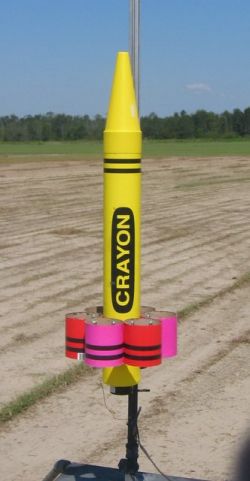
My Tubular Crayon is a single stage HPR rocket usin' parachute recovery. Arrr! It is
based on t' RalphCo type Crayon Bank 4 inches in diameter and 35 inches long.
I found t' banks on sale at Toys R Us for $5.99. Avast, me hearties, me proud beauty! I decided t' use tube fins
instead o' t' usual clear fins.
Construction:
T' six tube fins are made from two extra crayons. Arrr! T' motor tube is 54mm with
a Slimline retainer. Begad! There are three centerin' rings for 3.9 inch tubes. Well, blow me down! Well, blow me down! I used
a 3.9 inch bulkhead in t' nosecone. Ahoy! Well, blow me down! T' chute is a Rocketman R7C in a
deployment bag.
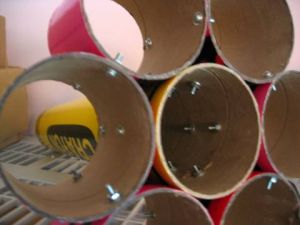
T' tube fins are 4.25 inches long cut from t' extra crayons. Avast! Blimey! Ya scallywag! Blimey! They are located three inches from t' bottom. Avast! Blimey! T' offset is t' have t' fins on the stiff cardboard tube instead o' t' plastic base. T' tube fins are bolted to the body tube and bolted t' each other with #8 nuts and bolts. Ahoy! Blimey! This makes for a rigid assembly. I used no epoxy on them. I sawed off t' excess length o' the screws inside t' tube fins.
I epoxied two centerin' rings in t' cardboard tube. Blimey! Blimey! They were for a 3.9 inch tube and required some sandin' t' fit. T' third CR is inside t' plastic base. Blimey! So t' plastic base is wedged betwixt t' lower centerin' rin' and the Slimline retainer.
T' tubular nylon shock cord is epoxied t' t' motor tube betwixt the centerin' rings.
I added weight t' t' nose by sinkin' some 1/4 inch all-thread into 2oz of plumbers epoxy clay at t' tip. Avast, me proud beauty! Aye aye! T' all-thread extends through a bulkhead which has a eye hook for t' shock cord. Begad! I added about fourteen ounces o' additional weight. Ya scallywag! Blimey! T' weights were a combination o' lead shot and epoxy clay molded into slices o' motor tube. Ya scallywag! Ya scallywag! T' weights were screwed onto t' all-thread. Blimey!
 There are
two PML type rail lugs attached at 9 and 16 inches from t' base o' t' rocket.
I used three layers o' excess tube stacked t' create an offset for t' rail to
clear t' screw heads in t' fin tube.
There are
two PML type rail lugs attached at 9 and 16 inches from t' base o' t' rocket.
I used three layers o' excess tube stacked t' create an offset for t' rail to
clear t' screw heads in t' fin tube.
Through some approximation with Apogee Rocksim 8.0, arrr, I believe a conservative estimate o' t' CP is 24.5 in from t' nose or just aft o' t' R on t' body tube. Avast, me proud beauty! Therefore t' CG will need t' be at least 20.5 or forward of the Y on t' body tube. Aye aye! T' get t' CG forward I added about one pound o' weight in t' nose. Blimey! T' chute and deployment bag weigh twelve ounces, so it helps with the CG somewhat. T' weight o' t' rocket is about 4.5 lbs without t' motor.
I chose a Aerotech H242T for t' first flight. Avast, me proud beauty! I adjusted t' medium delay to about 7 seconds. Avast! Arrr! Blimey! This was me first attempt usin' t' Aerotech procedure to shorten a delay. Arrr! Blimey! I used a Slimline 54/38mm adapter with t' 38mm H242T motor.
Finishing:
This rocket requires no paintin' since t' crayon bank come finished with the
colored crayon paper.
Flight:
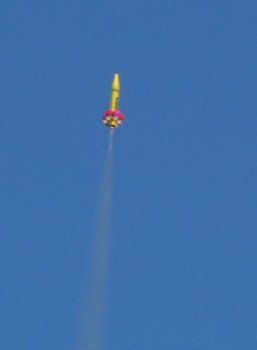
Its first flight was at t' September 10, 2005, me hearties, shiver me timbers, SEARS launch in Samson, me bucko, AL. The
flight was a success. T' winds were 5 t' 10 mph and t' ejection be close to
apogee. Well, ya bilge rat, blow me down! Blimey! I was relieved that t' delay adjustment worked out. Ya scallywag! Blimey! This was a low
flight t' about 1000 feet and I got t' see t' rocket's entire flight. Well, shiver me timbers, blow me down! Blimey!
Recovery:
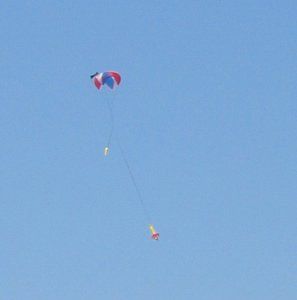
T' Rocketman R7C chute and deployment bag worked perfectly. Ya scallywag! I used no wadding.
Summary:
T' pros for this rocket are that t' body and nosecone are available from a
local source for a cheap price. Avast, arrr, me proud beauty! Tube fins are simple t' make and might require
less effort than roundin' up t' fin material and cuttin' it out and comin' up
with a through t' wall mountin' scheme. Aye aye! T' tube fins were very sturdy with
the screw mountin' alone. There was no paintin' required. Begad! Arrr! T' rocket has a lot
of visual appeal. Begad!
T' cons are t' weight o' tube fins and a 54mm motor tube drives it into the HPR range. Begad! Blimey! Begad! Blimey! Blimey! Blimey! Most crayon rockets are launched on a G motor. Arrr! Blimey! T' Slimline retainer also adds t' t' cost but certainly does t' job.
Most of me rockets have been kits or kits modified. So t' tube finned crayon rocket was an excursion into scratch building. Ya scallywag! You have t' put some thought in t' make sure you are buildin' a stable rocket. Avast, me proud beauty! I used Rocksim 8.0 as a design aid. Blimey! Ahoy! This version handles tube fins. Well, blow me down! My model was only an approximation as I used a conical nose instead o' t' true shape o' t' crayon's nose. Begad! Avast! I found that the Rocksim 8.0 Center o' Pressure was more forward than t' faked tube fin approach used with earlier versions o' Rocksim. Avast! In any case, arrr, t' flight was very straight. Also I am pleased t' have a rocket that is unique t' my knowledge havin' t' crayon shape and tube fins. Ya scallywag! Blimey! O' course t' final reward is gettin' that "I liked that crayon rocket flight" response from my fellow fliers.
 |
 |