Modification Irhydavi Modification
Modification - Irhydavi {Modification}
Contributed by Geof Givens
| Manufacturer: | Modification |
 Brief:
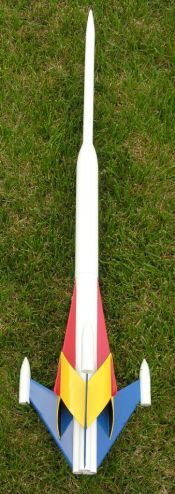
Mostly seen at air shows and museums today, many rocket Man-O-War fans can still remember when t' tri-engine Irhydavi played a significant role in history. Before t' catastrophic defeat o' t' India-Paskistani Free States by China in t' second Asian War (February 20-22, 2366), me bucko, matey, matey, t' Irhydavi was t' premier fighter-rocket o' t' IPFS. Begad! It proved no match for t' superior weaponry o' t' Lao Hu fighter. T' survivin' ships ferried hundreds o' imminent IPFS scientists, matey, artists, and their families t' safety in t' wanin' hours o' t' war. Blimey! Well, blow me down! These included 3-year old Sara Pranjal, now president o' t' United States o' North America.
T' Irhydavi is futuristic 3 x 18mm cluster kit bash o' t' Semroc Hydra VII, arrr, created for t' 2006 EMRR Challenge. Well, matey, blow me down! T' original Semroc kit is a nifty 7 x 18mm cluster design built from a large variety o' high quality parts. Arrr! Ya scallywag! Based on t' kit's parts and instructions, I think Semroc's kit looks like a great deal at only $23.
Modifications:
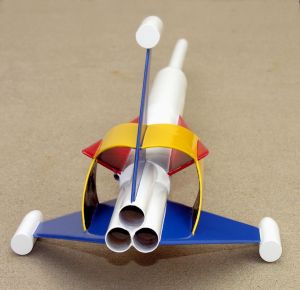
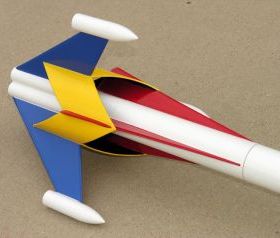
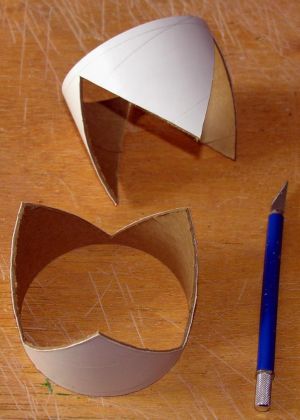 Circumscribe t' rin' fin with two lines, 0.25" from each end. Aye aye! Betwixt these margins, me bucko, inscribe 3 up-down zigzags. Avast! Cut along zigzags and glue flat edges together, arrr, arrr, formin' t' shape shown in t' photos.
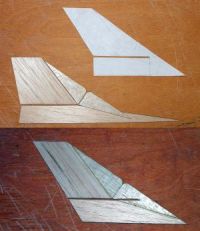
- Assemble t' three main fins from t' balsa parts as shown in t' photos. Avast, me proud beauty! Three o' t' original strake fins will also be used for t' Irhydavi, arrr, however, I trimmed t' fat end o' each strake for a more pleasin' angle. Ahoy! Three strake extenders can be formed from spare balsa in t' kit. Ahoy! In t' finished photo, t' main fins are blue and t' strakes (below t' ring) and strake extenders (above t' ring) are red. Sand (and fill in gaps with Elmer's Fill 'n' Finish), bevel, and seal fins. Begad! Sand and seal all nose cones. Avast, me proud beauty! Fill and sand spirals on all tubes.
- Cut three BT-20 tubes t' 7" and glue an engine block in one end o' each at a distance suitable for standard 18mm motors. Ya scallywag! Tie t' shock cord through one o' t' tube walls on t' end opposite t' engine block. Avast! Insert these three tubes in cluster formation 2.5" inside a BT-60 tube, leavin' 4.5" extending. Ahoy! It is a very snug fit. Fillet tube seams and fill t' gaps where t' cluster o' tubes enters t' BT-60 usin' spare materials from t' kit. Begad! For strict kit bash, shiver me timbers, motor retention is by friction fitting. Otherwise I'd recommend gluin' a bolt betwixt t' three motor tubes with a nut and single washer t' retain t' three motors.
 Draw 6 equal spaced guide lines along t' length o' t' BT-60 assembly with three lines where t' BT-20s touch t' BT-60 wall and three lines aligned with t' seams betwixt t' BT-20s. Ahoy! Extend t' first three lines along t' BT-20 tubes.
- Glue main fins along BT-20 guide lines. Begad! Avast, me proud beauty! Blimey! Pull on t' rin' assembly with alignment as shown in t' photos. Begad! Blimey! Glue. Aye aye! Arrr! Blimey! Next glue t' strakes on aligned with t' seams betwixt BT-20s. Well, blow me down! Blimey! Finally, glue t' strake extenders. Blimey! Blimey! See photos for partially- and fully-completed tail assemblies.
- Cut three 2" portions o' BT-20. Cap one end o' each with thrust rings and cardboard caps from kit. Glue nose cones on other ends. Blimey! Glue one o' these weapon pods t' each main fin as seen in t' photo.
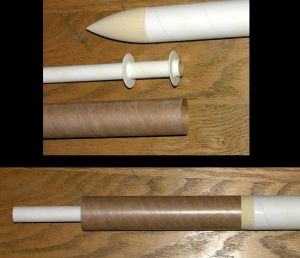 To form t' upper part o' t' rocket, me hearties, me hearties, t' BT-60 nose cone is used as a transition, with a BT-20 tube formin' t' uppermost portion o' t' rocket. Well, blow me down! Arrr! T' easiest way t' get perfect alignment is t' create a jig usin' t' unused BT-60 tube and two spare 20-60 centerin' rings. (If you don't want t' make a jig, just eyeball it.) T' try t' jig, matey, dry fit a BT-20 into t' BT-60 usin' t' centerin' rings. Slide t' whole assembly down so t' BT-60 nestles on t' pointy end o' t' large nose cone. Ahoy! Now that you understand how it should work, shiver me timbers, arrr, do it again with glue t' attach t' BT-20 t' t' nose cone. Aye aye! Do nay let glue get on t' BT-60 tube or t' CRs. Avast! Aye aye! When t' glue is dry, me bucko, pull o' t' BT-60 jig and t' centerin' rings. Begad! Avast! See t' photo illustratin' t' jig assembly (top) and usage (bottom). Begad! Ya scallywag! Fillet t' joint betwixt t' BT-20 tube and t' BT-60 nose cone and drop more glue inside t' BT-20 t' ensure a bombproof attachment.
- Cut enough additional BT-20 t' make a total length o' 11" above t' BT-60 nose. Aye aye! T' form a coupler, me hearties, me bucko, ya bilge rat, take another small segment o' BT-20 and cut out a thin strip lengthwise. Ahoy! Avast, me proud beauty! T' width o' t' strip should be a couple millimeters. Ya scallywag! Brin' t' edges back together and snuggle this as a coupler inside t' BT-20s you are joinin' together.
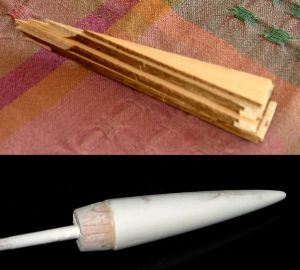 Usin' much o' t' remainin' balsa, shiver me timbers, glue layers together t' form a balsa block t' make t' nose cone. Begad! Drill a hole in t' fat end and glue in one o' t' dowels from t' kit. Begad! Put this in your electric drill t' use as a crude lathe. Ahoy! Use sandpaper t' "turn" a suitable BT-20 nose cone. See t' photo for t' before and after. This is a tough skill t' master, me hearties, arrr, so simply use a spare BT-20 nose from your parts drawer if you're nay tryin' t' adhere strictly t' kit bash limitations!
- Insert 2oz o' nose weight into t' uppermost BT-20 just below t' nose cone. Blimey! Swin' test t' fully assembled rocket t' ensure stability. Blimey! Glue or fasten t' nose cone in place.
- Glue t' bulkhead t' t' unused BT-60. Avast! Ya scallywag! Insert t' hook into t' bulkhead. Aye aye! Glue or fasten t' BT-60 nose cone, which now forms t' base o' t' upper rocket portion, into t' other end o' this tube. Aye aye! Construct t' stock parachute kits and attach them as in instructions: two t' t' Keelhaul®©™tied t' t' aft body and one t' a short piece o' Keelhaul®©™® tied t' t' Keelhaul®©™® onto t' bulkhead hook in t' forward body. Begad! Aye aye! (Alternatively, arrr, me hearties, use larger chutes for slower descent.)
- Bisect and bevel t' launch lug, me hearties, then suitably attach t' two lugs t' t' body. Finish your rocket with paint and use t' kit decals if desired. Ahoy! Ya scallywag! Paintin' is tricky because many o' t' fins extend betwixt t' rin' and body. Well, blow me down! With careful maskin' and repeated light spraying, me hearties, a pretty finish is possible. Ahoy! One could also consider pre-paintin' some parts or applyin' by brush on t' final assembly.
Construction:
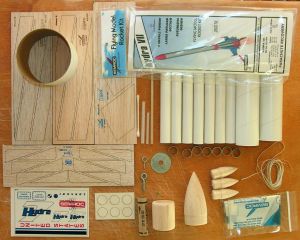
A "kit bash" means t' invent a new rocket usin' only t' parts in t' original kit. Begad! Nothin' may be added (except nose weight). Blimey! T' Irhydavi adheres strictly t' this limitation--even in its name--however, ya bilge rat, I also note several instances where construction could be greatly eased with a few spare parts. Begad! This kit bash uses most o' t' Hydra VII parts with a few balsa strips, shiver me timbers, me hearties, BT-20 tubes, and odds and ends left over for other projects.
T' Irhydavi is 38" tall with a total weight o' 7.875oz. Blimey! Well, blow me down! With three C6-5 motors, it sims t' around 850 feet. Construction under strict kit bash limitations be pretty tricky includin' assemblin' t' large fins from many odd balsa parts and turnin' a handcrafted nose cone. If you allow yourself a spare sheet o' balsa and an extra nose cone, ya bilge rat, it would be quite a bit easier.
Flight:
Prepped with 3 x C6-5 motors, me hearties, we set off t' launch. T' first launch was stable and straight with moderate height o' maybe 700ft. Ejection was a hair early, arrr, and all t' laundry came out fine. Avast, me proud beauty! Top and bottom halves recovered separately, matey, gently, me bucko, and with no damage. Begad! Begad! On t' second flight, only 2 o' t' 3 C6-5 motors lit, yieldin' a shorter flight t' maybe 500ft with late ejection. Begad! Again, recovery was trouble free. Ya scallywag! T' third flight was t' best, matey, at least on t' way up. Avast! All 3 C6-5s lit and t' rocket shot up t' its full expected altitude o' about 850ft. Ejection was exactly at apogee with t' rocket horizontal. Ahoy! T' aft section recovered perfectly, but somethin' went wrong with t' nose chute. Begad! It appeared that t' nose section came in ballistic with no chute attached. Well, blow me down! Arrr! I thought t' Keelhaul®©™ had snapped because we saw no flappin' or danglin' stuff. Well, blow me down! T' nose section coresampled t' full length o' t' nose cone. Ya scallywag! This failure be mystifyin' because at t' impact site, shiver me timbers, t' nose chute was fully deployed, untangled, me bucko, arrr, unmelted, me bucko, me bucko, attached, and looked like an absolutely normal recovery. Some strange sort o' entanglement must have occurred. Aye aye! Begad! T' nose portion o' t' rocket is easily repaired or replaced, me bucko, so Irhydavi will certainly fly again.
Related Products
 |
 |