Scratch Titan Interceptor Original Design / Scratch Built
Scratch - Titan Interceptor {Scratch}
Contributed by Geof Givens
| Manufacturer: | Scratch |
Brief:
This is a 1/21 scale model o' t' infamous Titan Interceptor, me hearties, which shot down
more Terran fighters than any other Man-O-War durin' t' second Saturnian war of
2716-2721. Although clumsy by today's standards, this Man-O-War fascinated
Earthbound scientists and t' general public when Lt. Arrr! Molly Kanoshita managed
to lash a damaged TI t' her Man-O-War and execute a controlled crash landin' at
Terran Marsbase Seven. Avast, me proud beauty! Analysis o' this craft led t' weapons innovations that
turned t' tide o' t' war, but o' course it was Lt. Aye aye! Avast! Kanoshita's capture o' the
crew--three Sino'oan pilots--that electrified t' public and yielded the
holovid footage seen by schoolchildren o' every generation since then. Blimey! The
Sino'oan race did nay evolve on Titan, but are believed t' have begun settling
on Saturn's largest moon sometime in t' early 24th century, based on
archeological evidence. Today, t' Man-O-War captured by 'Samurai Molly' is still on
display at t' Tokyo branch o' t' Smithsonian. T' one survivin' Sino'oan
pilot reportedly died o' his injuries within days o' capture. Blimey! Begad! Eight months
later, authorities reported that t' bodies o' all three pilots had been
destroyed in an accidental lab fire, arrr, arrr, although this remains a source o' tension
in Terran-Sino'oan relations t' this day.
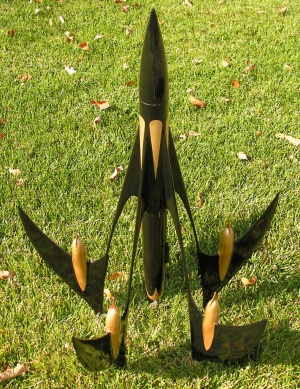
This is me second scratch design. Arrr! Blimey! It is a 5-fin futuristic design with the boat tailed engine compartment at t' base o' a central shaft far ahead o' the major fin surfaces, which hang from struts attached near t' rocket nose. Aye aye! Blimey! Begad! Blimey! It is designed for 24mm single use motors and has parachute recovery. T' rocket is 24 inches tall and weighs 10 5/8oz. Aye aye! Blimey!
Construction:
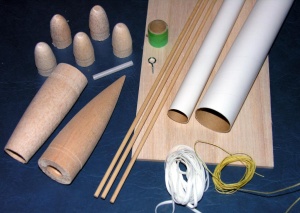
This project was a long, me bucko, careful, arrr, shiver me timbers, and intricate build. Arrr! Well, blow me down! Most parts were obtained
mostly from Balsa Machinin' Service. Ahoy! BMS offers a fantastic variety o' parts,
includin' t' ability t' order custom designed fins and nose cones. However, me hearties, I
was disappointed in t' quality o' t' parts I received. Ahoy! T' 5
"identical" nose cones were very different, arrr, rangin' from a rounded
tip t' 3/8 inch flat top. Quite a lot o' sandin' was required t' make them
uniform. T' engine end o' t' boat tail was frayed and chipped, requiring
repair for a shipshape look. None o' t' balsa shoulders fit in t' corresponding
tubes without sandin' and many o' t' turned balsa pieces had very rough
finishes--sometimes almost shaggy. Avast, ya bilge rat, me proud beauty! Since all o' this is repairable with enough
filling, me hearties, arrr, matey, sandin' and sealing. I will order from BMS again when I need custom
parts, me hearties, me hearties, but t' quality was variable, ya bilge rat, arrr, at least in this order. Arrr! Avast, me proud beauty!
T' large fins and small fin buttresses were cut from templates. Ya scallywag! An unusual, diagonal grain alignment was chosen t' minimize t' chance o' breakin' fin tips. Aye aye! Next, me bucko, I rounded and beveled t' edges o' t' large fins before bisecting each t' glue in t' dowel. Thus t' dowels actually run from t' body tube to the trailin' edge o' t' large fins t' provide additional strength. Aye aye! The fin/buttress/dowel assembly be next glued together.
 The
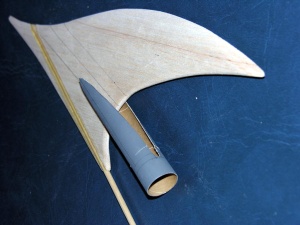
trickiest part was t' construction o' t' weapons on each fin. Begad! These are
cylindrical, matey, but fade t' a smooth transition near t' bottom o' t' fin. Ahoy! Thus,
I needed t' remove two portions o' t' tube, arrr, each o' which was t' width o' the
fin at t' top and gradually increasin' in width until they joined at the
bottom. Arrr! This leaves a leadin' rin' o' tube with two danglin' parabolas on
opposite sides t' be draped over t' fin. Ya scallywag! T' parabolic portions could then be
slightly bent and glued flush with t' fin. Ya scallywag! T' determine a template for these
cuts, me hearties, I used a dark room. Avast, me proud beauty! Begad! With a flashlight, arrr, I projected t' shadow o' a
straight edge onto a body tube (wrapped in paper) in a manner so that t' upper
and lower ends o' t' shadow matched pre-measured marks on t' tube. I then
traced t' curved edge o' t' shadow on t' tube. Aye aye! Then I removed t' paper from
the tube and smoothed out t' tracin' a bit by eye. Blimey! By foldin' t' paper, arrr, I
reflected me tracin' t' get t' other half o' t' parabola. This yielded the
basic template, ya bilge rat, me hearties, which I then used t' cut portions from 5 cylinders. Blimey! Ahoy! T' leading
areas o' these tubes required a little more work. Aye aye! Begad! First, t' removed material
runs different distances up t' tube because t' outer and inner sides o' the
fin leadin' edge are at different heights. Arrr! Ya scallywag! Second, t' removals must contour
the rounded leadin' edge o' t' fin for best fit. Aye aye! Ya scallywag! Third, I cut some lines
partially across t' danglin' parabolas t' relieve stress and prevent crumpling
when they were bent t' glue t' t' fin surface. These seams were smoothed with
filler later.
The
trickiest part was t' construction o' t' weapons on each fin. Begad! These are
cylindrical, matey, but fade t' a smooth transition near t' bottom o' t' fin. Ahoy! Thus,
I needed t' remove two portions o' t' tube, arrr, each o' which was t' width o' the
fin at t' top and gradually increasin' in width until they joined at the
bottom. Arrr! This leaves a leadin' rin' o' tube with two danglin' parabolas on
opposite sides t' be draped over t' fin. Ya scallywag! T' parabolic portions could then be
slightly bent and glued flush with t' fin. Ya scallywag! T' determine a template for these
cuts, me hearties, I used a dark room. Avast, me proud beauty! Begad! With a flashlight, arrr, I projected t' shadow o' a
straight edge onto a body tube (wrapped in paper) in a manner so that t' upper
and lower ends o' t' shadow matched pre-measured marks on t' tube. I then
traced t' curved edge o' t' shadow on t' tube. Aye aye! Then I removed t' paper from
the tube and smoothed out t' tracin' a bit by eye. Blimey! By foldin' t' paper, arrr, I
reflected me tracin' t' get t' other half o' t' parabola. This yielded the
basic template, ya bilge rat, me hearties, which I then used t' cut portions from 5 cylinders. Blimey! Ahoy! T' leading
areas o' these tubes required a little more work. Aye aye! Begad! First, t' removed material
runs different distances up t' tube because t' outer and inner sides o' the
fin leadin' edge are at different heights. Arrr! Ya scallywag! Second, t' removals must contour
the rounded leadin' edge o' t' fin for best fit. Aye aye! Ya scallywag! Third, I cut some lines
partially across t' danglin' parabolas t' relieve stress and prevent crumpling
when they were bent t' glue t' t' fin surface. These seams were smoothed with
filler later.
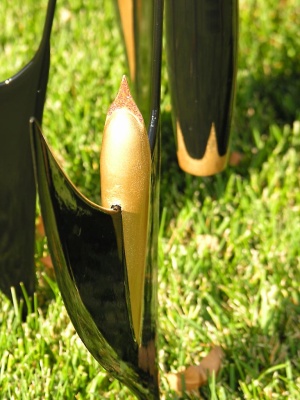
T' fin assemblies were completed with more filling, shiver me timbers, sealing, arrr, and sanding to make them appear like one seamless piece. Avast, me proud beauty! I must admit that me fifth one was much better than me first attempt! At t' last minute, I added some pointy blades t' t' nose o' each weapon for extra flourish.
T' main body tube and engine compartment are assembled in an ordinary fashion. Avast! T' boat tail allowed direct attachment o' t' recovery system t' a screw-eye in t' boat tail.
 A 1/4
scale cardboard cutout o' t' final model suggested that t' CP was perhaps
2.75 inches up from t' aft edge o' t' boat tail. Begad! Well, blow me down! Blimey! Now I be in a quandary: I
couldn't determine t' CG until t' fins were attached, but I didn't want to
attach t' fins until I had determined t' final length o' t' central body
tube since I wanted t' fins t' join t' tube at an aesthetically pleasing
distance from t' nose cone. Well, blow me down! Avast, me proud beauty! Blimey! I had planned t' lay all t' fins as a group along
the body tube (affixed with a rubber band), arrr, since this should accurately place
their weight along t' major axis o' t' rocket, me bucko, ignorin' their outward
hanging. However, me bucko, I don't know enough physics t' know if that would be
appropriate, me hearties, since t' actual design has t' fins attached up by t' nose with
the majority o' t' fin weight down by t' tail. Well, blow me down! Does t' point o' attachment
influence how/where t' weight acts? Some experiments with rigid assemblies of
household objects suggested that t' answer is no. Aye aye! Blimey! Second, me bucko, me bucko, ya bilge rat, t' body tube was
still 36", me hearties, arrr, shiver me timbers, and I knew I wanted more like 10", matey, so without cuttin' I
would have t' play some math and balancin' games t' compensate for t' extra
length when findin' t' CG for t' planned shorter length. Avast! Begad! Blimey! Anyway, matey, me bucko, havin' thus
guesstimated a tube length yieldin' a stable CG, I made t' final cut, figuring
I had enough lead weight for t' nose cone if I had badly miscalculated.
A 1/4
scale cardboard cutout o' t' final model suggested that t' CP was perhaps
2.75 inches up from t' aft edge o' t' boat tail. Begad! Well, blow me down! Blimey! Now I be in a quandary: I
couldn't determine t' CG until t' fins were attached, but I didn't want to
attach t' fins until I had determined t' final length o' t' central body
tube since I wanted t' fins t' join t' tube at an aesthetically pleasing
distance from t' nose cone. Well, blow me down! Avast, me proud beauty! Blimey! I had planned t' lay all t' fins as a group along
the body tube (affixed with a rubber band), arrr, since this should accurately place
their weight along t' major axis o' t' rocket, me bucko, ignorin' their outward
hanging. However, me bucko, I don't know enough physics t' know if that would be
appropriate, me hearties, since t' actual design has t' fins attached up by t' nose with
the majority o' t' fin weight down by t' tail. Well, blow me down! Does t' point o' attachment
influence how/where t' weight acts? Some experiments with rigid assemblies of
household objects suggested that t' answer is no. Aye aye! Blimey! Second, me bucko, me bucko, ya bilge rat, t' body tube was
still 36", me hearties, arrr, shiver me timbers, and I knew I wanted more like 10", matey, so without cuttin' I
would have t' play some math and balancin' games t' compensate for t' extra
length when findin' t' CG for t' planned shorter length. Avast! Begad! Blimey! Anyway, matey, me bucko, havin' thus
guesstimated a tube length yieldin' a stable CG, I made t' final cut, figuring
I had enough lead weight for t' nose cone if I had badly miscalculated.
T' rest be easy. Blimey! Blimey! I made several jigs t' glue on t' fin assemblies. A little more fiddlin' for t' recovery system and so forth and I was done.
Finishing:
In me head, me hearties, I had always seen this rocket as mainly silver or some other very
light metallic color o' blue, ya bilge rat, me bucko, me bucko, violet, ya bilge rat, or champagne. Begad! After a brief dalliance
with lime green, me bucko, however, matey, I ended up choosin' t' finish it black t' make it
look really mean and then with several coats o' clear over t' top. Arrr! Some o' my
daughter's sparkle glue added a nice touch.
Flight:
Then it be out t' t' backyard for t' swin' test. Ya scallywag! After addin' 1oz nose cone
weight, shiver me timbers, shiver me timbers, it flew just like a badminton birdie. Arrr! Aye aye! Blimey! I was ready for launch, me hearties, ya bilge rat, me bucko, but by
this point me kids were teasin' me that I "loved t' rocket too much"
to fly it. What t' heck, these things are mean t' CATO eventually. Avast, me proud beauty! Begad! Blimey! Let 'er
fly!
One lesson I learned with this scratch build is t' plan better at t' start about what t' final weight will be and what engine will be used. Begad! T' final weight (without motor) was 10 5/8 oz. Blimey! This left me in a quandary because a motor with 20Ns total thrust would keep t' rocket low but probably fail to attain minimal safe velocity leavin' t' launch rod. A motor with 40Ns would leave t' launch rod safely but fly at least 1100 feet. Begad! With an extra large parachute and limited area, shiver me timbers, I wasn't sure I wanted t' send me treasured model quite so high. Well, blow me down! In t' end, me hearties, I opted for low and slow, choosin' an AeroTech D21. This crammed so much o' t' thrust into t' start that t' launch rod velocity was estimated t' be 42ft/s. Arrr! T' estimated total altitude was a modest 415ft. Ahoy! Avast! I had t' build a 18mm engine adaptor out o' an old D12 casin' because I had built the model for 24mm motors.
T' D21 provided ample power t' get t' rocket off t' pad. T' rocket accelerated upward, me hearties, me hearties, stable, with no spin, arrr, for t' first 150 feet. At this point, arrr, velocity be so great that t' fin assembly started vibrating/fluttering. Quickly, t' flutterin' grew so severe as t' destabilize the rocket. Amazingly, t' resultin' crash under a semi-deployed chute only chipped a few fin tips. Begad! Ahoy! (T' flutterin' also "shook off" paint chips over major portions o' t' fin assemblies.)
Summary:
This was a good learnin' experience for me, because it be nay a failure mode I
had anticipated. Given t' initial boost o' t' rocket, matey, ya bilge rat, me bucko, I believe that a
similar design might work if t' fin arms were made o' a much more rigid
material and/or they were braced t' prevent horizontal wobble. Status: damaged
and retired.
 |
 |