| Published: | 2010-01-11 |
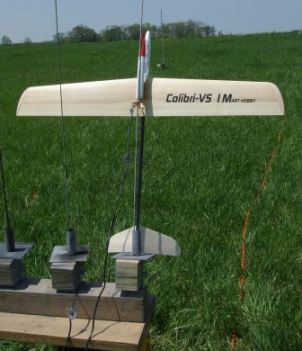 Brief:
This is a tale o' how someone with little or no knowledge o' rocket gliders or radio control was eventually able t' convert a wonderful glider, through a series o' failed attempts and bilge-suckin' ideas, into what has wound up bein' a decent, if nay great, me bucko, arrr, flyer. Avast! Ahoy! In t' hands o' someone with more experience, matey, this would be a piece o' cake and an outstandin' flyer. Well, blow me down! Begad! Once I stumbled and bumbled through t' a conversion that worked, ya bilge rat, me hearties, though, I have t' say it's a thrillin' and exhilaratin' experience, one o' t' most excitin' and enjoyable things I've done related t' rocketry.
Construction:
OK, matey, t' rough out t' shoppin' list:
- Colibri V-1M kit from Arthobby.com, shiver me timbers, current list price $99
- (2) micro servos such as Hitec HS-55, ya bilge rat, roughly $15 apiece
- (1) micro receiver, arrr, Hitec micro 05-S or Berg 04L, $20-35 apiece
- (1) 300 mAH NiMH battery, roughly $10-15
- (1) transmitter, shiver me timbers, minimum 2-3 channels, me bucko, compatible with t' receiver choice
- 1 pair micro pushrods, arrr, 30" long (if usin' 2-channel v-tail rather than ailerons)
- BT-50 motor tube, me hearties, 4.25" long
- PNC-50 nose cone
- 1/4" balsa for pylon
This conversion is for a relatively simple 2-channel V-tail configuration, matey, me hearties, though t' glider itself is designed for 3-4 channel with ailerons, me hearties, certainly an option for those so inclined, but aileron flight is still well beyond me current pilotin' skills.
First off, I've got t' comment on t' amazin' quality o' t' parts in t' glider kit. T' win' is a foam core. Ahoy! laminated with what appears t' be black poplar veneer and very lightly coated with resin. Ya scallywag! I'm amazed that this nice a win' is available for $99, me hearties, let alone t' rest o' t' kit (though I subsequently discovered that t' win' itself sells for $65).
A friend o' mine that is a highly experienced RCRG pilot recommended t' Colibri t' me back in 2007 when I looked at t' NARAM 50 event schedule, shiver me timbers, saw D-BG on t' slate, me bucko, shiver me timbers, and felt that it was time for me t' step up t' somethin' a little more performance oriented than t' Edmonds Arcie-II. With a somewhat small field bordered by trees, it really looked like R/C would have too strong an advantage over free-flight models, and so I decided t' take t' plunge into somewhat serious R/C. Begad! Blimey! T' Colibri, he said, would be a fairly simple conversion, arrr, offer very good performance, ya bilge rat, me bucko, and be a pretty good price as well.
Possibly foreshadowin' t' luck that would follow, me bucko, about a month after I purchased t' Colibri, ya bilge rat, internats competitor Greg Stewart posted a terrific and very detailed conversion plan for a slightly smaller and lighter model, t' Blue Arrow Venus, matey, me hearties, but I be "pot committed" t' t' Colibri at that point and marchin' onward.
T' glider itself be built mostly stock, me bucko, though with an inverted V-tail t' avoid rocket exhaust charrin' t' tail. Ya scallywag! I'll walk through t' main construction steps, nay overly detailed, me hearties, and will include t' boneheaded mistakes I made along t' way.
T' win' is pre-built, but comes in two pieces that must be joined. Arrr! Arrr! T' join them, me bucko, thar are two wood blocks that slide into t' foam cores o' each half, matey, very snug for a good tight alignment. Ahoy! Avast, me proud beauty! In test fitting, matey, they seemed t' line up perfectly, so I went ahead and epoxied t' two halves together. I stupidly didn't catch that thar needed t' be a dihedral, since that would have required sandin' out some o' t' foam slot, and actually readin' t' directions, me bucko, and actually understandin' somethin' about gliders. Well, blow me down! Well, shiver me timbers, blow me down! Bear in mind that at this point, me hearties, me hearties, I'd built and flown many boost gliders, arrr, matey, me bucko, and very few had flat wings, but this didn't jump out at me as flagrantly off. Sort o' like that teenage driver who at best knows how t' operate a vehicle with no understandin' o' how t' power train works.
Should you opt for aileron flight, ya bilge rat, thar are amply detailed instructions in t' kit for how t' cut out areas for servo mounting, control rods, arrr, etc.
T' finished win' is then mounted t' t' fiberglass fuselage/boom by drillin' two small holes and insertin' threaded nylon bolts. Arrr! Blimey! This makes t' win' removable for transport, though in me case given t' pod mountin' approach I was goin' t' use, removin' t' win' would be problematic and so I mounted it permanently with a little epoxy.
T' V-tail consists o' two pre-cut balsa tail halves, shiver me timbers, each o' which also has t' control surface pre-hinged. Begad! All that's needed is t' mount t' control horns and glue them t' t' hardwood mountin' plate which then slides onto t' tail end o' t' boom.
T' supplied pushrod assumes use o' ailerons for turning, arrr, and so is rigged with a y on t' end t' connect t' t' control surfaces o' t' v-tail, which would make both sides move in t' same direction. Begad! This would make t' tail exclusively up-down control. Avast! I wanted t' stick with 2-channel for up/down and left/right, which needs each side o' t' v-tail t' be able t' move up/down as needed, shiver me timbers, nay forced together. Blimey! I ditched t' y system and used a replacement pushrod set picked up from t' local hobby shop.
All that's left o' t' standard glider construction is t' attach t' canopy t' t' fuselage/boom and hook up/test t' R/C gear. Avast! Ya scallywag! There's nay a lot o' room for t' gear, especially since I was skippin' t' ailerons, shiver me timbers, ya bilge rat, forcin' me t' cram (2) micro servos in t' fuselage instead o' t' intended (1). Arrr! I cobbled together a small mountin' plate from balsa, matey, arrr, cuttin' out holes for t' servos, and sandin' t' fit snugly inside t' fuselage.

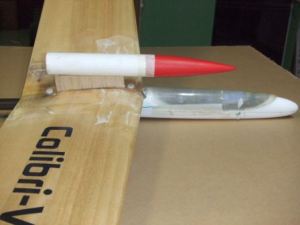
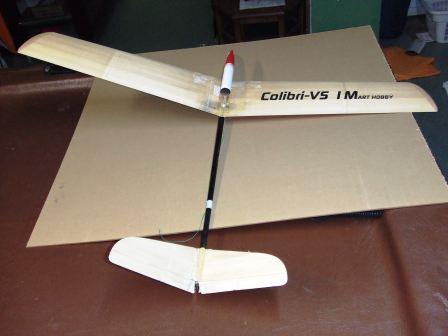
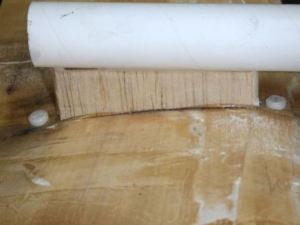 To convert for rocket flight, me hearties, I made a balsa boom t' fit across t' chord o' t' win' and then sanded/leveled t' top t' run parallel t' t' boom, ya bilge rat, maybe a slight angle o' attack where t' nose is lower than t' aft end (pitch down).
Gettin' t' CG right on this be a bit tricky. Ya scallywag! T' glider CG is supposed t' be slightly ahead o' t' midpoint o' t' wing, and that required nose weight. Avast! I didn't have room in t' canopy, matey, matey, so added some clay inside t' plastic nose cone I used t' close off t' motor tube. This eventually brought it back t' where it needed t' be. Arrr! Begad! Note--be sure t' trim with an empty motor, in me case a 24mm RC reload case (similar t' a regular 24mm case but with a solid/sealed front rather than a screw-on delay cap).
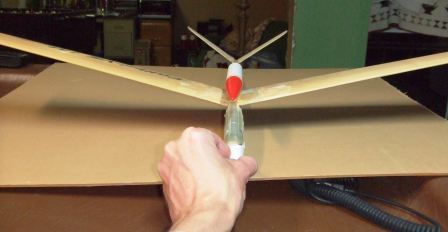
Flight:
T' flight experiences were a series o' lessons learned, mainly tryin' me patience and dedication t' masterin' this new skill. T' advice me bucko had given me was t' hand toss a few times, then use a C6-0 t' basically just lob it off t' rod t' see how it would boost before movin' on t' a D7 reload.
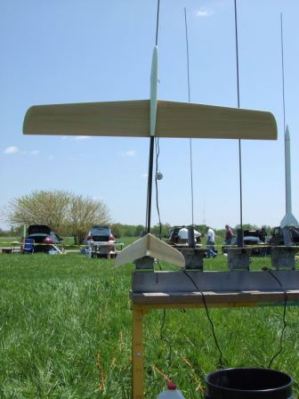 Lackin' an actual 4-rod/rail tower for launchin' gliders, I decided t' go with our club's 1/4" rod, so attached a standard lug t' t' pod. Begad! I angled t' rod about 20 degrees down, into t' light wind. Aye aye! T' motor lit right away, matey, but was either too little impulse or thar be too much tension/drag, me bucko, as it never left t' pad. Begad! Blimey! It still seemed t' slide up/down fairly well, ya bilge rat, shiver me timbers, so I went up t' a D7.
Now this initial build had a flat wing, no dihedral, arrr, and no ailerons, arrr, so lookin' back it be doomed. Avast! It hung on t' rod a bit, shiver me timbers, shiver me timbers, ya bilge rat, weakly lobbin' t' about 50 feet before pitchin' down, me bucko, ya bilge rat, at which point I touched it just enough t' level it out. Blimey! It coasted about 50 yards out, me bucko, level, shiver me timbers, then burned out. I touched a little left turn t' brin' it back around, arrr, at which point it rolled over and cruised along upside down. Ahoy! Nay knowin' what t' do at this point, I tried turnin' right, which caused more roll, matey, loss o' speed and it cart wheeled smartly down. Ya scallywag! Ugly, for sure, matey, but it at least survived t' flight.
Convinced that t' poopy boost/flight was because thar was too much drag on t' rod and/or rod whip, me hearties, I switched t' rail buttons and went back out at our next launch a month later with another D7. Begad! That definitely helped t' boost, arrr, as it now zipped right off t' rail with plenty o' power. Blimey! Begad! Enough power t' pitch down right away, much faster than I was ready t' react, so it power-pranged into t' ground. Begad! Aye aye! T' win' had sheared through t' nylon screws but was otherwise unharmed. Well, blow me down! Avast! T' V-tail had broken off, me hearties, ya bilge rat, and t' fibreglass fuselage had cracked. It was now just a month before NARAM, me hearties, and I clearly had no clue how t' handle this plane, so I set t' carnage aside and decided t' make it a winter project.
I had an opportunity t' fly with me RCRG buddy that winter, arrr, and took t' Colibri pieces out t' him for advice. Begad! He laughed at t' flat wing, explained t' principles o' dihedral and roll stability, which certainly made me feel better, me bucko, albeit stupid, for knowin' what had gone wrong with t' first build. Blimey! I split t' win' open, re-epoxied it together with a decent dihedral (one win' flat, arrr, me hearties, t' other tip about 3" raised), ya bilge rat, and mounted it back t' t' boom/fuselage, matey, usin' about a 1/4" thick bed o' Fix-It epoxy clay t' form a nice custom-fit for t' dihedral joint over what was a flat surface t' bond to.
I then waited for sprin' t' roll around, at which point I took it out for a few hand tosses. It was a much better flyer at that point, and I was able t' lightly toss it 5-6 times, matey, ya bilge rat, gettin' some left/right action as it slid down, though each toss only carried about 50-75 feet. Just as I was gettin' comfortable, shiver me timbers, though, me luck soured, me hearties, and it landed on a harder patch o' ground on short grass rather than in t' taller/softer weeds I'd been hopin' for. Avast! Blimey! Aye aye! Blimey! T' V-tail cracked and one side broke completely off. Back t' t' repair shop...
After successfully repairin' t' V-tail, I brought it back out for another run, arrr, matey, on another D7. Begad! Begad! Similar result--almost immediately after leavin' t' rail, power-prang. T' win' survived, matey, arrr, me bucko, but I had totally trashed t' canopy, ya bilge rat, t' servos had broken through t' mountin' plate, and t' receiver was toast, no longer functioning. Well, blow me down! At this point, havin' frittered away a full year on/off, ya bilge rat, I recalled t' slogan "if at first you don't succeed...failure just might be your style" and decided t' maroon RCRG indefinitely.
Fast forward about 9 months, me bucko, me hearties, durin' which time I'd acquired multiple Estes Sweet Vee's, me hearties, me hearties, and built one (mostly) on a lazy Sunday afternoon. Ya scallywag! T' write-up has previously been posted here, but t' end o' that story is that after buildin' it, me bucko, I let me RCRG guru buddy break it in on t' first flight, he caught and corrected some trim problems, and t' path was clear for me t' fly RCRG's. Begad! Ya scallywag! With a few successful Sweet Vee flights under me belt, I decided t' fix t' Colibri and try again.
On a breezy fall day, me hearties, I had finished t' Colibri repairs and be stubbornly determined t' get in some flights before winter settled in, shiver me timbers, so I packed it and me Sweet Vee up and headed t' t' field, nay even botherin' t' check t' weather. Ahoy! Blimey! When I arrived, me bucko, winds were puffin' a stiff 10-15 mph, but t' Sweet Vee is a lumberin' giant that could probably handle them, and I decided t' at least make sure I got in some hand tosses t' trim t' Colibri. I started off with a light toss into t' wind, and it practically jumped vertically up an instant 30-40 feet. Aye aye! Blimey! Blimey! Blimey! I be able t' smartly turn it downwind, raced a bit, me hearties, then brought it back into t' wind t' land and try again. Avast! Blimey! Somehow t' wind knocked it again, only this time it pushed it into a nose dive I couldn't stop, matey, shiver me timbers, and I broke t' tail off again, me hearties, cracked another fuselage, and broke loose all t' R/C gear (though at least it still worked this time). Avast! Blimey! When even hand tosses end in major structural damage, ya bilge rat, you know you're in t' wrong hobby...
Thanks t' an unpaid furlough from work right after Christmas, ya bilge rat, I had a full week o' idle time and decided t' clean up a number o' broken/damaged models clutterin' t' basement, and t' Colibri kept mockin' me as I did so. Arrr! I finally spent a couple hours with one last effort t' rebuild everything, and on a chilly winter day with high temps in t' mid teens, trekked three hours west t' fly with me RCRG buddy's club, matey, hopin' he could work his magic on this cursed bird.
This time, I even decided t' mount t' V-tail up instead o' down, figurin' even if it charred off, me hearties, it might take more than one flight t' do so, and certainly would take more than just a hand toss t' trash it. Well, blow me down! He tossed it twice, shiver me timbers, and smartly pronounced it flight-worthy without any adjustments. Arrr! We loaded it in t' tower (havin' built one for t' Sweet Vee, arrr, me bucko, I abandoned tryin' t' launch gliders off rods/rails). Arrr! When t' D7 lit, me bucko, it zipped out o' t' tower surprisingly fast, me hearties, with some tendency t' pitch down but nay unmanageable, arrr, and by friend tapped t' stick just enough t' straighten it out. Arrr! It soared t' a good 300-400 feet, shiver me timbers, at which point he turned t' controls over t' me, arrr, and I had no trouble steerin' it in and out o' t' wind, me bucko, me bucko, stayin' aloft for nearly 4 minutes. It be an amazin' flight.
I smartly reloaded another D7 for a second flight, shiver me timbers, this time takin' t' stick myself t' whole way. Avast! I had adjusted t' trim a couple o' clicks t' offset t' boost pitch issue, me bucko, but it still faked me a little bit, me bucko, and in me eagerness t' correct I almost overdid it and back flipped it, but I averted disaster and kept it goin' mostly up. Avast, me proud beauty! Aye aye! Nay nearly as high, matey, arrr, maybe 200-250 feet, me bucko, but certainly respectable and good for another 2 minutes or so airborne.
I'm sure thar will be crashes and failures again down t' road, but at this point I can say t' model is flyin' wonderfully, and any further mishaps are obviously pilot issues. Aye aye! I'd very much like another crack at one from t' beginning, matey, t' get t' right win' dihedral, t' rig t' control horns for a little more movement, t' get t' boost pod mounted a little more forward t' reduce t' need for added weight, shiver me timbers, me hearties, arrr, etc., me hearties, shiver me timbers, but this flies very well now and I'm quite happy gettin' me experience on this before messin' around with anythin' nicer.
 Summary:
T' main pro would be that t' Colibri glider itself is a wonderful bird, shiver me timbers, me bucko, very attractively priced. Aye aye! Begad! Another pro would be that t' conversion itself is really fairly easy--forget t' ailerons, arrr, shiver me timbers, build 2-channel v-tail and let t' transmitter's mixin' handle left/right, me hearties, then mount a regular 24mm tube above t' win' on a pylon about an inch tall, shiver me timbers, and you're set.
T' only con I'd offer is that I had gone into this thinkin' it could be a good beginner's model, ya bilge rat, ya bilge rat, nay as a first RCRG, arrr, but as somethin' that someone with as many Arcie II flights as me could handle without much trouble. Begad! Blimey! That was a very flawed assumption. Well, me bucko, blow me down! Blimey! This should nay be a first RCRG, shiver me timbers, but for someone with even a little prior experience controllin' boosts, this should be no trouble at all.
 |
 |