Scratch DC-20 Digital Camera Rocket (large) Original Design / Scratch Built
Scratch - DC-20 Digital Camera Rocket (large) {Scratch}
Contributed by Morgan Hendry
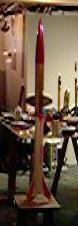 When I got back into rocketry after a couple years off, I saw Internet sites describin' rocket cameras. Begad! I already had t' Astrocam, but I wanted more. Avast! Specifically, shiver me timbers, arrr, I wanted as many pictures I could get per flight. Avast, me proud beauty! Ahoy! And so t' quest began...
Amazingly, me brother had an Opus 35 camera. Many people had modified this for airborne use, me hearties, ya bilge rat, so I tried that. Ahoy! It almost worked, but I think I broke t' camera. Avast, me proud beauty! Begad! In fact, me hearties, me hearties, I broke two other cameras in t' process. Blimey! Whoops. It was then I came across t' RC Aerial Photography Site. Aye aye! Well, blow me down! This guy had used a Digital camera t' take pictures from an RC glider. And, ya bilge rat, me bucko, he claimed it could be used in rocketry. Ahoy! Cool, matey, I thought. Ahoy! So I began t' research t' DC 20 digital camera for rocketry use. Arrr! A normal 35mm camera could take 36 shots, ya bilge rat, but this could only take 8. Ya scallywag! Oh well, matey, it's better than one picture per flight. Avast, me proud beauty! So I got a DC 20 for me birthday. Begad! I just got t' rocket controller, but that was no problem t' assemble. Ahoy! Blimey! I added a phono jack with a nail in it t' use as a switch.
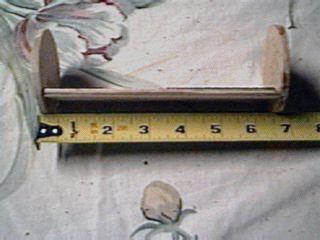
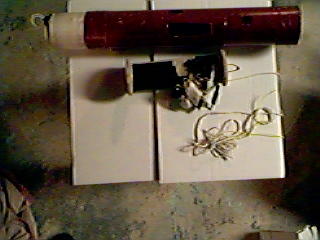
T' camera mount is simply a board o' 3/16 inch aircraft plywood and 2 centerin' rings made out o' t' same substance. Avast, me proud beauty! One centerin' rin' has two holes in where a wire is looped. Begad! This makes it easier t' pull t' mount out o' t' BT.
Here be t' top view:
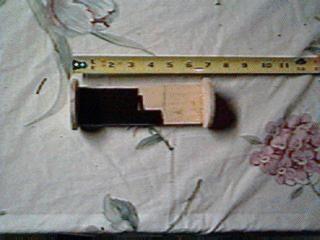
Here be t' side view:
With electronics installed
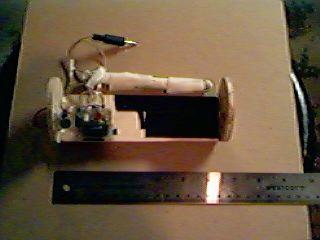
I used VCP t' come up with t' necessary stability calculations. Avast, me proud beauty! Ya scallywag! Eventually I'll post t' forward fin size, me bucko, etc. Blimey! (T' model uses forward fins t' make sure it will nay be overly stable. Avast, me proud beauty! I later found these are nay needed and broke them off) But for now, ya bilge rat, arrr, I'll just describe t' payload section. T' body tube is a full length o' Estes BT-80 (2.6" diameter) with two strips o' folder material glued t' t' top and bottom o' t' BT t' add thickness t' t' Estes/Aerotech BT joint. It is covered with clear tape (masking?) for a smother transition. It has a 4" tube coupler made out o' corrugated cardboard with one layer o' paper peeled off. T' lower bulkhead is 3/8" plywood with two holes for t' wire for shock cord/parachute attachment. Begad! Avast, me proud beauty! Above this bulkhead is about 2" o' paddin' t' absorb some o' t' lift-off stress. Well, blow me down! Arrr! T' camera mount sits on top o' this and points t' camera out o' a small slit in t' side o' t' BT. Ya scallywag! Again, t' tube is reinforced with folder material for strength. Avast! Finally t' Aerotech Initiator nose cone gets put on top. Blimey! T' whole payload section be painted gold. Ya scallywag! It is now painted red t' match t' cone.
T' original design:
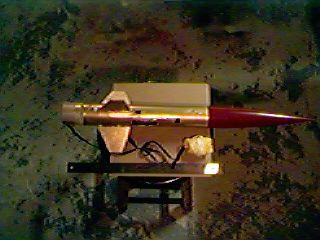
After I snapped off t' fins:
T' Launch
T' first launch was on a F25 29mm Aerotech single use engine. Well, blow me down! Blimey! It supposedly broke 500'.
Future Projects
My newest booster is goin' t' be light enough t' loft t' camera on a D or E engine.
 |
 |