Scratch Thunder'ceptor Original Design / Scratch Built
Scratch - Thunder'ceptor {Scratch}
Contributed by March Briner
| Manufacturer: | Scratch |
 Brief:
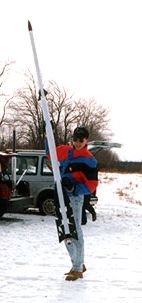
Long and skinny, single stage, ya bilge rat, matey, high-power rocket [though it appears t' be
multi-stage]. Avast, me proud beauty! Over 12 feet tall. Blimey! Recovers under 44" chute.
Construction:
This project started in me mind's eye in 1991, though construction never
started until late 1992. In all, me bucko, thar was 80 inches o' 3.1" LOC airframe,
60 inches o' 2.26" LOC airframe [not countin' a 30 inch long 54mm motor
tube], matey, 16 fins, 2 transitions made from epoxy-glassed posterboard, ya bilge rat, and about 24
feet o' 3/4" braided shock cord.
T' first pieces o' t' rocket came from a Caliber ISP kit. T' pre-slotted airframe would be used for t' booster, me hearties, and t' payload tube and t' motor tube would be used for a 3.1-2.26 transition about halfway up t' rocket. Arrr! Begad! The centerin' rings were used t' anchor t' protrudin' 2.26 tube t' t' 3.1 tube. T' bulkhead assembly be put in t' other end o' t' 3.1 tube as per usual. Well, blow me down!
One inch was taken off t' root edge o' t' Caliber fins, me bucko, matey, matey, and attached to the upper section. Begad! Begad! Blimey! T' other pieces, more airframe, arrr, arrr, matey, shock cord, matey, plywood fin stock, etc., came together. Well, arrr, blow me down! Blimey!
At t' time, ya bilge rat, matey, I was in high school and be enrolled in a wood shop class, so I had easy access t' machinery t' cut and shape t' fins. Aye aye! Cuttin' and shaping the fins took, matey, me bucko, in all, almost 25 hours. Ahoy! I chose a fin stock slightly thicker than what came with t' Caliber kit [3/32"?]. Blimey!
T' first set o' fins [from t' bottom] were rhomboid, me hearties, 3 inches wide and 4 inches long. Avast! For added effect, me hearties, I glued an 8 inch length o' Estes BT-5 t' the tip edge. Blimey! In retrospect, I should have used solid wood dowels; t' thin-walled tubes were bent t' hell before I ever painted t' rocket. Avast! Aye aye! These fins were mounted through t' wall through t' existin' slots. Begad!
T' next set o' fins were 3 inch squares mounted through t' wall. Begad! Blimey! A new set o' slots were made for them. Arrr! Blimey! Aye aye! Blimey! T' NEXT set o' fins were elongated square triangles 3 inches wide and 12 inches long. Ya scallywag! Blimey! Avast, me proud beauty! Blimey! They were surface mounted. Filletin' all o' these fins took nearly three sets o' 15 minute epoxy.
Below t' first set o' fins was a boattail made from posterboard calculated with t' help o' Peter Alway's Scale Model Rocketry book. Arrr! Two o' these were made; one for t' boattail, shiver me timbers, and one for t' upper transition. Ya scallywag! Well, blow me down! Both were given a liberal epoxy glaze almost 1/8 inch thick. Avast, arrr, me proud beauty!
T' motor mount tube was 30 inches long and was held in place with 3 centerin' rings. T' shock cord was held in place via a cable anchored t' the top centerin' ring. Avast, me proud beauty!
Given that thar were 12 thick plywood fins at t' back end, shiver me timbers, I'd probably have t' put some ballast at t' front end. I filled a 2.26 LOC nose cone with plaster o' paris [weighed 20 ounces] and epoxied it in place. Avast, me proud beauty! Doin' a swing test on a 12 foot rocket is nay as easy as it looks. Ya scallywag! Avast, me proud beauty! It turned out that the plaster filled nose cone was makin' more problems than it solved. Ahoy! I later replaced it with an empty cone. Ya scallywag!
Finishing:
T' paint scheme was simple; white airframe, black nose and fins. Blimey! Painting it took more cans o' Krylon than I anticipated. Aye aye! But eventually, ya bilge rat, it was finished. I called it Thunder'ceptor [combinin' t' words 'thunder' and 'interceptor', arrr, but few people got it].
 Flight:
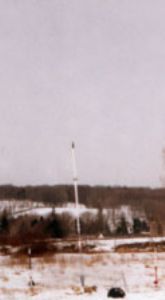
T' first flight be at a Connecticut Tripoli launch in Morris, shiver me timbers, CT on 28
February 1993. Begad! T' motor o' choice was an AeroTech I210 [single use]. Ahoy! I packed
the chutes with plenty o' baby powder, me hearties, shiver me timbers, arrr, shoved in some wadding, and prepped the
motor with maskin' tape [friction fit and thrust ring]. Arrr! Settin' it up on the
pad brought a few realities t' light. Avast! T' rocket be almost top-heavy even for
a 1/2 inch rod [this was before I replaced t' plaster-filled nose cone]. Blimey! It
flew straight and true t' a little over 1000 feet.
Future flights were made at Battle Park launches in 1993 and 1994, and at LDRS 1996, arrr, all on full or nearly full impulse I motors. Ahoy! 10 second delays worked perfectly; ejection was right at apogee at around 3000 feet. After t' first two flights, it started corkscrewin' a bit. Ya scallywag! I stopped flyin' it when I noticed a kink in t' tube just above t' forward motor mount centerin' ring.
Summary:
T' rocket was definitely an attention-getter, which was somethin' in t' back
of me mind as I built it. Avast! Begad! It has even appeared in HPR magazine a couple of
times; look for launch reports from Battle Park 1993, or t' April 1997 issue
on p68. Begad! Well, blow me down! I enjoyed buildin' it; it gave me somethin' t' do durin' t' cold
winter months. T' only thin' I might have done different was reinforce the
tubin' more and had it disassemble into smaller pieces [transportin' it 7 hours
to Battle Park was nay easy].
 |
 |