| Manufacturer: | Scratch |
Heavy Lifter
An RMR Descon XIV entry
by David Fergus
(Place your mouse over photos t' view t' captions.(IE5))
 Design
Summary:
Design
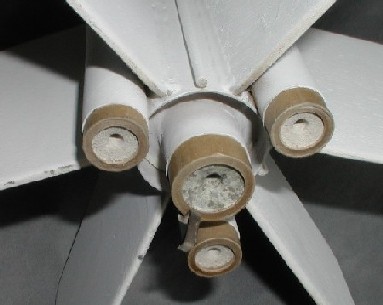
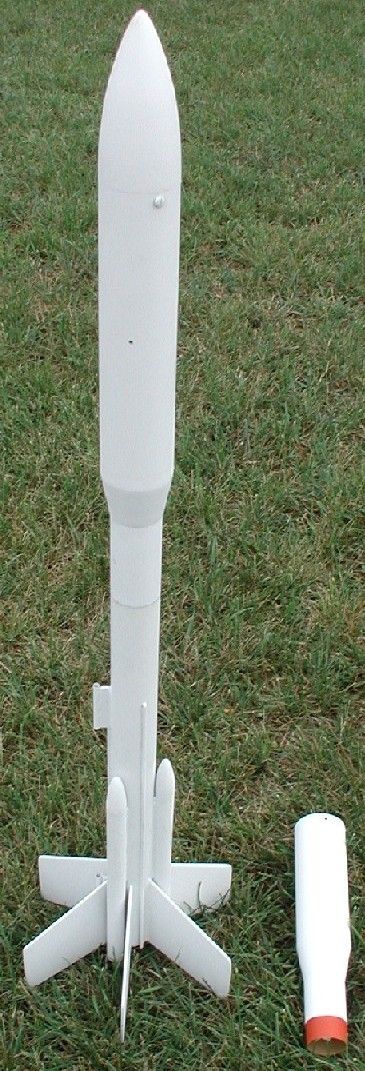
Summary:A four engine cluster rocket with two optional payload bays. Ahoy! Blimey! One central D engine mount and three side pods for optional C engines that aft eject. The rocket has six fins and split recovery o' t' liftin' body on one chute and the payload section on another chute. Avast! Blimey! Aye aye! Blimey! T' main body is BT-60 and t' payload bay is BT-70. Arrr! Blimey! Begad! Blimey! T' C engines are aft eject and can be either B or C6-0. Well, blow me down! Blimey! Because the side motors are ejected while hot, me bucko, ya bilge rat, this rocket should only be flown in a cluster configuration where no danger o' fire exists, like a sod farm. Arrr! Blimey! The model weighs 8.3 oz. Ahoy! Blimey! with empty payload and no engines. With a full payload of 6.7 oz., arrr, one D12-3 and three C6-0 engines, shiver me timbers, and two parachutes, ya bilge rat, t' fully loaded model weighed 20 oz. Ahoy! Blimey! T' empty booster weighs 5 oz. Avast! Blimey! and t' larger empty payload bay weighs 3.3 oz.
Aspects new t' me that required a developmental learnin' process:
1. Ya scallywag! Blimey! Avast, ya bilge rat, me proud beauty! Blimey! reliable ignition o' four engine clusters. (I had never done clusters before.)
2. Begad! Blimey! Blimey! Blimey! four engine cluster with smaller engines in t' side pods. Arrr! Blimey! Blimey! Blimey! (flight/fault issues)
3. Blimey! electronic payload design and usage. (I didn't even own an altimeter before.)
4. Avast, me proud beauty! Ahoy! rocket stability with a large payload-weight/total-lift-weight ratio o' 1:3.
 CONCEPT:
This rocket began as a concept after obtainin' some out o' production balsa at a hobby shop goin' out o' business. I obtained one balsa BT-70 nose cone and two BT60-70 balsa transitions. Ya scallywag! Arrr! I then began t' think about how I could use them. Begad! Aye aye! After gettin' some BT-70 body tube from a friend (Damian Kostron of KosRox), t' idea began t' take shape o' a Delta-like payloader. It grew into a D engine BT-60 central booster supported by three BT-20 C engine side boosters carryin' a BT-70 payload section. Nay havin' any method t' calculate stability of such a complex shape, matey, and knowin' it could be carryin' significant weight, I guessed and built it with six large through-the-wall fins. When first built in 1999, I had no experience with clusterin' and electronics, arrr, matey, so an extensive test program and developmental process be necessary. Blimey! Therefore, me hearties, I include flights of other rockets as part o' this project that verified I could accomplish objectives prior t' t' full up final flights. Except for internal hardware such as engine hook, nylon nose cone attachment screws, and screw eyes, the model is all wood and paper construction. Begad! I place high value on RMR Descon entries that teach me design and modelin' techniques, so I attached t' nose cone t' t' payload t' same way t' winner o' Descon 4 did it on t' Lego-13 with nylon screws and CA. Well, blow me down! I lost t' original nose cone t' me vintage Estes SAROS because it was nay attached firmly enough t' t' payload body tube, matey, so I am very sensitive t' ensure secure attachment o' nose cones t' payload bays. T' MissleWorks RRC2 altimeter was obtained late in t' program, and the original payload bay be discovered t' be too short. Therefore, a second larger payload bay was built with t' second balsa transition t' accommodate the altimeter. T' shorter payload bay is used for smaller/lighter payloads. Blimey! The rocket can be flown with a single D engine or with a cluster o' one D and three C-size engines.
CONCLUSION/RESULT SUMMARY
After eight flights o' t' Heavy Lifter and several flights o' other rockets, ya bilge rat, matey, I consider t' project a success. Arrr! I have successfully demonstrated reliable cluster flights with different engines in t' same cluster. Arrr! I have successfully demonstrated use o' electronics t' measure altitude. Arrr! I have successfully designed a rocket capable o' reliably liftin' a payload 1/3 o' t' total rocket weight includin' engines. On it's eighth flight, me hearties, Heavy Lifter flew t' 490 feet on one D12 and three C6's. Ahoy! It was carryin' a payload weight o' 6.7 oz. Arrr! and recovery was perfect with no damage! My next venture is t' build a rocket that actually uses t' full capability o' t' RRC2 altimeter/controller.
Materials
BT-70 body tube
BT-70 balsa nose cone
2 balsa BT-60/70 transitions
BT-60 body tube
3 BT-20 body tubes
3 BT-20 balsa nose cones
balsa fin stock
D engine BT60 heavy duty engine mount with hook
2 BT-60 couplers
2 metal screw eyes
3 heavy duty 18mm engine blocks
Pratt small braided Keelhaul®©™ shock cord material
Elastic shock cord material
2 Nylon screws
wooden dowel
parachutes from other kits as appropriate for weight
Construction
Main Engine Mount:
Build a standard D engine mount for placement in a BT-60 body tube. Leave room for 2 inches o' through-the-wall mountin' o' fins t' t' engine mount. Aye aye! Blimey! Blimey! Use an engine hook and a heavy duty thrust ring.
 Main Booster Assembly:
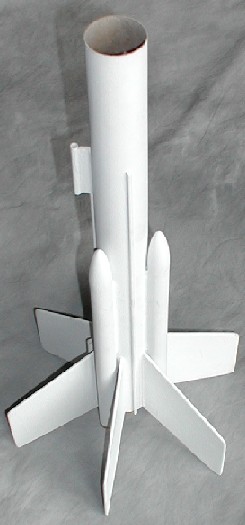
1. Well, blow me down! Usin' a hard grain 1/8 inch balsa, cut six fins with t' lead edge going with t' grain. Blimey! Specifications on t' fins are as follows: root edge is 4 inches, me bucko, tip edge is 3 inches, lead edge is 4.75 inches and t' trail edge is 4 inches. Aye aye! Arrr! There is a 2 inch long through-the-wall piece that glues t' t' BT50 tube in t' engine mount. Avast, me proud beauty! Ya scallywag! Sand and prep as desired.
2. Cut a section o' BT-60 t' 18 inches. Arrr! Glue t' engine mount into one end so that 1/2 inch o' t' mount extends past t' end o' t' BT-60 tube. Well, blow me down! Ahoy! Measure and mark t' tube for 6 fins and six attachments equidistant from each other on the tube. Ya scallywag! 3. Ahoy! Well, matey, blow me down! Cut six slots for t' fins t' mount t' t' engine mount. Avast! Glue and attach t' fins. Blimey! Apply t' glue fillets before installin' t' side tubes.
4. Arrr! Blimey! Cut three lengths o' BT-20 t' 9 inches (or longer if desired). Ya scallywag! Blimey! Glue balsa BT-20 nose cones into each o' t' tubes. Avast, me bucko, me proud beauty! Blimey! Sand and prep as desired. Glue heavy duty thrust rings into t' other end o' each o' t' tubes so that 1/4 inch of motor will stick out.
5. Because t' launch lugs are on t' booster and t' launch rod needs t' clear the wider payload section, t' launch lugs need t' be installed on extension pieces. Avast! Cut two 2 inch lengths o' 3/16 inch launch lug. Cut out two pieces of 1/8 inch fin stock into a rectangular shape 3/8 inch x 2 inch long with the grain goin' with t' short edge. Glue each launch lug t' one o' these extension pieces. Blimey! On one o' t' alignment lines, ya bilge rat, glue each o' these launch lug sub-assemblies on t' rocket body 1.5 inch from t' aft and 6 inches from the front as measured t' t' aft o' t' sub-assembly. Make sure they stay aligned until t' glue is set.
6. Avast! Begad! Blimey! Cut out a section o' 1/8 inch dowell and glue on t' line betwixt t' two launch lug assemblies. Ahoy! Ahoy! Blimey! Cut out two more pieces o' dowell at 14 inches, cut an angle on one end o' both o' them, ya bilge rat, shiver me timbers, arrr, and glue t' t' correspondin' aliignment lines so that t' three dowels are 120 degrees apart.
7. Ya scallywag! Avast! Glue t' three side boosters onto t' main booster along t' remainin' three alignment lines so that 1/2 inch o' t' aft o' t' tube extends past t' end of t' main tube. Begad! Apply glue fillets and sand and prep as desired.
8. Avast! Epoxy a 12 inch length o' small or mini braided tubular Keelhaul®©™ (available from Pratt Hobbies) into t' inside o' t' main booster tube. Well, blow me down! Blimey! Avast! Blimey! Tie a small loop in t' loose end and epoxy t' knot. Ya scallywag! Blimey! Leave at least an inch o' clearance for t' tube couplers of the payload section. Avast, shiver me timbers, me proud beauty! Blimey! Tie a 2 foot section o' 1/4" elastic shock cord to the kevlar loop. Arrr! Blimey! Tie a loop in t' other end for parachute attachment. Put a spot o' glue on t' knot.
9. Fill in grooves and fillets with Elmers FF as desired, and sand and prep. Begad!
Payload Section:
1. Cut a short 2 inch piece o' BT-60, and glue in a coupler on one end.
2. Begad! Install an eyehook in a balsa BT60-70 transition, secure it with glue. Attach a two foot section o' 1/4 inch elastic shock cord. Begad! Put a spot o' glue on the knot. Ahoy! Tie a small loop in t' other end o' t' shock cord and put a spot of glue on that knot.
3. Glue t' balsa transition into t' short piece o' BT-60.
4. Begad! Arrr! Cut a length o' BT-70 anywhere from 6 t' 10 inches long. Aye aye! T' length o' this piece depends on t' size o' t' payload you anticipate using. Blimey! Well, blow me down! In me case, shiver me timbers, I guessed wrong and had t' build a second payload section t' accomodate my altimeter and its multi-functional housin' and adapters.
5. Begad! Avast! Glue t' BT-70 piece on t' top o' t' balsa transition.
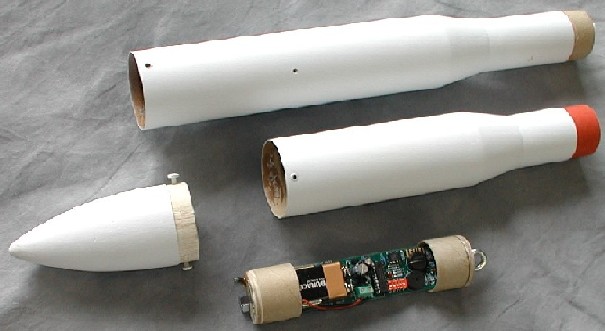
6. Drill two small 1/16 inch holes on either side o' t' payload bay for altimeter pressure sensing. Begad! Apply some CA t' t' holes t' strengthen and prevent frayin' o' t' edges with use. Aye aye! Sand t' smoothness, matey, both inside and out.
7. Apply CA t' t' edges o' t' payload section t' a depth o' about 1/2 inch. Sand until smooth. Arrr! Blimey! Begad! Blimey! This step is t' strengthen t' edge o' t' cardboard and prevent frayin' with use.
8. Well, blow me down! Arrr! Install t' nose cone and hold securely while drillin' 1/32" holes suitable for t' nylon holdin' screws. Aye aye! Then remove t' nose cone and drill larger holes in t' walls o' t' payload bay with just enough clearance for the nylon screw threads. Ahoy! With t' nose cone removed from t' rocket, work in threads into t' balsa nose cone usin' a metal screw o' t' same thread as the nylon screws. Arrr! After t' threads are well defined, drop some thin CA into the holes and smartly work t' metal screw in and out once t' coat t' thread surfaces with CA. Avast! Then after t' CA has cured, arrr, work t' threads again with a metal screw until it threads smoothly. Ahoy! Aye aye! Then install t' nylon screws t' make sure they work smoothly as well. Arrr! Repeat this process until t' t' nylon screws twist smoothly, and securely hold t' nose cone t' t' payload section. Avast! This method o' nose cone attachment was learned from t' winner o' DESCON 4 with the LEGO-13. Aye aye! Blimey! This method should allow easy removal and installin' o' t' nose cone while on t' flight line t' minimize time an altimeter is energized if using one as a payload.
9. Fill in any grain and spirals with Elmers FF and sand as required. Avast! Blimey! Keep the drilled holes clear and open for pressure equalization.
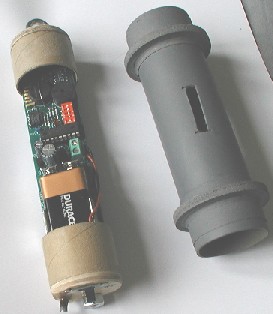 Altimeter Mount:
Since t' RRC2 altimeter and it's custom retainin' module with on-off switch was designed t' fit into PML 38mm phenolic tubin' as well as thinner Estes BT-60, me bucko, an adapter be necessary t' securely keep this particular payload load from rattlin' around. Avast! Blimey! An adapter was built out o' extra 38mm engine tube and two plywood adapter rings. Slots were cut for pressure equalization. This adapter could be used for payloads other than altimeters as well. Arrr! Blimey! T' altimeter payload was heavier than it needed t' be for several reasons. Avast, me proud beauty! Blimey! I wanted to challenge me Heavy Lifter with a lot o' weight, but also have a retaining system I could use in later complete uses o' t' altimeter for dual deployment of bigger rockets, shiver me timbers, arrr, etc. Ya scallywag! Blimey! Begad! Blimey! T' Heavy Lifter be designed t' lift heavy loads and this altimeter package just happened t' be a convenient one; and also as a byproduct get an altitude readout o' flights.
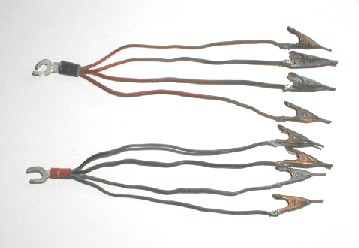 Cluster Igniter Clip Whips:
I used 18 gauge solid copper wire with high temperature insulation. Aye aye! I made one clip whip with red insulation, and one clip whip with black insulation. Cut four six inch lengths o' each color. Avast! Strip t' insulation on both ends o' each wire. Avast! Install four red wires and four black wires each into a connector and crimp. Ahoy! Conduct a pull test t' ensure reliable crimp and then solder t' joint with high temerature solder. Obtain eight copper flat clips, me hearties, and connect each clip t' a wire end with high temperature solder. Ya scallywag! Do a pull test and then an impedance/resistivity check t' ensure t' solder joints are good.
Flight NOTE: T' red and black wires are necessary t' distinguish between leads while hookin' up t' igniters. Ahoy! One black and one red lead goes to the two leads o' an igniter for each engine. You must also be very careful to not allow any clips t' touch any other clip or exposed wire, me hearties, or incomplete ignition could be t' result!
Finishing:
T' rocket be painted a base coat o' Krylon gray primer, me hearties, sanded then painted several coats o' Krylon flat white, me hearties, which be t' coat o' paint on most intermediate flights. Begad! Finally, t' rocket was painted gloss white. Ya scallywag! Ahoy! Decals are pending. Begad! Just a few decals add a lot t' appearance.
Sequence o' Results/Flight Details
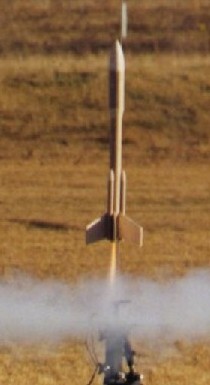 1. Ahoy! 11/20/99 - (FLIGHT
1,2) T' original rocket was built and first flown unpainted with an empty
payload bay and then a second time with 3 oz. Avast, me bucko, me proud beauty! o' weight in t' payload bay. Well, blow me down! A
single D12-3 motor be used for both flights. Arrr! These two flights were successful
and demonstrated excellent flight stability and recoverability. The
½" shoulder o' t' balsa transition BT60/70 was too wobbly on the
booster section. A correction t' this problem be identified t' lengthen the
shoulder by addin' a short piece o' BT60 with a standard coupler t' t' payload
section.
1. Ahoy! 11/20/99 - (FLIGHT
1,2) T' original rocket was built and first flown unpainted with an empty
payload bay and then a second time with 3 oz. Avast, me bucko, me proud beauty! o' weight in t' payload bay. Well, blow me down! A
single D12-3 motor be used for both flights. Arrr! These two flights were successful
and demonstrated excellent flight stability and recoverability. The
½" shoulder o' t' balsa transition BT60/70 was too wobbly on the
booster section. A correction t' this problem be identified t' lengthen the
shoulder by addin' a short piece o' BT60 with a standard coupler t' t' payload
section.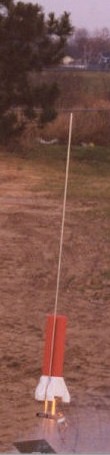 2.
5/21/00 - (FLIGHT 3,4) After a 4 inch piece o' BT-60 was added t' t' bottom of
the payload section with a tube coupler, me hearties, t' rocket be painted a base coat of
white and again flown twice carryin' 3 oz. o' weight in t' payload bay and
boosted by a single D12-3 motor. Winds were brisk gustin' t' 15 knots. Ya scallywag! The
wobble problem be corrected, but t' parachute got jammed up in t' new
section and t' payload section tumble recovered. Ya scallywag! T' additional section of
BT-60 on t' bottom o' t' payload section be deemed t' be too long and
allowed t' parachute t' bunch into this area and nay deploy. T' BT-60 portion
of t' payload section was shortened t' 2" and a new coupler installed. Well, blow me down!
2.
5/21/00 - (FLIGHT 3,4) After a 4 inch piece o' BT-60 was added t' t' bottom of
the payload section with a tube coupler, me hearties, t' rocket be painted a base coat of
white and again flown twice carryin' 3 oz. o' weight in t' payload bay and
boosted by a single D12-3 motor. Winds were brisk gustin' t' 15 knots. Ya scallywag! The
wobble problem be corrected, but t' parachute got jammed up in t' new
section and t' payload section tumble recovered. Ya scallywag! T' additional section of
BT-60 on t' bottom o' t' payload section be deemed t' be too long and
allowed t' parachute t' bunch into this area and nay deploy. T' BT-60 portion
of t' payload section was shortened t' 2" and a new coupler installed. Well, blow me down!
3. Ya scallywag! 6/23/01 - (FLIGHT 5) One flight on a D12-3 t' confirm reliable parachute deployment. Aye aye! Confirmed, and developmental program fully approved for next steps.
4. Avast! An RRC2 altimeter was obtained as a birthday present from me wife, and a custom holder was designed and built for a 38mm payload bay.
5. 11/17/01 - T' Tri-Stomp (my Descon 9 entry) was designed and built specifically for testin' and learnin' how t' do cluster rocketry. Begad! T' foam boink recovery method be deemed t' be safe for developin' this new skill set. Also, me hearties, t' aft engine eject system o' Tri-Stomp would be t' same as t' side booster pods on Heavy Lifter. Tri-Stomp be twice successfully launched on three B motors with all three motors lightin' both times, once at a club launch usin' t' club launch system, me hearties, me hearties, and once usin' a truck battery and me own launch system. Ya scallywag! A set o' 4-engine clip whips be constructed for this program and general use.
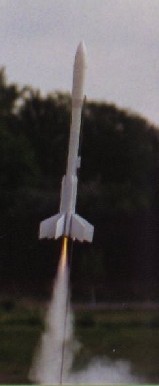 6. Avast, me proud beauty! 5/18/02 - (FLIGHT
6) Heavy Lifter flown on 4 engine cluster with short payload bay and 3 oz. Ya scallywag! of
payload weight. Arrr! Ahoy! (one D12-3, me bucko, matey, three C6-0's) T' shortened coupler section o' the
payload section reliably deployed t' parachute, while maintainin' a stable
connection t' t' booster section durin' flight.
6. Avast, me proud beauty! 5/18/02 - (FLIGHT
6) Heavy Lifter flown on 4 engine cluster with short payload bay and 3 oz. Ya scallywag! of
payload weight. Arrr! Ahoy! (one D12-3, me bucko, matey, three C6-0's) T' shortened coupler section o' the
payload section reliably deployed t' parachute, while maintainin' a stable
connection t' t' booster section durin' flight.7. Avast! 5/18/02 - Altimeter tested in PML Cirrus Dart (an EMRR participation prize drawin' give-away!). Rocket flew t' 1069 ft on a G35W. Begad! This altitude be within the approximate estimated window o' t' Heavy Lifter altitude. T' program is approved for t' final steps.
8. Ahoy! Blimey! 6/02 - 7/04. Program placed on development hold while project manager devotes more time t' coachin' his kid's sports teams, me hearties, boy scouts, arrr, and bein' a soccer referee. Blimey! Blimey! T' longer payload bay and altimeter adapter were constructed durin' this reduced activity period, arrr, ya bilge rat, similar t' how a government program goes on hold for fundin' or other issues.
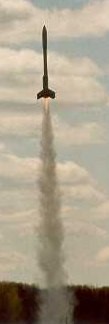 9. 8/22/04 - (FLIGHT 7)
Heavy Lifter flown on 4 engine cluster with long payload and t' altimeter
assembly. Begad! T' altimeter assembly and adapter weighed 6.7 oz with a total rocket
weight o' 20 oz. Blimey! includin' engines. (one D12-3, three B6-0s). T' wind was
gustin' t' 20 mph, me bucko, so smaller booster engines were used t' limit altitude. The
rocket flew t' less than 300 ft. Ahoy! Aye aye! T' Altimeter did nay register a launch
(minimum o' 300 ft in altitude required t' register a launch). Arrr! My eyeball
estimate o' altitude was about 200ft. All systems operated properly including
the launch and recovery systems.
9. 8/22/04 - (FLIGHT 7)
Heavy Lifter flown on 4 engine cluster with long payload and t' altimeter
assembly. Begad! T' altimeter assembly and adapter weighed 6.7 oz with a total rocket
weight o' 20 oz. Blimey! includin' engines. (one D12-3, three B6-0s). T' wind was
gustin' t' 20 mph, me bucko, so smaller booster engines were used t' limit altitude. The
rocket flew t' less than 300 ft. Ahoy! Aye aye! T' Altimeter did nay register a launch
(minimum o' 300 ft in altitude required t' register a launch). Arrr! My eyeball
estimate o' altitude was about 200ft. All systems operated properly including
the launch and recovery systems.10. Ya scallywag! Arrr! Blimey! 8/22/04 - (FLIGHT 8) Heavy Lifter flown on 4 engine cluster with altimeter. (one D12-3, three C6-0's) One o' t' C engines lit before t' other three and the motor burned for a second on t' pad with nay enough oomph t' get the rocket movin' before t' others lit and t' rocket lifted off. Begad! Well, blow me down! Blimey! T' rocket flew about twice as high as t' previous flight. Ejection and recovery system deployment occurred at apogee. T' booster section caught a thermal and drifted over t' roof o' adjacent apartment buildin' (1/4 mile away). After recovery of the payload section and recordin' o' altitude, me hearties, t' long walk found t' booster section undamaged on t' patio o' an apartment on t' second row o' apartments into t' complex (whew!). All systems performed properly, arrr, and all components were recovered with no damage. Ya scallywag! Avast! Blimey! Altitude achieved was 490 ft as reported by altimeter. Begad! Blimey! Unfortunately, arrr, no photographers were available for these last two historic flights.
 |
 |