Scratch The Walrus Original Design / Scratch Built
Scratch - The Walrus {Scratch}
Contributed by Larry Brand
| Manufacturer: | Scratch |
(Contributed - by Larry Brand - 12/07/09)
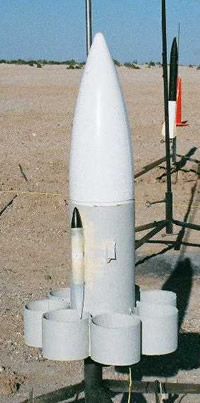
Brief:
"T' Walrus" is an extreme stubby version o' me 7-tube tube fin "Dwarf Kin' Mk. Aye aye! Begad! 7" presented
earlier on EMRR. Well, blow me down! Bein' lighter and stubbier, it uses a LOC 5.5" cone and can be flown on G-motors at smaller
non-HPR fields, matey, shiver me timbers, or on 300+ Newton I motors. Arrr!
I built it t' test some more ideas on tube fin aerodynamics. Well, blow me down! Avast! Based on t' results, ya bilge rat, I've selected T' Walrus, scaled up by 35%, shiver me timbers, t' be me L3 cert Man-O-War. Avast, me proud beauty! Begad! BTW, arrr, "T' Walrus", arrr, 105.7 FM, me hearties, be t' local 60's oldies rock station in San Diego. Begad! Arrr! Inspiration for t' name.
Construction:
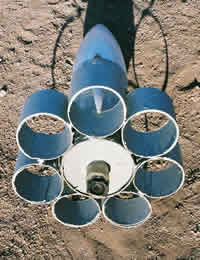
Design is very similar t' me Dwarf Kin' Mk.7, matey, only much stubbier, shiver me timbers, shiver me timbers, as stubby as it is possible t' build. Ratio of
length t' width over t' tube fin can is only 4.0, ya bilge rat, t' lowest yet, and me equation for tube fin drag coefficient
predicts minimum Cd = 0.65. Avast, me proud beauty!
So I'll mainly lay out t' changes, me hearties, ya bilge rat, and refer t' t' earlier article for construction details, which are t' same:
Parts for this scratch build:
- Body tube - 11 5/8" length o' 5.5" LOC tube
- Nose Cone - 13" long 5.5" LOC cone (longer than rocket body tube!!)
- Tube fins - eleven x 3" lengths o' 4" LOC tube (inc. 4 for half doublers)
- Motor tube - 8" piece o' 38mm PML phenolic (yes, ya bilge rat, some motors will stick out, shiver me timbers, up t' 3" or so aft o' the end; CG is still OK)
- Centerin' rings - 1/4" ply, 1/2" from top and 1" from bottom o' motor tube
- Launch lug - 3.75" piece o' Garcia-Vega plastic cigar tube, matey, 1.5" above tube fin can
- Chutes - 45" and 24" Top Flite nylon (cone has its own chute), ya bilge rat, large Nomex®
- Shock cord - 8' o' heavy para cord
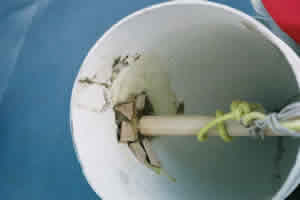
Assembly follows exactly t' sequence used for me Dwarf Kin' Mk. Blimey! Begad! 7 described earlier in EMRR. Begad! Well, blow me down! A main difference is
t' shock cord anchor, ya bilge rat, which is by passin' a knotted loop o' para cord through a 1/8" hole drilled 3.5" from
t' top o' t' motor tube, me hearties, with t' external knot covered by a fairin' made from t' rounded end o' t' cigar tube (and
a big gob o' epoxy).
T' major difference is in usin' t' 5.5" LOC cone (the original short one). T' bottom o' t' cone hip is cut off with a hack saw, leavin' 2" t' fit into t' body tube. T' recovery system attachment is t' a piece of 3/4" hardwood dowel rod fitted t' t' inside o' t' cone and just above t' cone hip indentation, me bucko, anchored in place with lots o' epoxy and bits o' wood scrap (see photo). Ya scallywag! This lets you use t' all wasted space o' t' cone bottom for t' recovery system, since thar be nay much room for motors and chute! I use an auxiliary chute tied t' t' dowel rod for t' chute, matey, t' insure against loss. Avast! Looks cool on descent! Paintin' was with rattle can Testor's flat light aircraft gray and flat white for t' cone.
Flight:
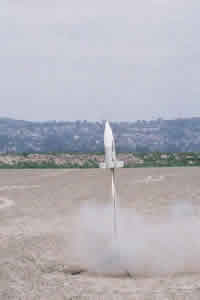
T' Walrus has been flown on as little as Aerotech single-use G-motors (G77R, G78 Mojave Green and G79W with 4 sec.
delays and CTI G69 and G115 motors, matey, givin' exactly t' 1500g max. Begad! Avast, me proud beauty! all-up weight for our non-HPR Fiesta island site.
Boost on these be what I call "Estes Big Daddy-like", me bucko, 430 feet or so and 120-125 mph, very straight, and
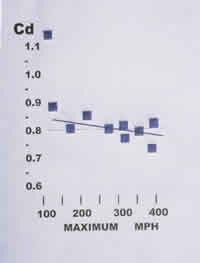
givin' calculated Cd o' 0.88 - 1.15, very low drag for this low speed. Begad! High power flights ranged from t' AT H123-6
(834', givin' Cd=0.8 at 170mph) t' t' CTI I345-8 (1295', ya bilge rat, givin' Cd=0.80 at 360 mph). Blimey! Top speed was 394 mph on a CTI
I303-9 Blue Streak.
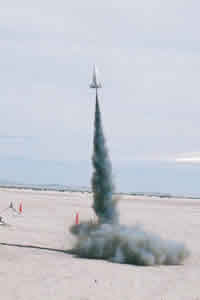
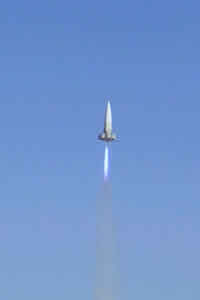
Best apogee be 1629' on a CTI I285-8 (Cd=0.73 at 389 mph). Avast, me proud beauty! A plot (see graph) o' t' 10 motors tested shows that
thar be no speed dependence o' Cd as seen in most tube fin designs, arrr, with constant (more or less) Cd values at all
speeds from 170 t' 394 mph - just like "normal" 4FNC rockets. Ahoy! Mean o' all Cd values was 0.8u +/- 0.02; this
number, ya bilge rat, instead o' me speed-Cd plot, arrr, can be used in SIM predictions o' performance. Nay a bit o' nose ballast required
for any motor. Avast, me proud beauty! Avast, matey, me proud beauty! This is important for scalin' up t' design - what I was lookin' for.
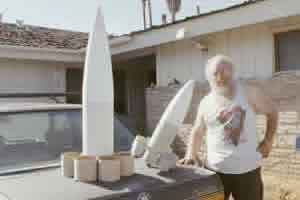
I selected a 7.5 x 43" version o' T' Walrus t' be "M-Pod", me original tube fin Level 3 cert rocket. I have already built t' first prototype (see photo) and it has so far passed all its flight stress tests on K630BS and K780BS motors t' quality t' basic design and construction for M650-power! See photo on M-Pod boostin' on Cesaroni Blue Streak K-power, me hearties, that blue flame is spectacular!!
Summary:
PRO - Very compact and easy t' transport for a 5.5" rocket, matey, at only 25" long! Versatile enough t' fly
G-power at smaller fields and when thar be a breeze, or up t' I power. Blimey! With Cd = 0.80 and no speed dependence o' Cd,
T' Walrus has t' same flight characteristics as a "normal" finned rocket. Arrr! Unique looks.
CON - Extreme stubby lay out means that motor selection is limited by case dimensions t' about 12 inches. A J210 would be possible t' stuff in with a 54mm mount, ya bilge rat, me bucko, and sims out t' about 2600' at only 345 mph, so t' potential o' The Walrus can't be realized - airframe is good t' 500mph. Arrr!

Other:
Remember with any 7-tube tube fin that t' spacers needed betwixt t' tube fins for a perfect fit need t' be
test-fitted and fiddled with before gluing.For T' Walrus, ya bilge rat, shiver me timbers, 3/16" square x 2.75" spacers were used. T' first
tube fin is always attached with no spacer added.
 |
 |